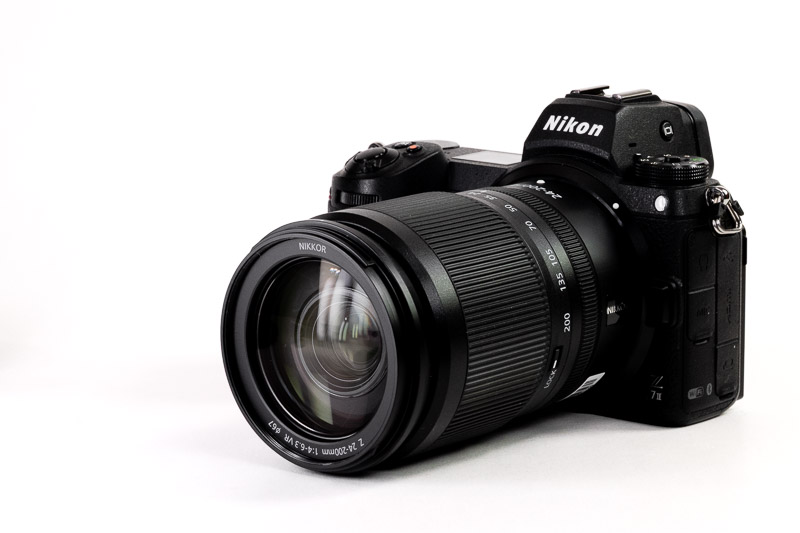
Introduction
Could the Nikon Z 24–200mm f/4–6.3 be the only lens you really need? After reviewing the Nikon Z 24–70mm f/4 S and the Nikon Z 24–120mm f/4 S, several readers asked if I could also take a look at this superzoom.
I said that if there was enough interest—and if I could get my hands on a copy—I’d do it. The interest was clearly there, and thanks to my friends at Kamerastore I managed to get a loaner. A deal is a deal. So let’s see how it performs—and whether it can match the other two standard zooms.
 I tested this lens on a 46 Mp Nikon Z7ii (Sample images were taken with a Nikon Zf)
 You can see this review as a YouTube video here!
 Sample images in high resolution here.
Sample Images
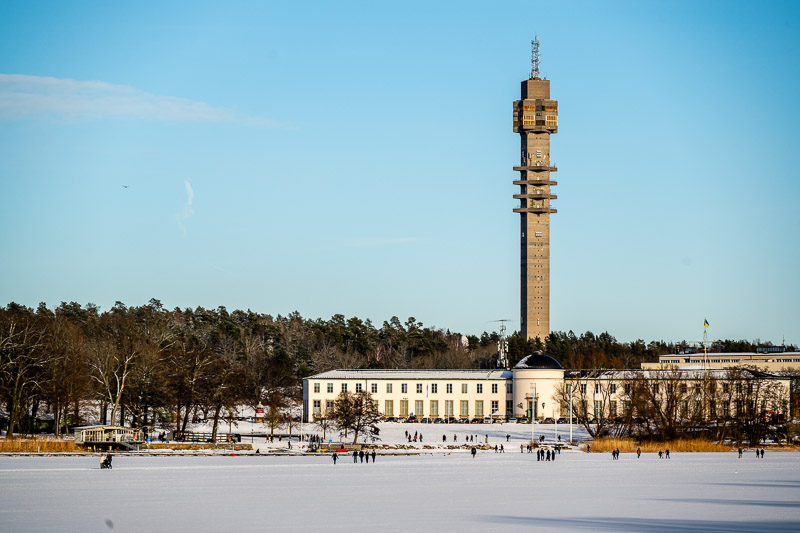





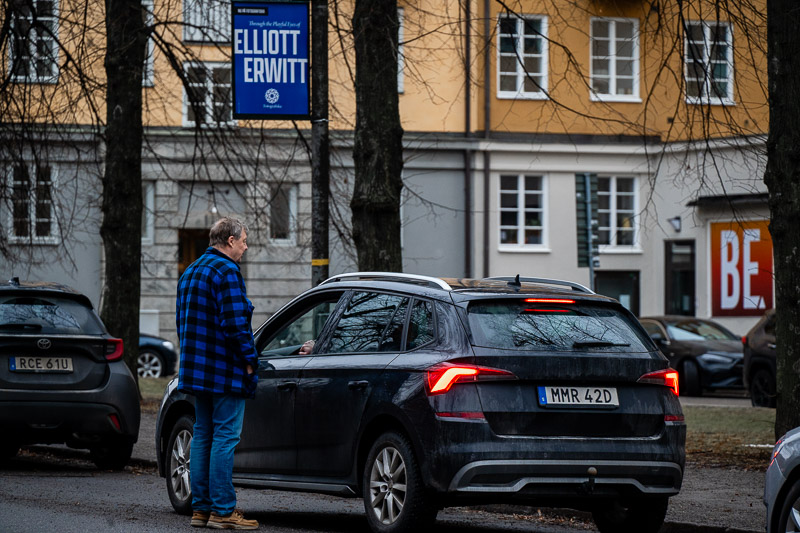



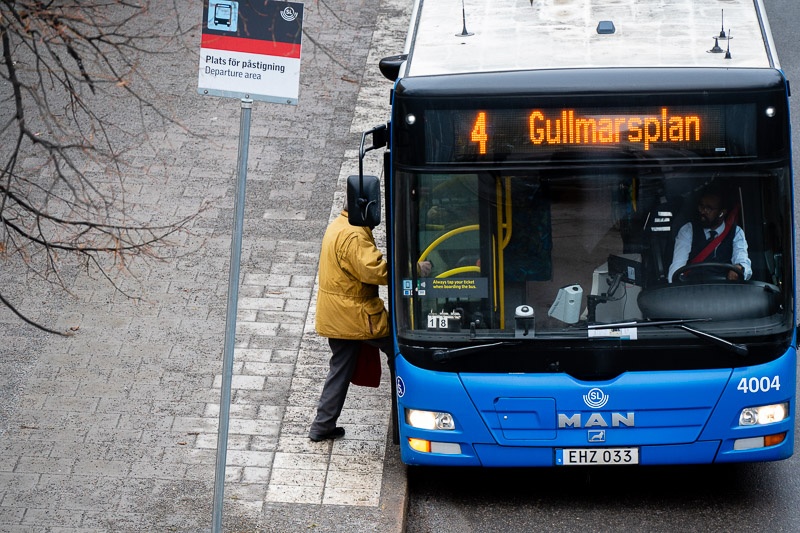

Most of the sample images in this review and many more can be found in higher resolution here.
Specifications
| Focal Length | 24-200 mm |
| Angle of View | 84°-12°20′ |
| # of Aperture Blades | 7 (rounded) |
| Max Aperture | f/4-6.3 |
| Min Aperture | f/22-36 |
| Min Focus Distance | 0.5 m @24 mm / 0.7 m @200 mm |
| Filter Size | 67 mm |
| Lens Mount | Nikon Z |
| Weight | ≈ 570 g |
| Size (D x L) | ≈ 76.5 mm x 114 mm |
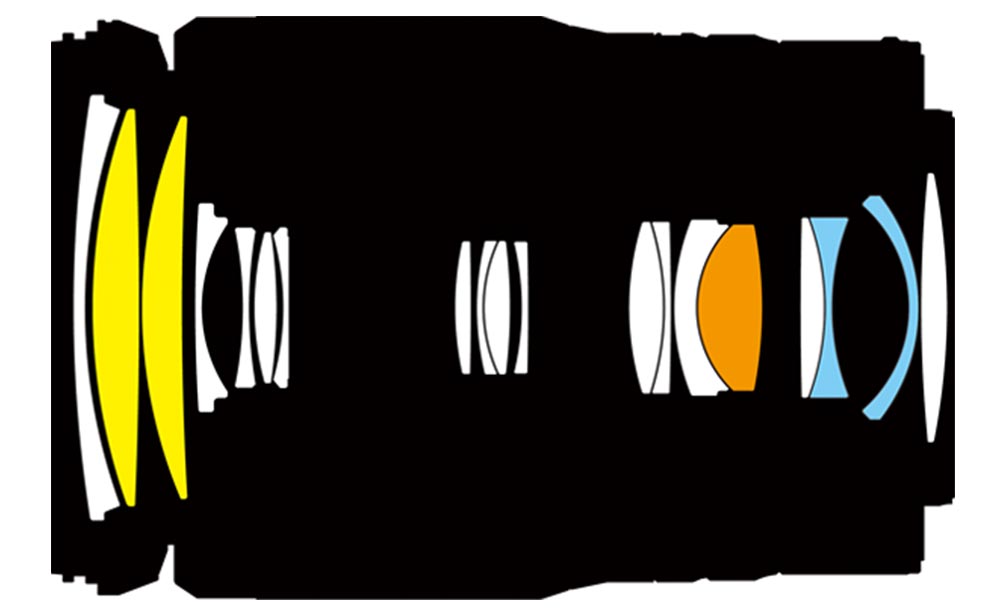
| Elements/Group | 19 elements in 15 groups |
 |
 |
| Buy new: Amazon (anywhere) for $797 (Affiliate links) Buy used: Kamerastore from $620 (Affiliate links) |
Disclosure
Big thanks to Kamerastore—a reliable source of used cameras and lenses—for loaning me this lens for two months so I could really put it through its paces.
Handling and Build Quality
The 24–70/4 S and 24–120/4 S are very similar in build, handling, and optical properties, so I’ll refer to them collectively as the S lenses throughout this review.
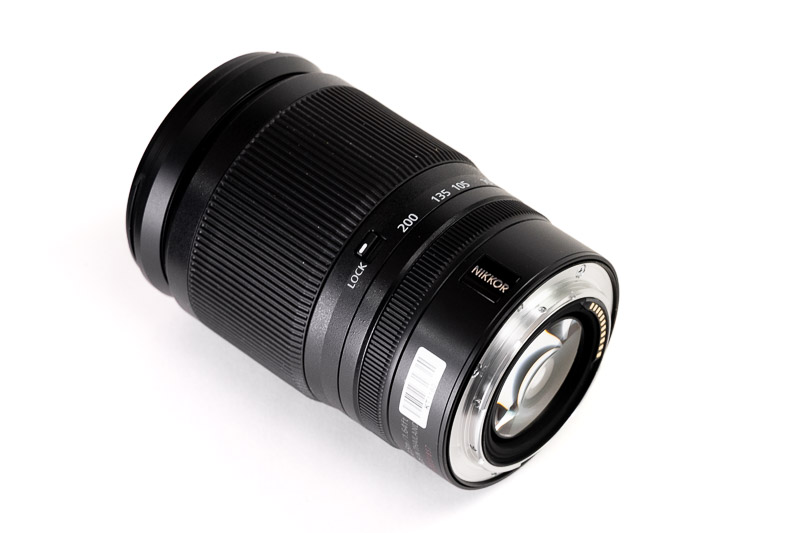
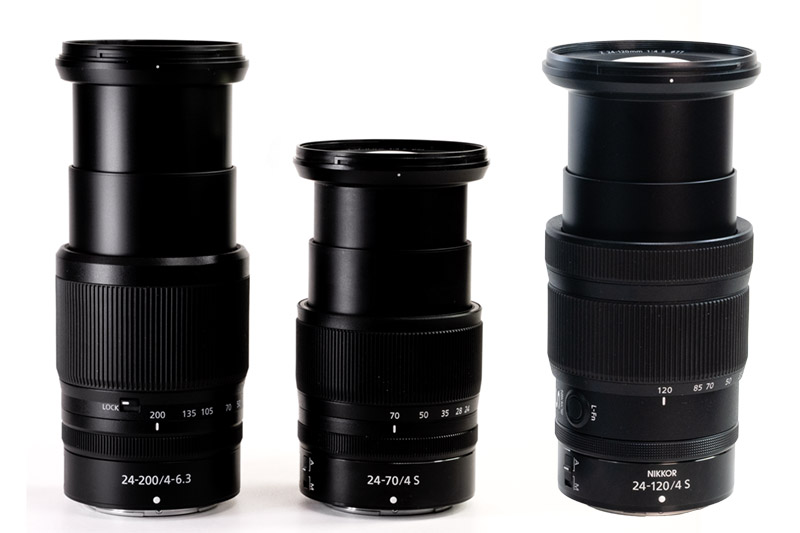
This is an autofocus lens without an aperture ring, but with a very large zoom ring and a very narrow manual focus ring, which is in fact the usual programmable control ring, with manual focus as its default function. You can turn this ring at any time for instant manual focus override. The lens extends substantially as you zoom in, as shown in the images below.

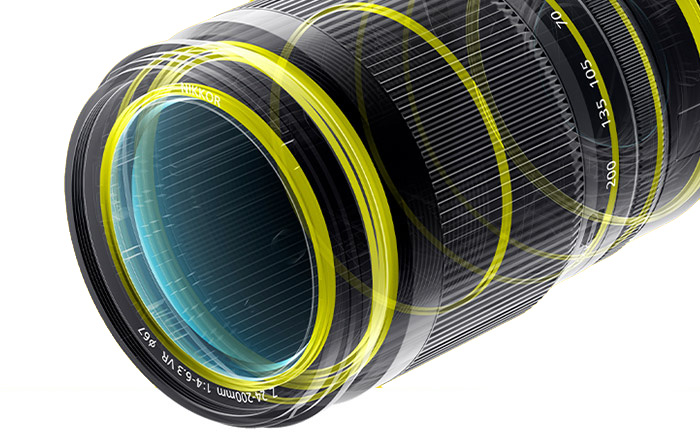
The lens has a fluorine-coated front element for repelling dust and water, and also ARNEO Coat is adopted in this lens for the first time in a non-S-Line lens. The lens is environmentally sealed to keep dust and moisture out, especially around all moving parts of the lens barrel:
The lens has a built-in Vibration Reduction (VR) function that, according to Nikon, provides stabilization equivalent to a 5-stop faster shutter speed when VR is set to “NORMAL” and the zoom is at its maximum telephoto position. This means fewer stops at its shorter focal lengths, down to three stops at 24mm. There is no VR on/off switch on the lens, nor an AF on/off switch. The only switch is for locking the zoom ring, but it only engages at 24mm, where the lens is at its most compact, and is not particularly useful.
Autofocus is fast and accurate, at least as fast as the S lenses in good light. However, due to the smaller maximum aperture, it switches to Nikon’s slower low-light AF earlier than the S lenses, and in dim lighting it can sometimes refuse to autofocus.
The maximum aperture of the lens at different focal lenghts are:
| Focal length | 24mm | 28mm | 35mm | 50mm | 70mm | 80mm-200mm |
|---|---|---|---|---|---|---|
| Max Aperture | f/4 | f/4.5 | f/4.8 | f/5.6 | f/6 | f/6.3 |
Compared to the 24-70/4 and 24-120/4, it is a bit larger and heavier than 24-70/4 S, but it is a tiny bit smaller and lighter than 24-120/4 S.

Optical Features
|
|
|
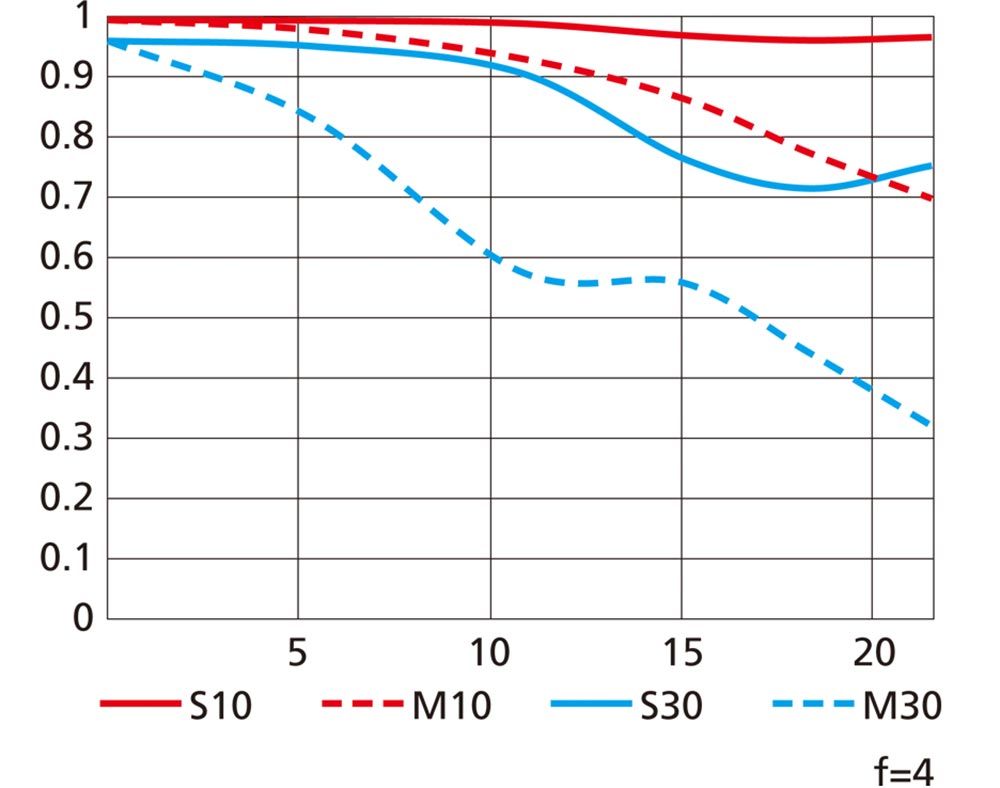 Wide
Wide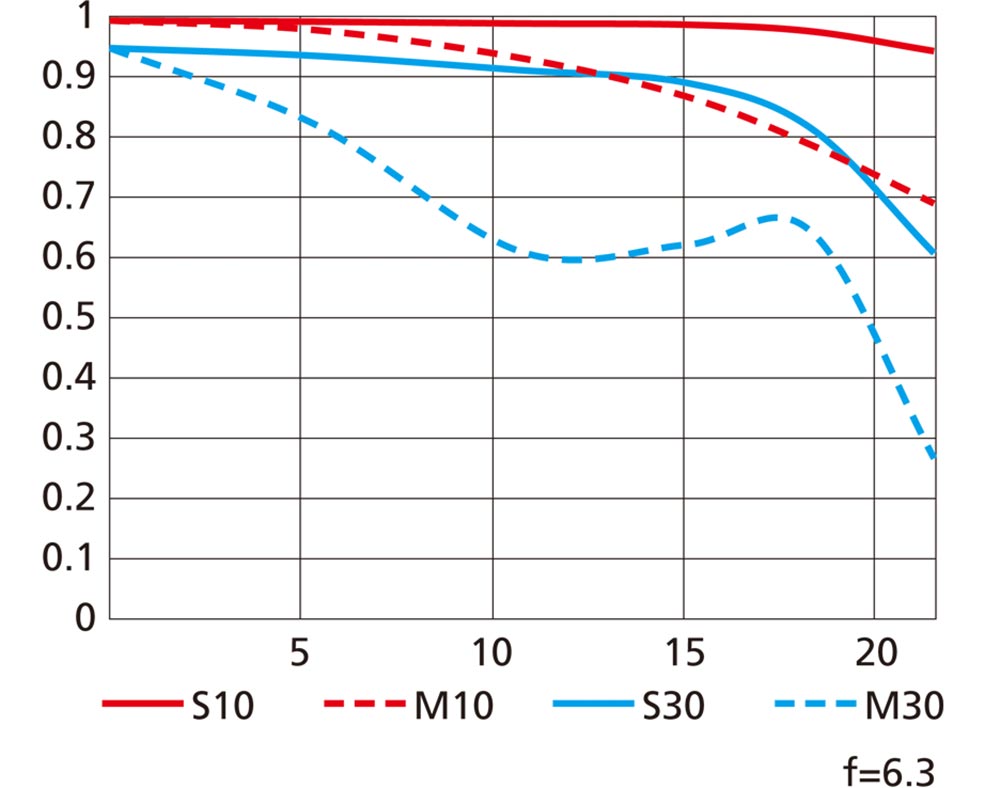 Tele
TeleSharpness (Infinity)
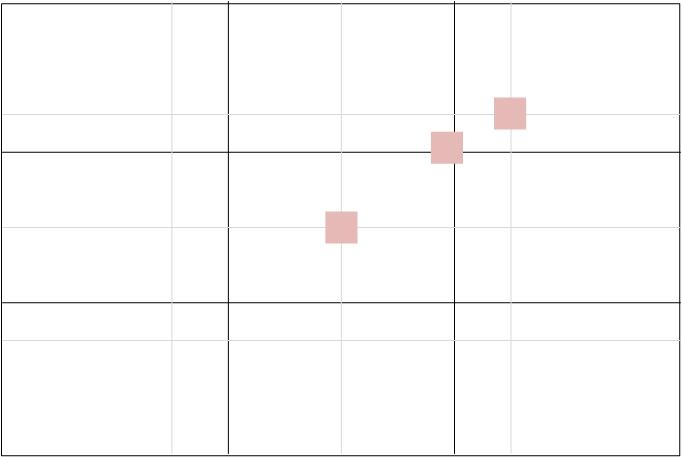
For the infinity sharpness test, we look at three areas of the image, centre, mid-frame, and corner, see highlighted areas in the image below!
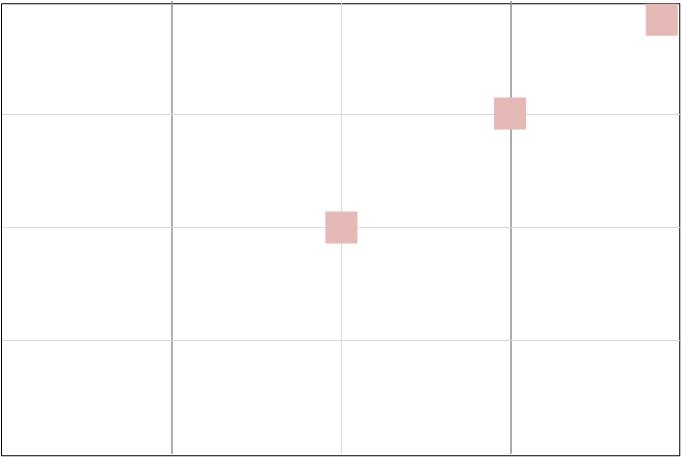
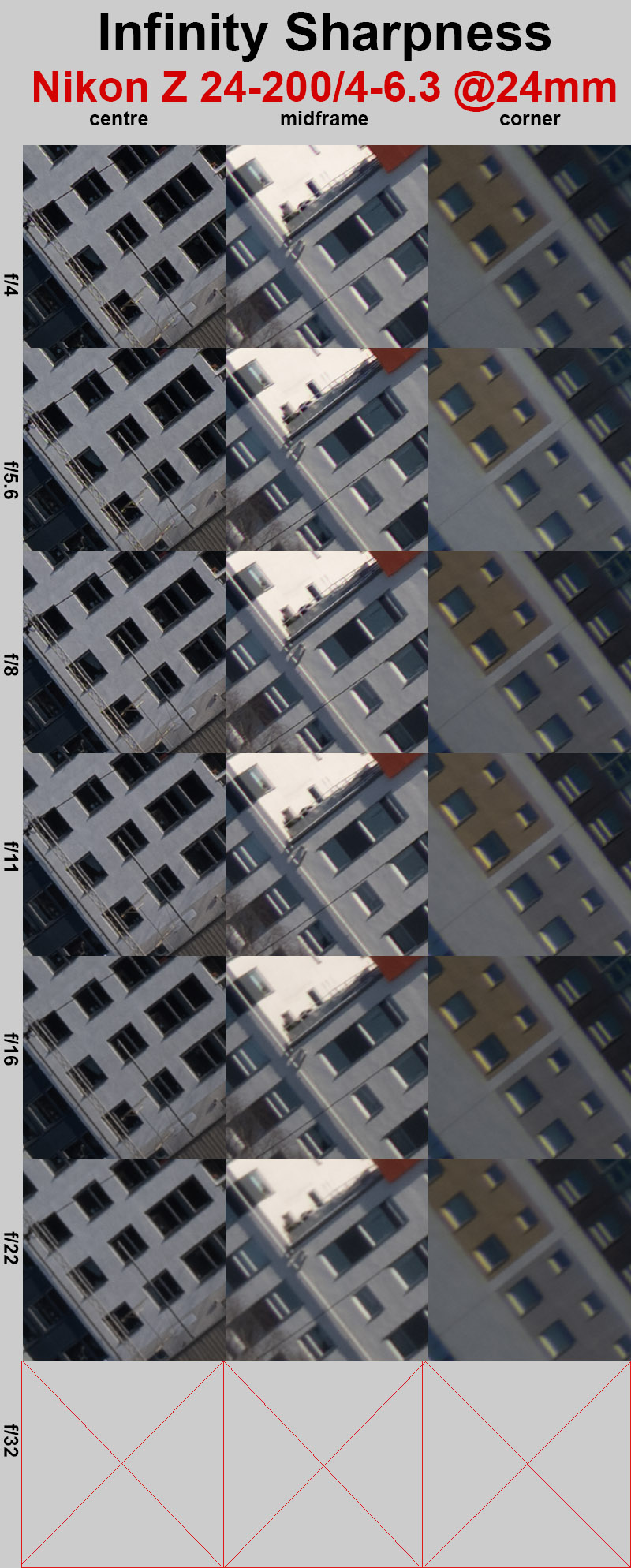
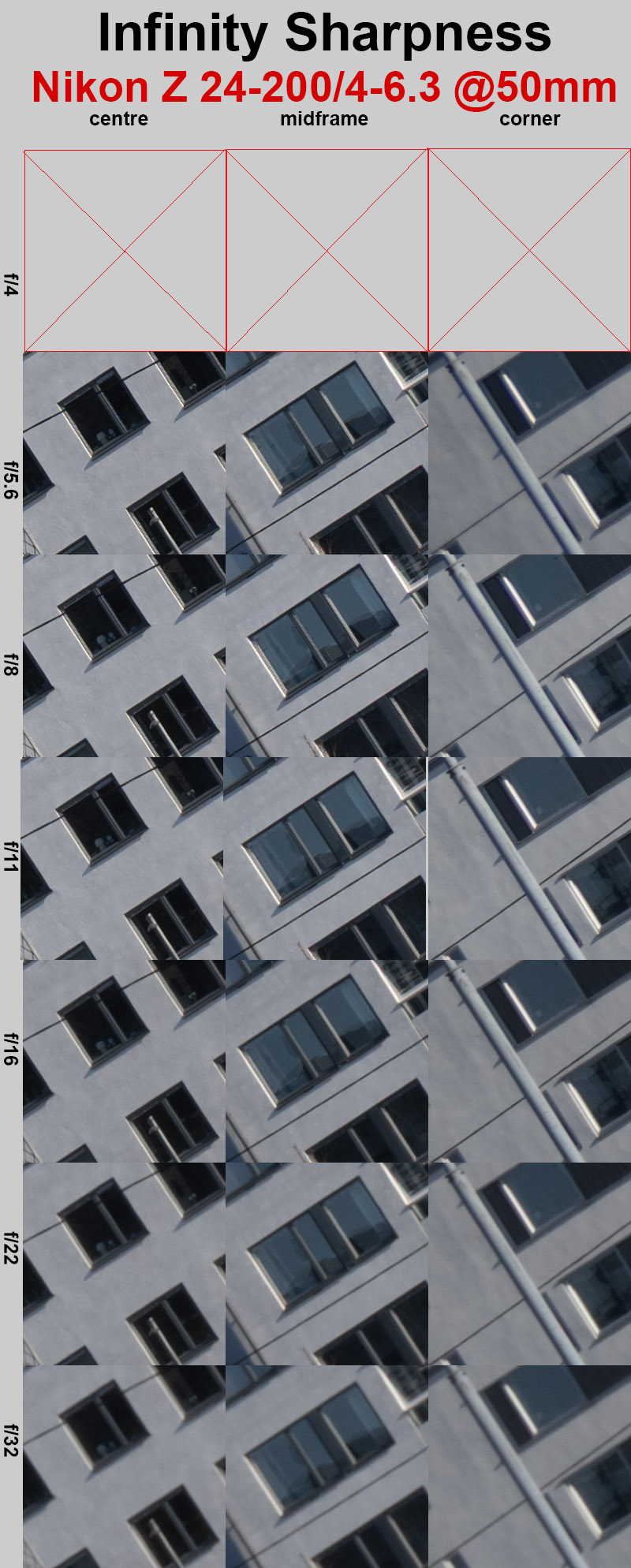
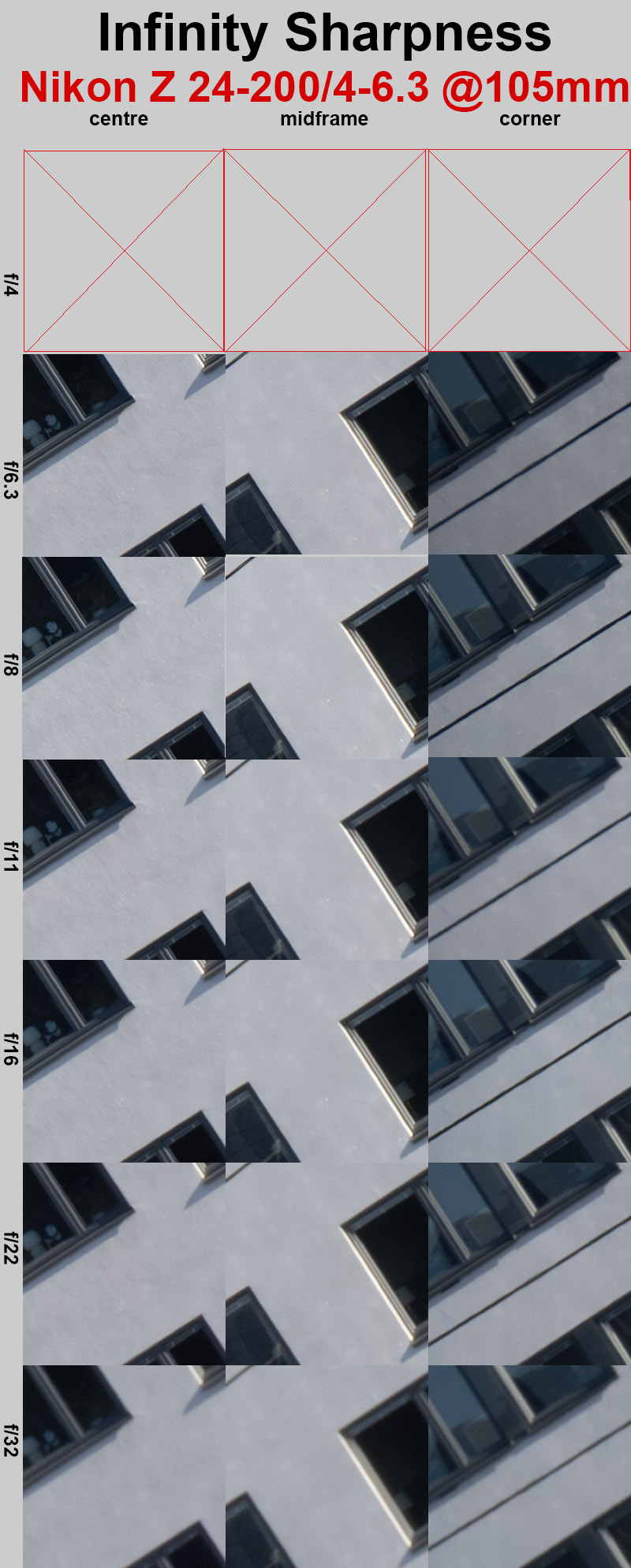
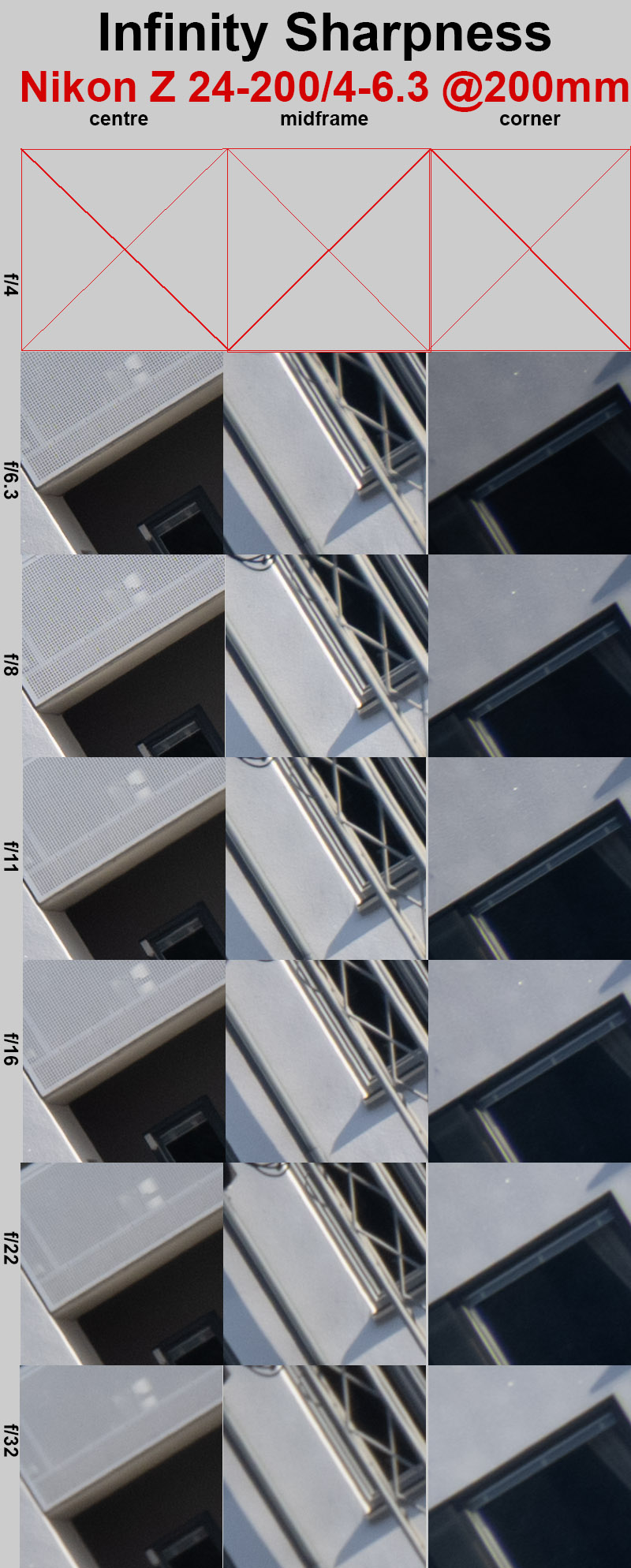
To keep things brief, I will just explain the general observation.
Sharpness in the center is excellent at all focal lengths; it is best at about 35mm and weakest at 200mm. In general, it is very strong between 35mm and 70mm. At 24mm and 105mm it is slightly softer but still strong; at 135mm and 200mm it is more than good enough, though not as strong as at shorter focal lengths. The sharpest aperture is f/6.3, while the best across-the-frame sharpness is reached at f/8. At f/16 you start noticing softness due to diffraction, which becomes more noticeable at f/22 and smaller.
Compared to the S lenses, at 24mm they are marginally sharper at f/4 in the center and a bit sharper in the corners. At f/5.6 the gap narrows, and from f/8 it is hard to see any difference.
At 50mm the trend is similar: the S lenses are a little sharper up to f/5.6, but from f/8 they look the same. At 105mm the 24–120/4 S is sharper overall. At 200mm, however, the 24–200mm wins by a knockout.
In practice, it will be difficult to notice any shortcomings in sharpness at any focal length with the 24–200mm. Only when viewing 100% crops side-by-side—like here—do the small differences become visible.
Sharpness (Portrait)
Let’s look at the points of interest for portraits at the portrait distance: the very centre, the centre’s inner periphery (1/3 rule intersection), and the centre’s outer periphery (1/4th intersection).
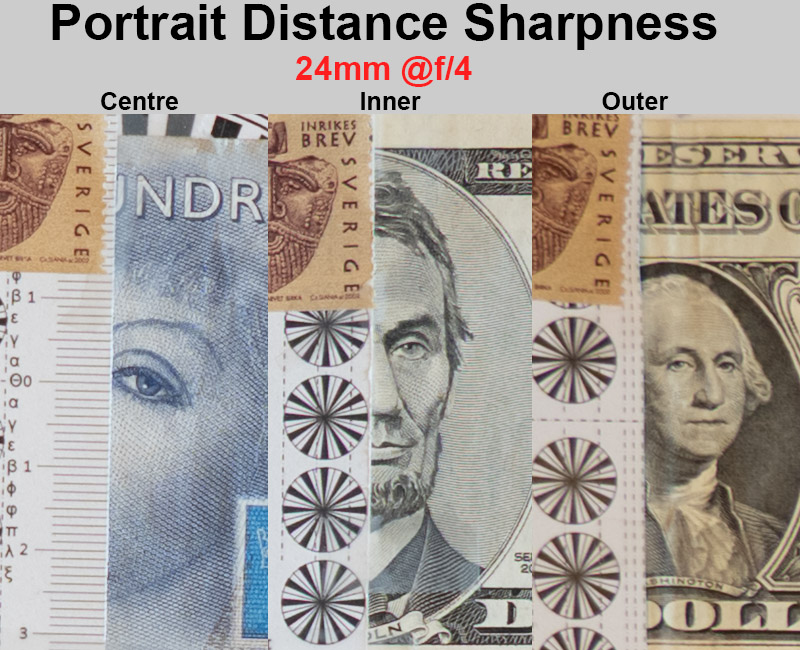
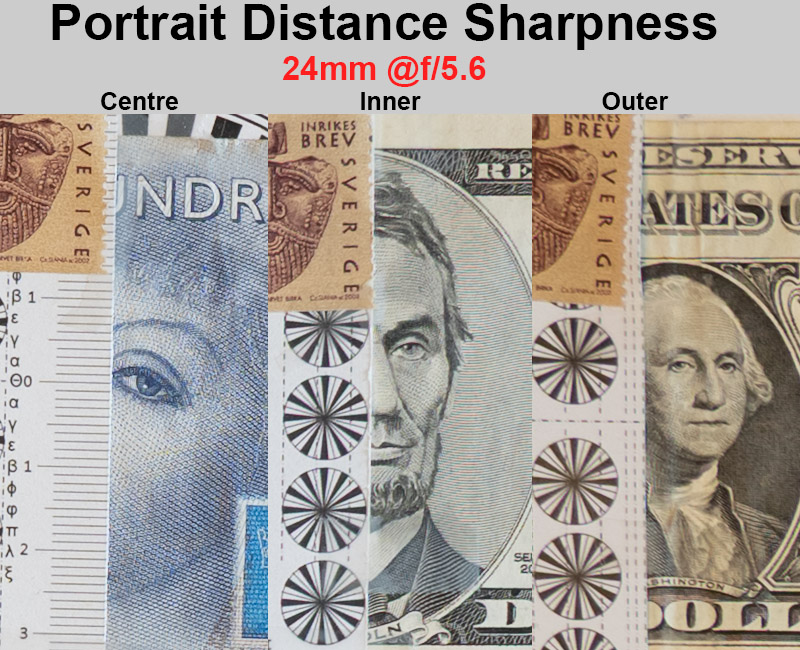
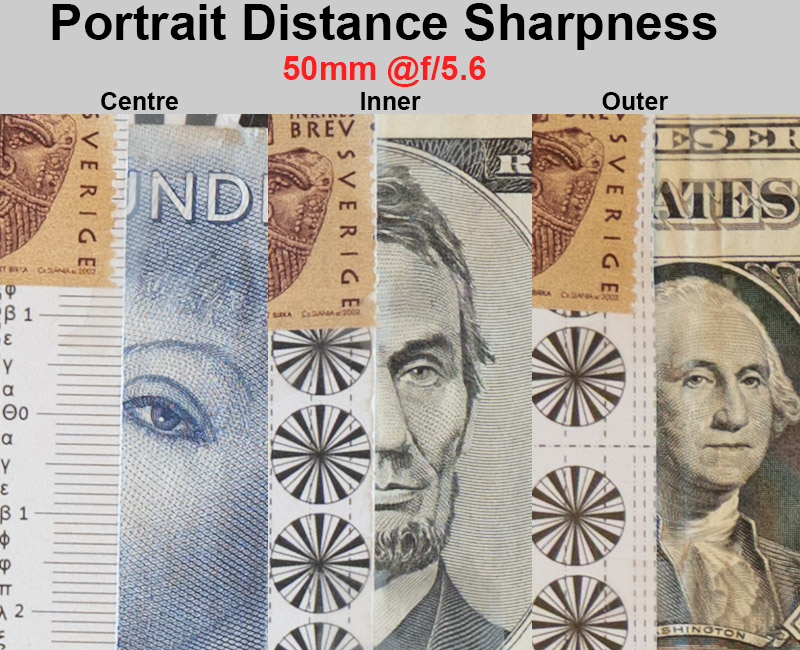
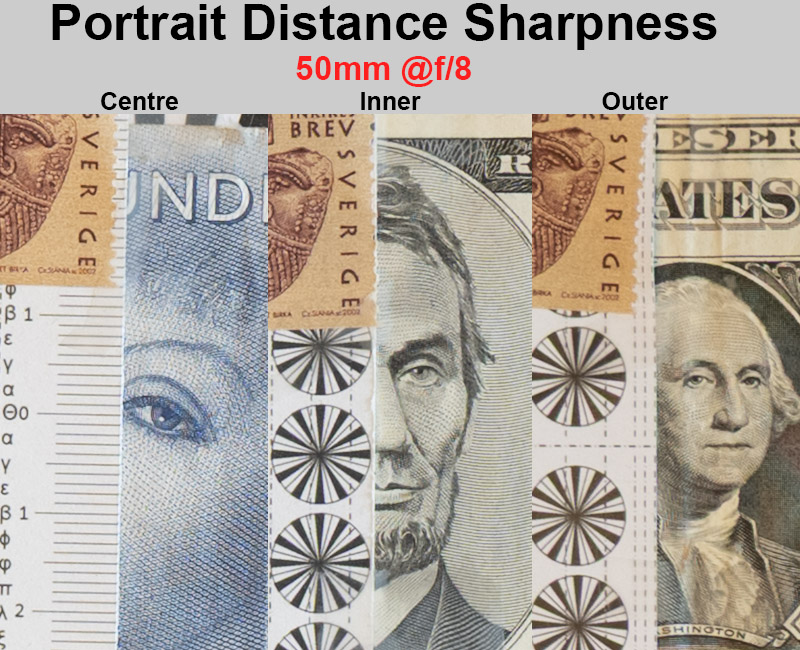
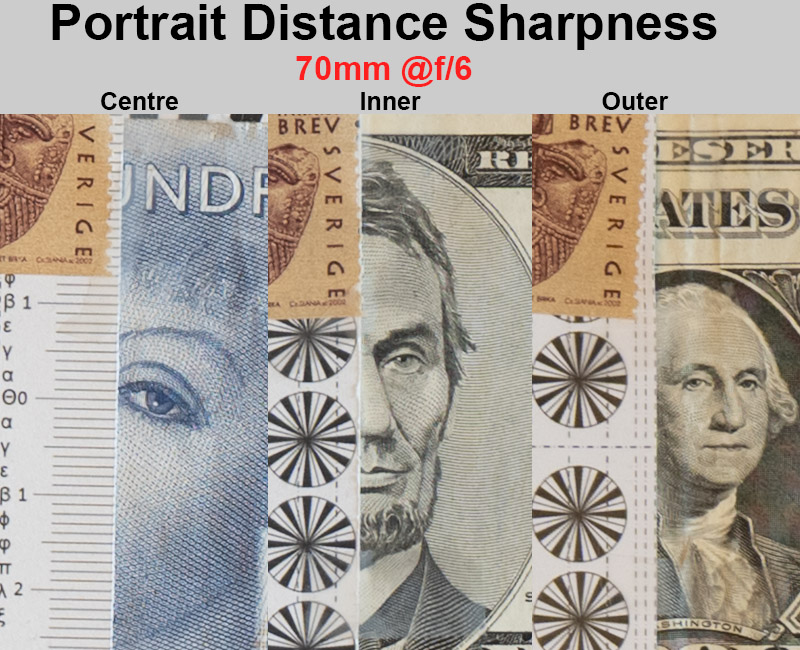
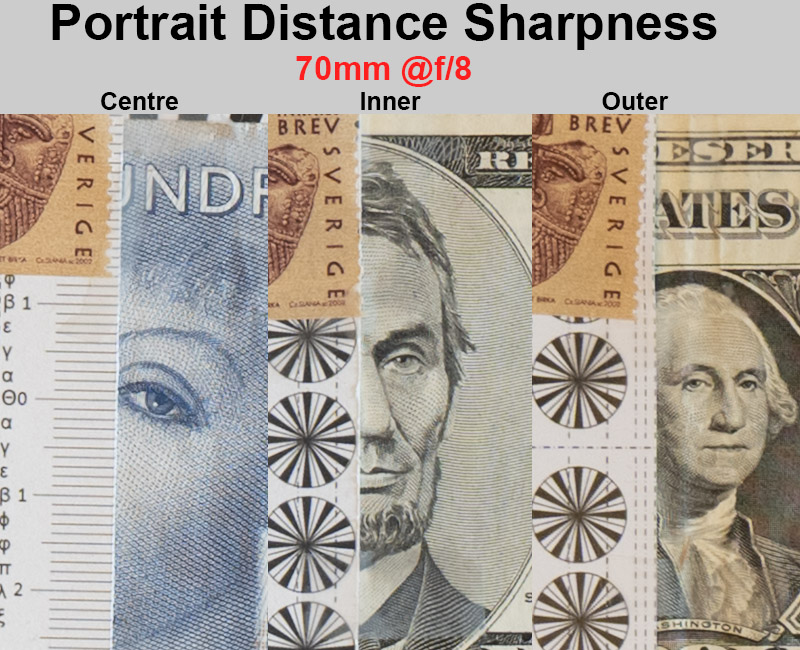
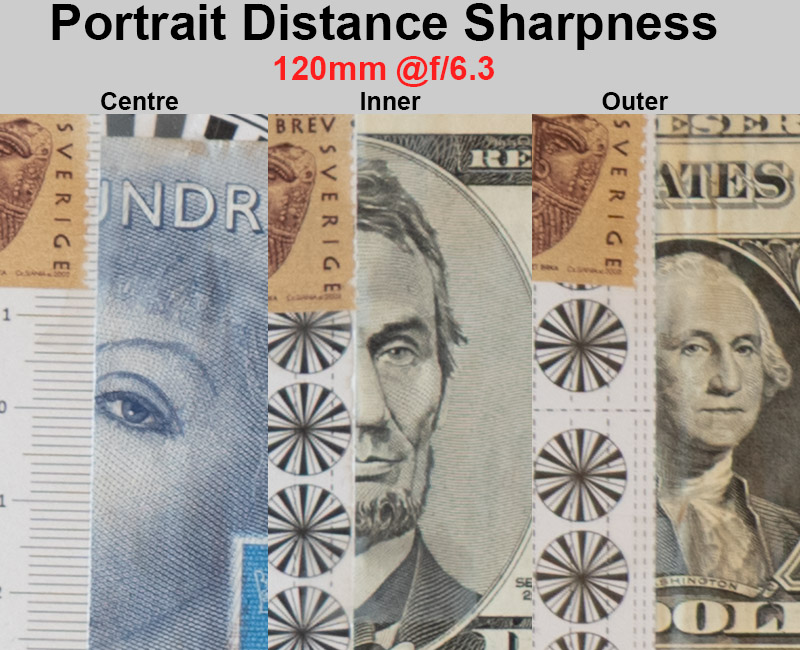
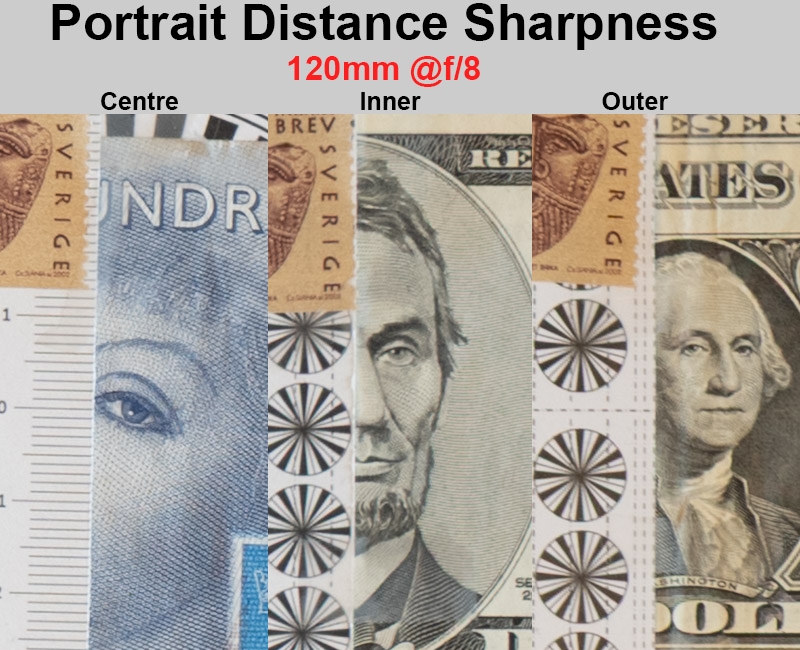
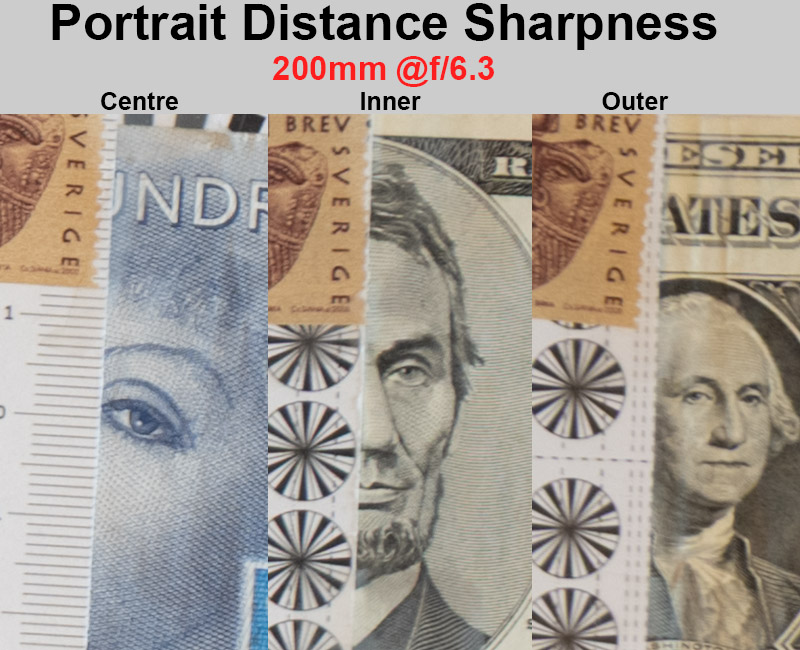
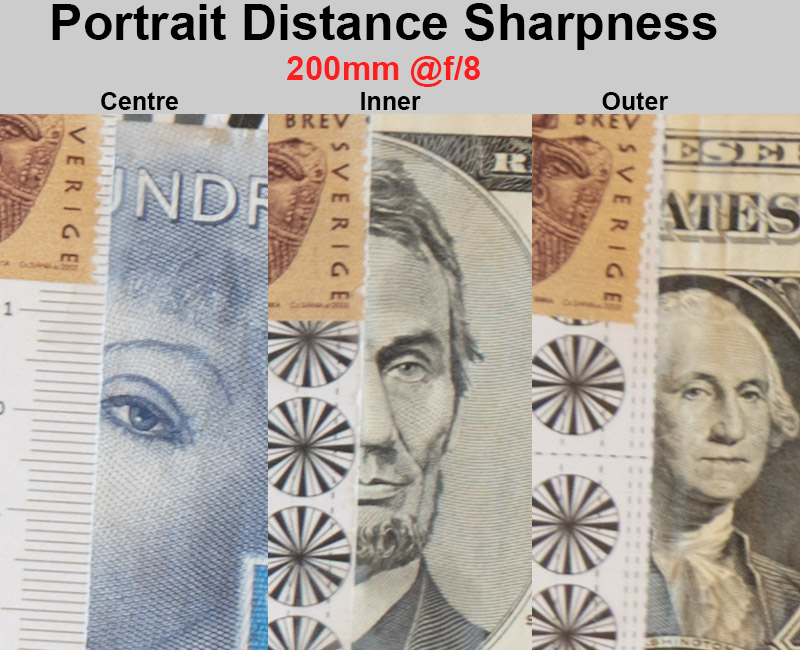
Excellent sharpness at all measured points up to 70mm except f/4 at 24mm, very good at 100-120mm, and good at 200mm.
Ignoring the corners in this test, this lens performs roughly on par with the S lenses at equivalent focal lengths, except at 24mm @f/4, and 120mm where the 24-120 is slightly sharper, though the S lenses benefit from a wider maximum aperture, allowing for stronger background blur.
Sharpness (Close-up)









Excellent sharpness at all focal lengths up to 120mm. At 200mm we can see the image softens at its maximum aperture, becomes good at f/8, and very good at f/11.
Lens Distortion
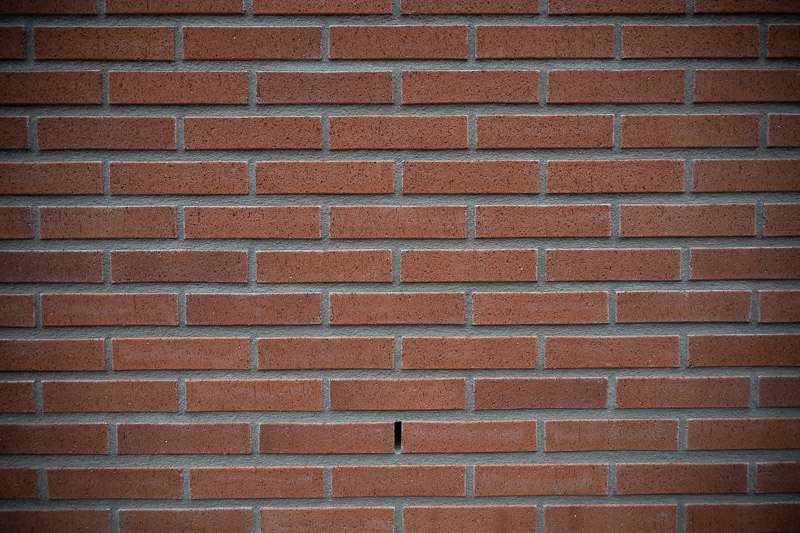
The in-camera “Auto distortion control” in Nikon cameras is locked and always applied for a number of Z lenses with significant native distortion, including this one. The camera corrects the distortion automatically and embeds the correction in the RAW metadata, so the distortion is normally invisible in both JPEG and RAW images.
All three lenses perform equally well in this regard, provided the in-camera correction is ON.
Vignetting
Vignetting is obvious only at 24 mm at f/4 and f/5.6. Even at smaller apertures it can still be visible in homogeneous scenes such as snow-covered landscapes or evenly lit monochrome scenes. From 70mm onward, vignetting is no longer an issue.
Here, the other two zoom lenses performed better, especially at 24mm.
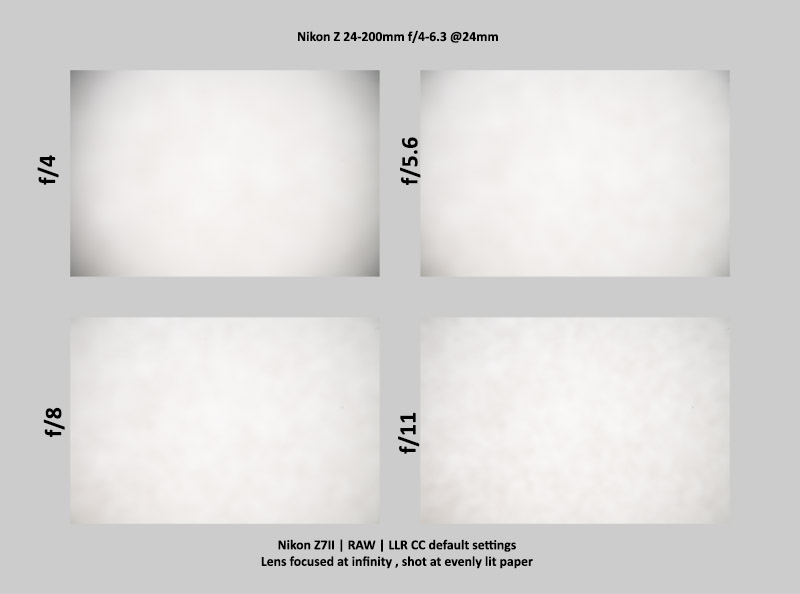
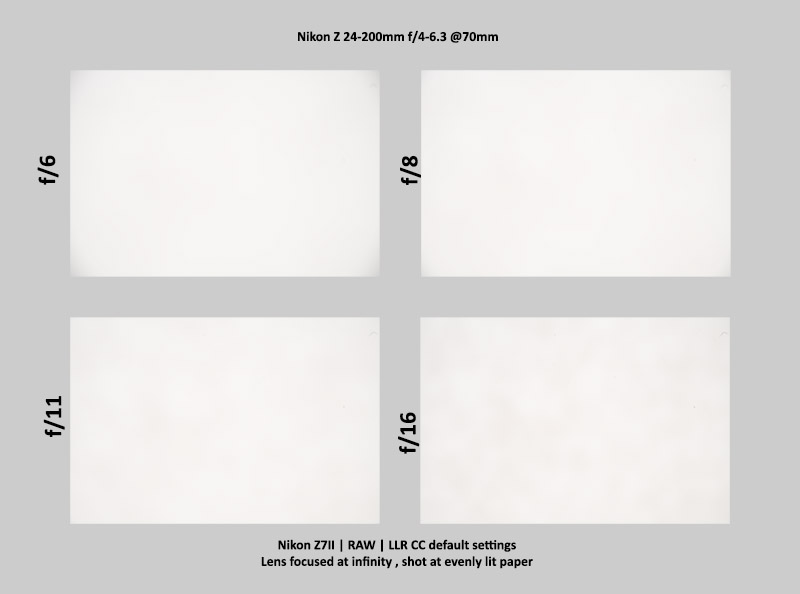
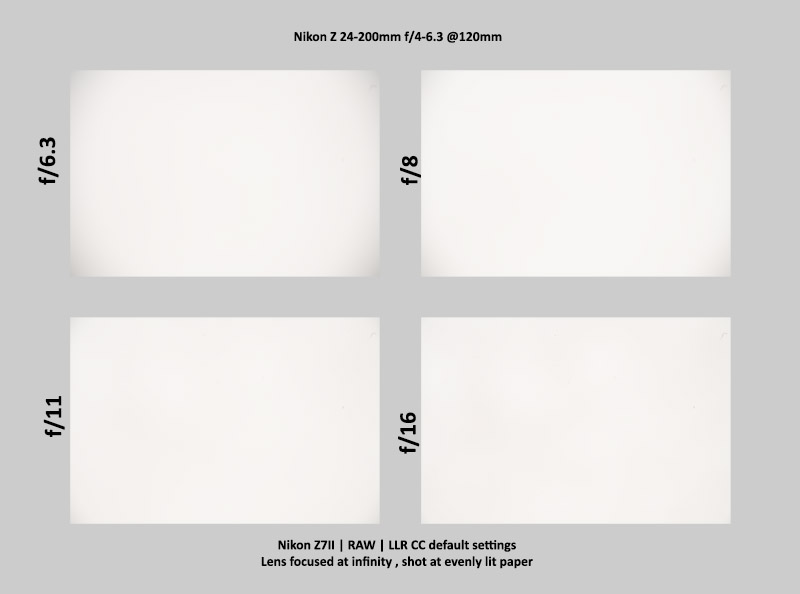
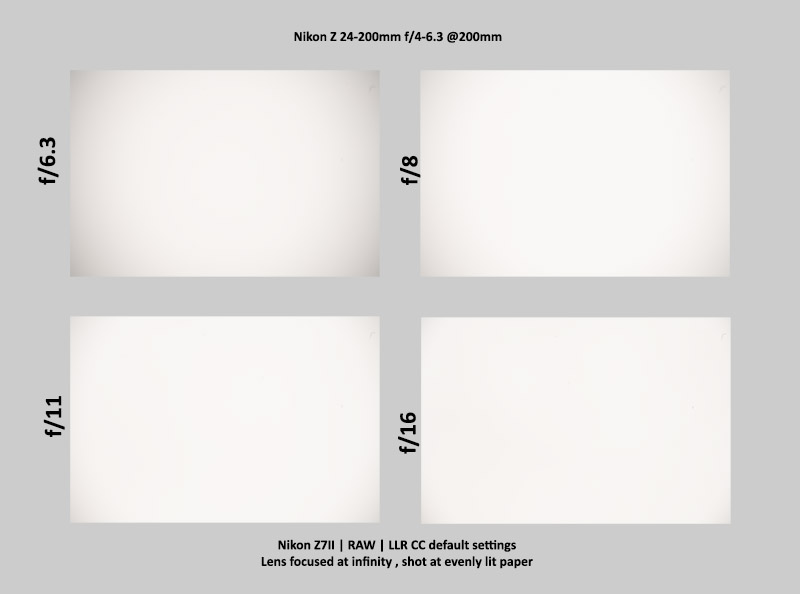
| 24mm | 70mm | 120mm | 200mm | |
|---|---|---|---|---|
| f/4 | 2.3 EV | – | – | – |
| f/5.6 | 1,8 EV | – | – | – |
| f/6 | – | 1.1 EV | – | – |
| f/6.3 | – | – | 1.3 EV | 1.4 EV |
| f/8 | 1.3 EV | 0.8 EV | 0.8 EV | 1.1 EV |
| f/11 | 1.3 EV | 0.6 EV | 0.6 EV | 0.8 EV |
| f/16 | 1.1 EV | 0.6 EV | 0.4 EV | 0.4 EV |
Chromatic Aberrations
Longitudinal chromatic aberration is best controlled between 70mm and 120mm, where none is visible. At 200mm a small amount of LoCA appears, but it is negligible. The weakest control occurs at 24mm. The effect is still relatively small, but it can show up in normal shooting situations, and it does not disappear when the lens is stopped down.
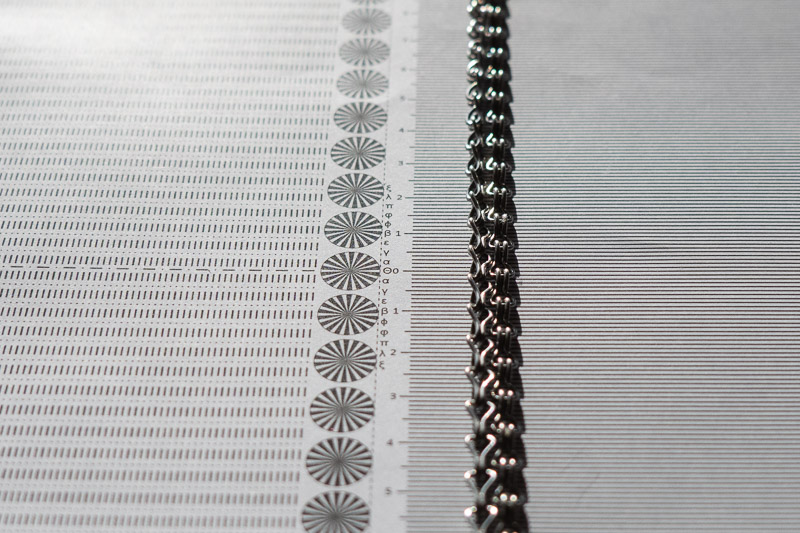
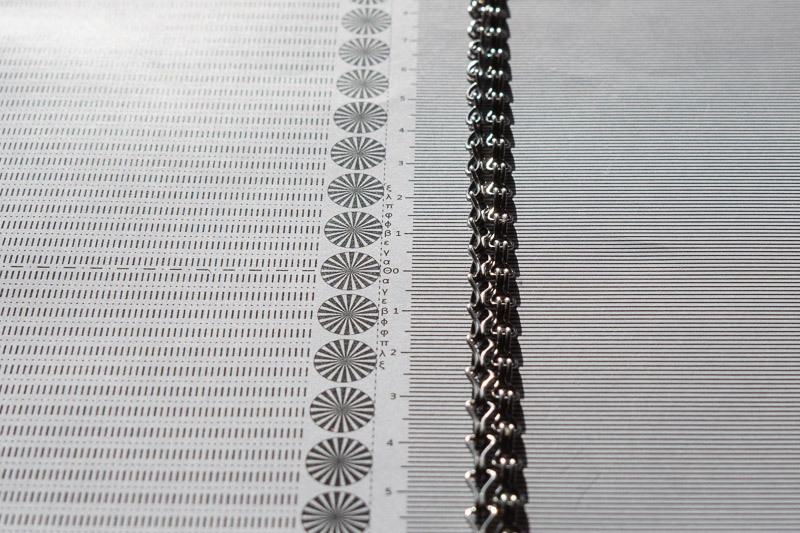
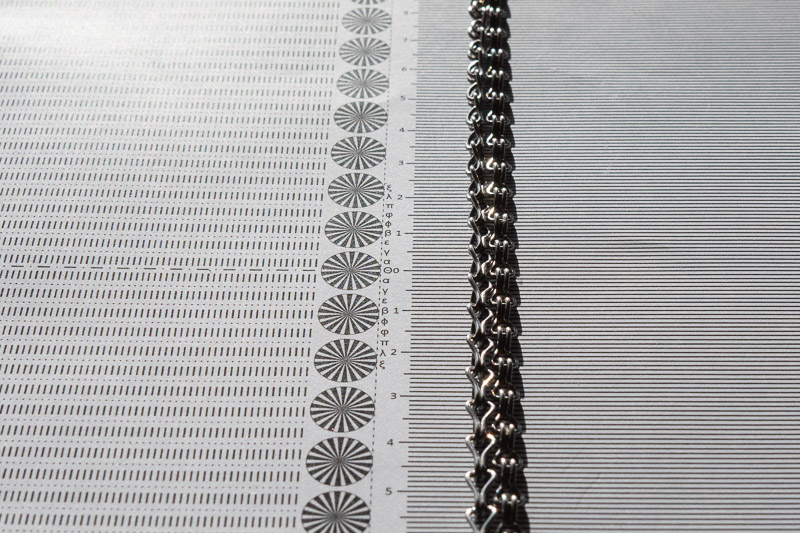
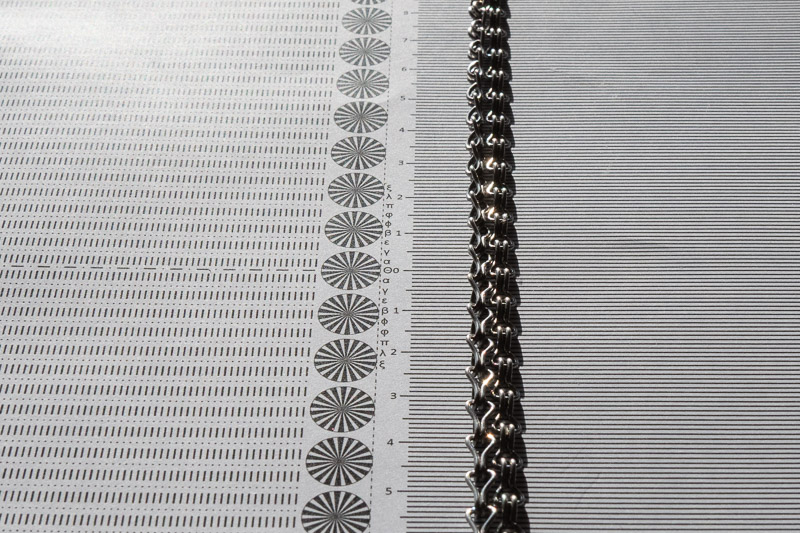
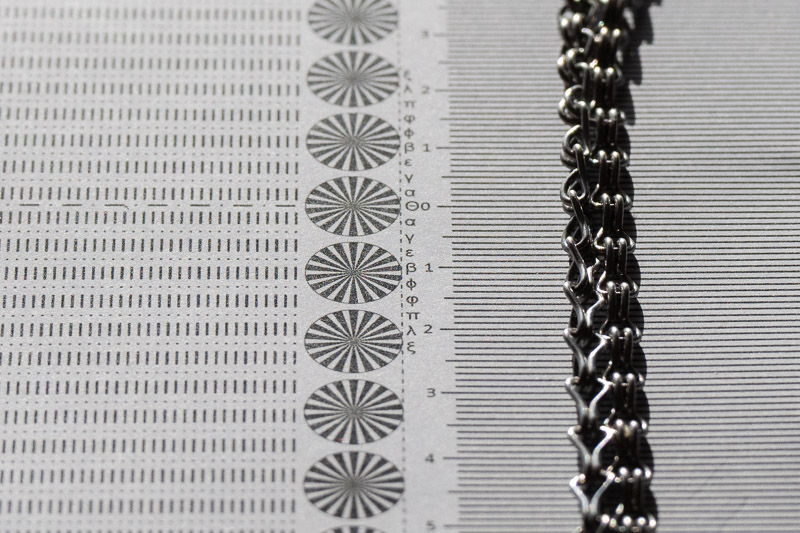
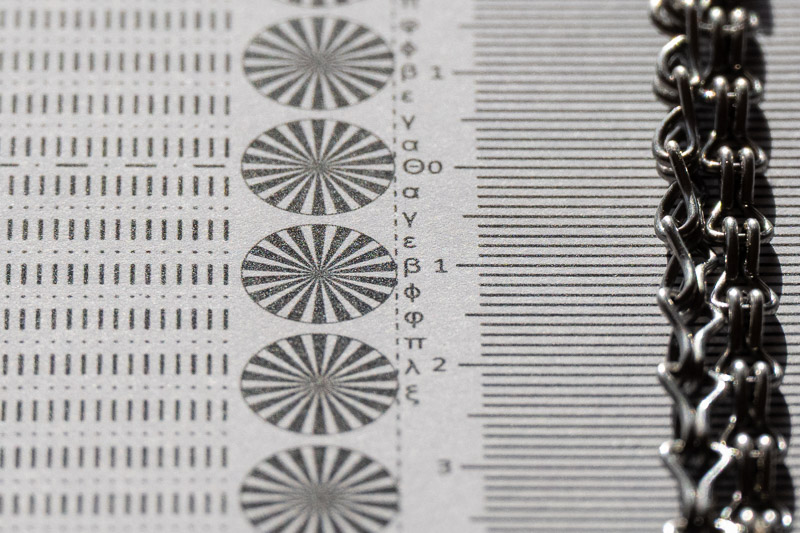

Lateral chromatic aberration is somewhat worse. The best control is again at 70mm, although even there a small amount of LaCA is visible. Performance then declines in the following order: 70mm, 120mm, 200mm, and finally 24mm, where the aberration becomes quite pronounced. At 24mm the LaCA is the strongest I have seen among Nikon Z lenses so far.


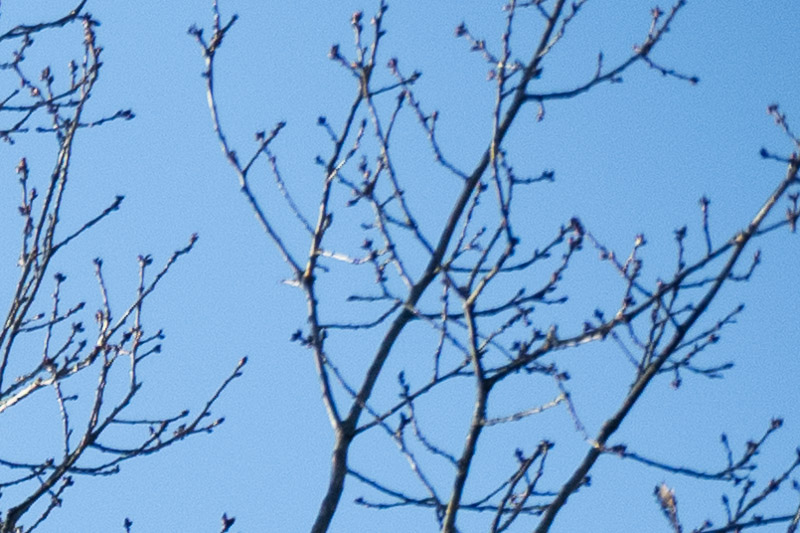
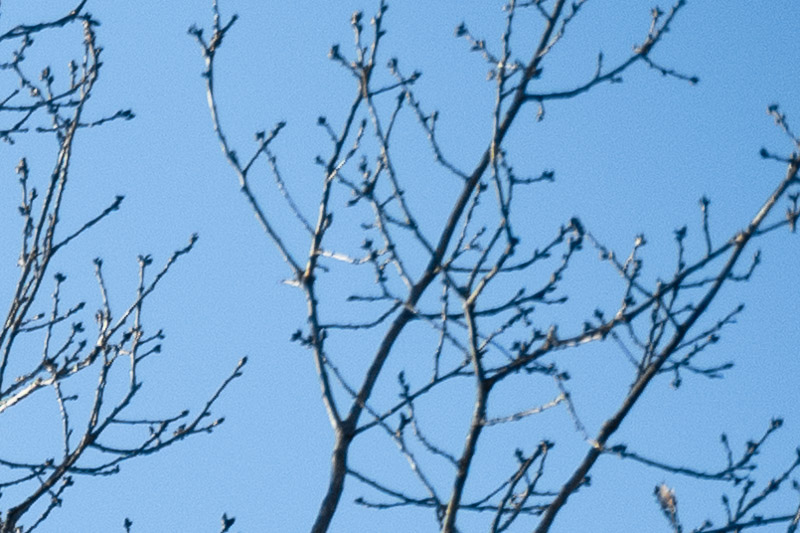
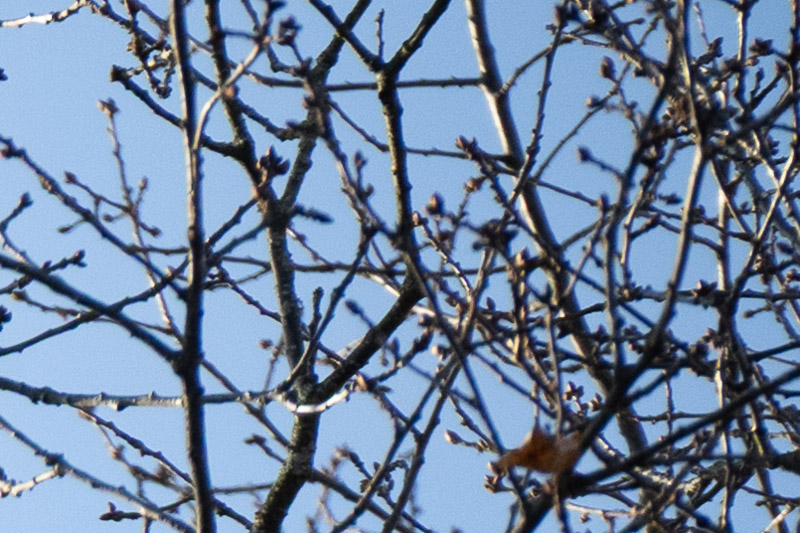
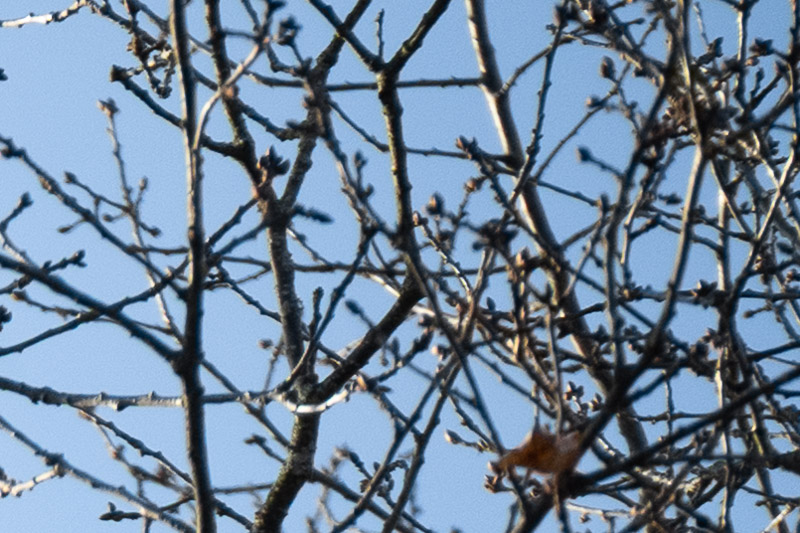


In comparison, the S lenses show much better control of chromatic aberration across the zoom range, especially the 24–70/4 S, which has some of the best chromatic aberration control among Z lenses.
Flare Resistance
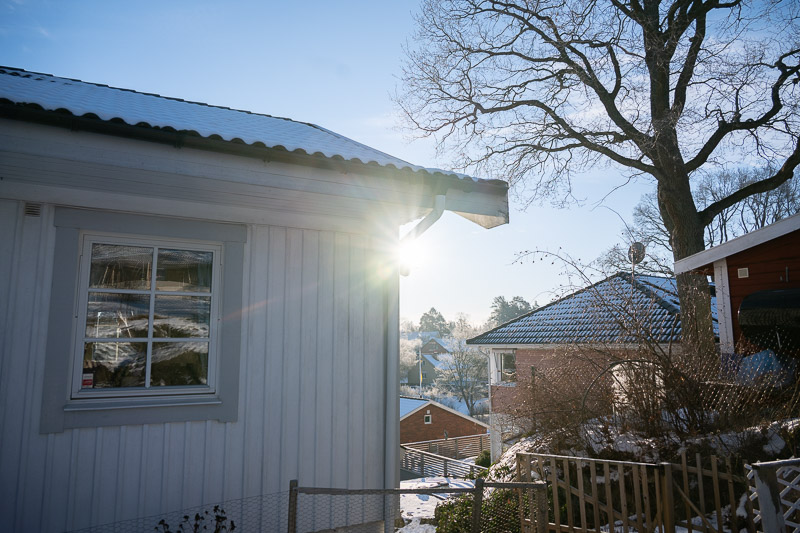
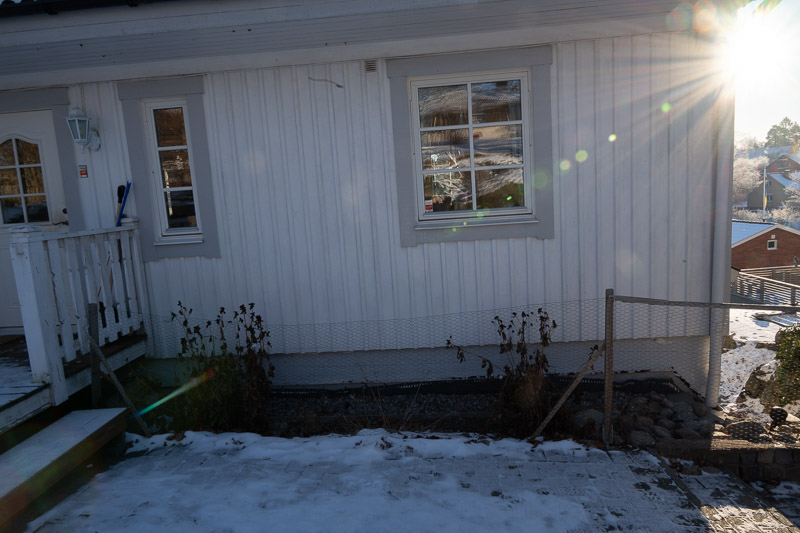
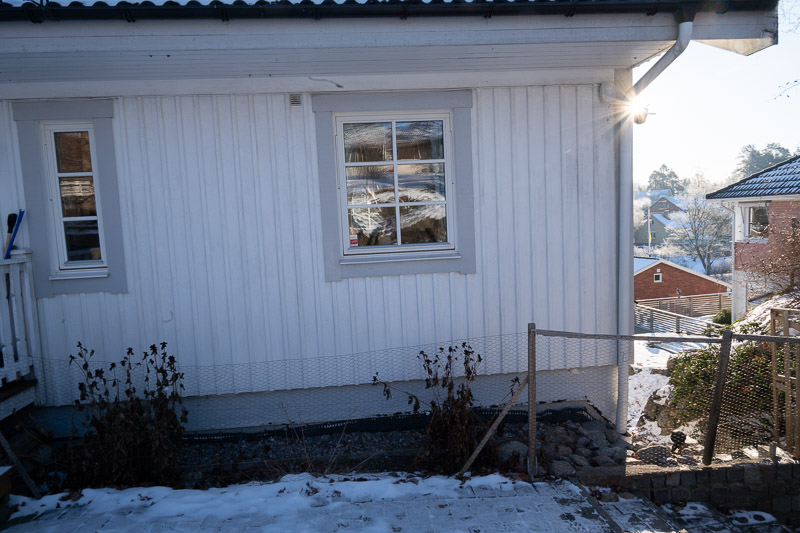
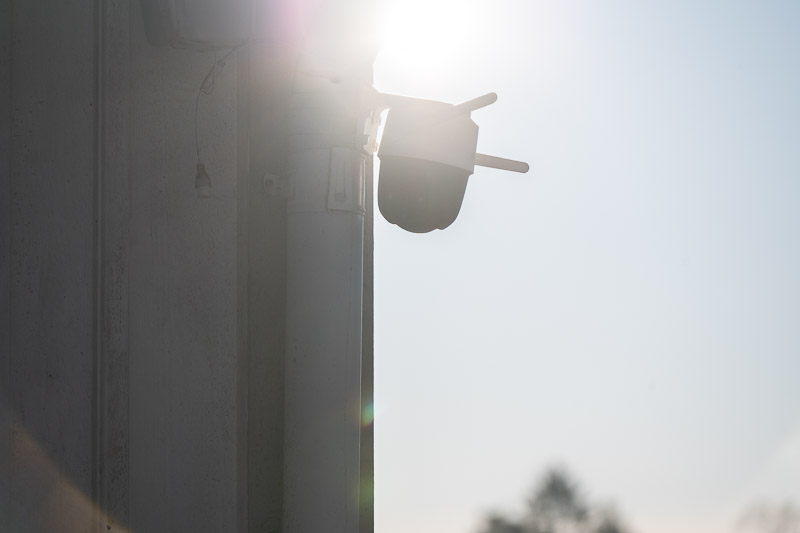
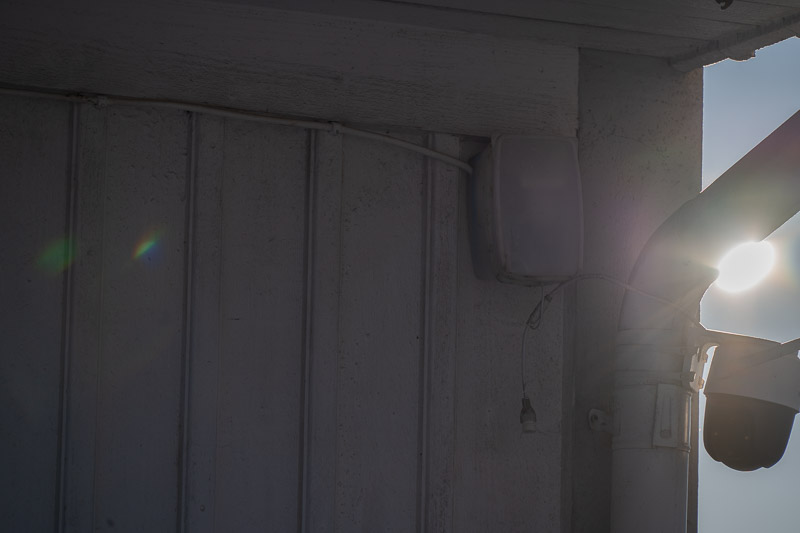
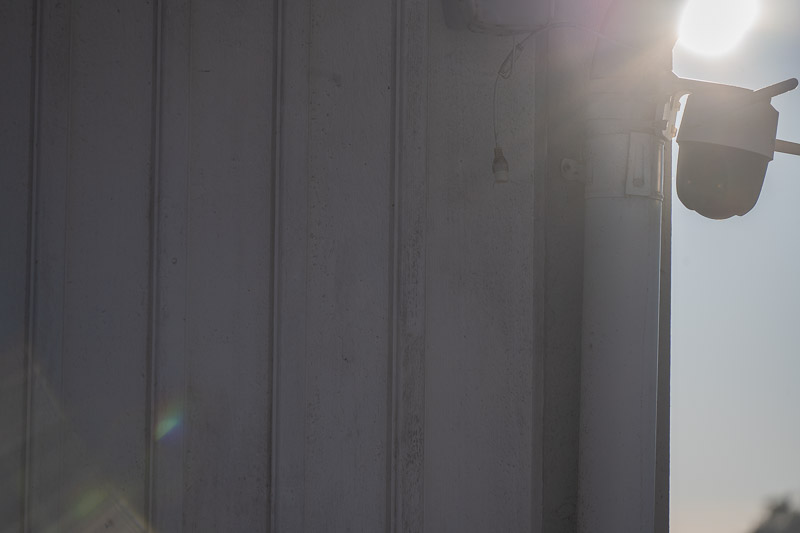
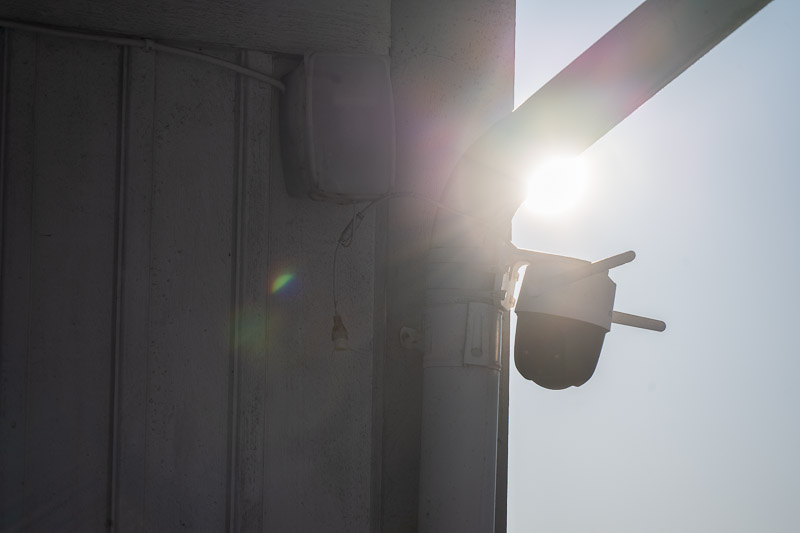
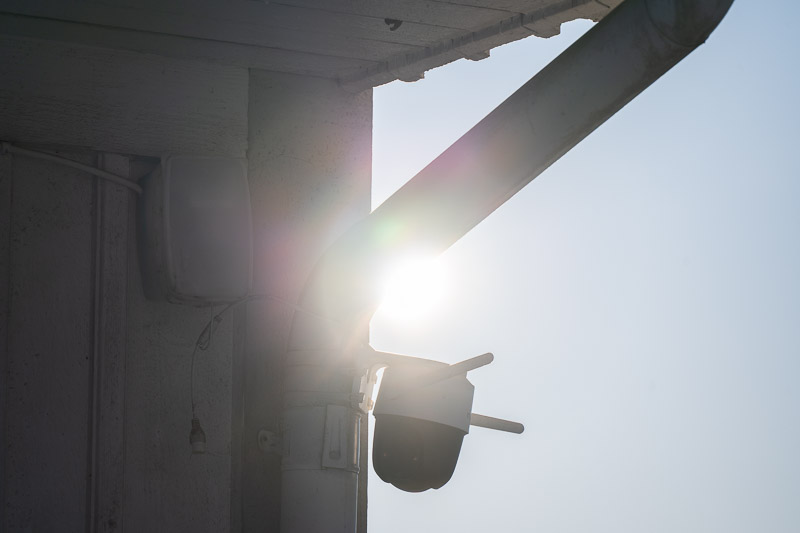
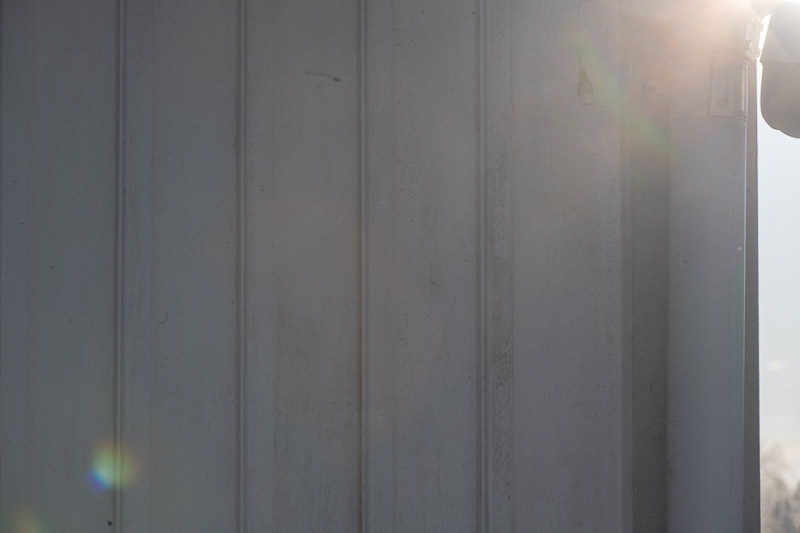
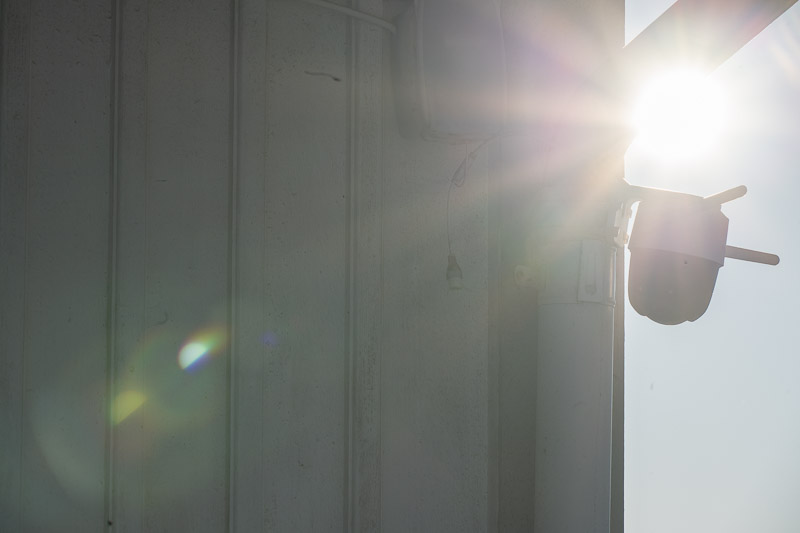
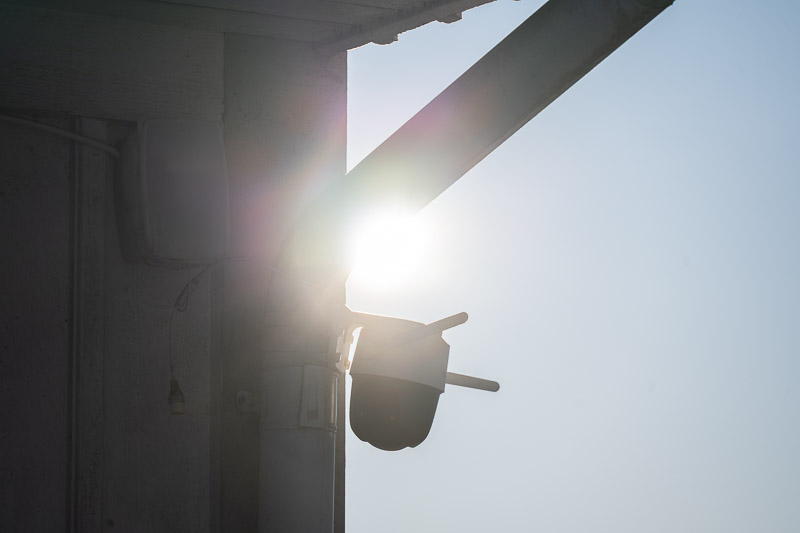
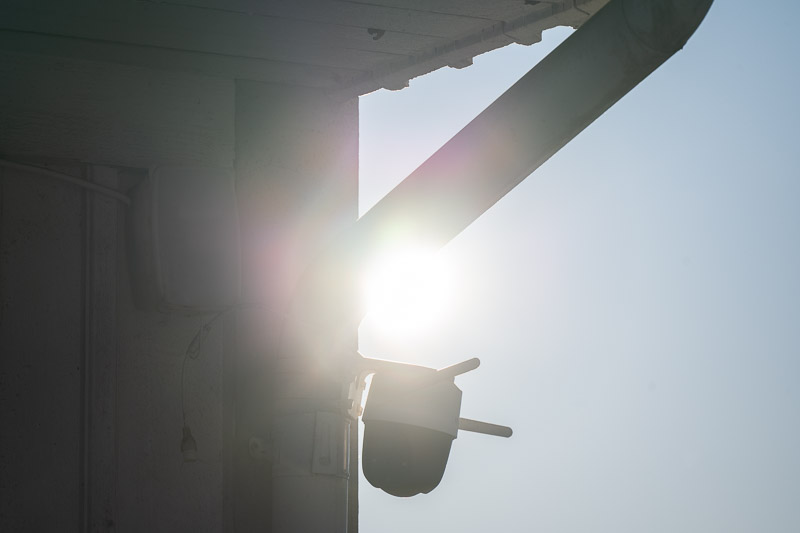
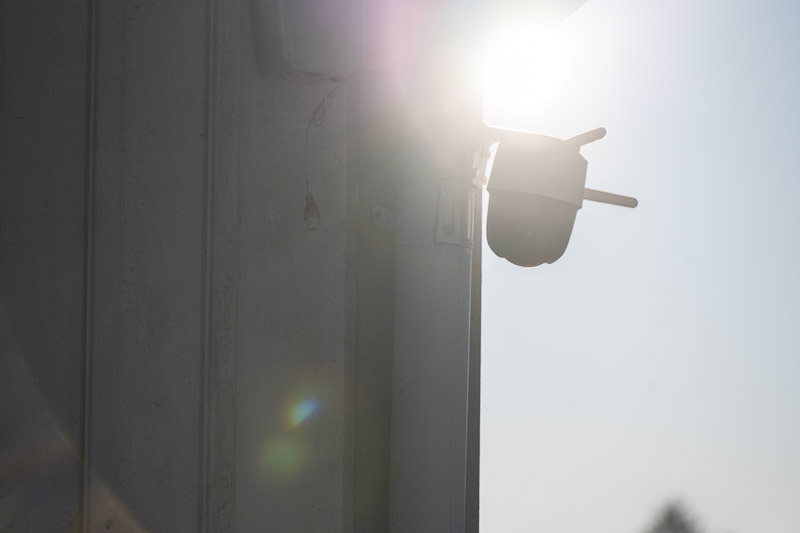
Assessing flare resistance is a complex process. You can make any lens look bad if you try long enough; often, flare can change dramatically by shifting the position or angle of the lens just slightly. This lens is no exception, and its nature as a zoom only adds to the challenge. Furthermore, the high element count and numerous glass-to-air surfaces don’t help matters.
That is why Nikon made an exception by treating this lens with its premium ARNEO coating—typically reserved for S-series glass. While this helps, and flare resistance remains acceptable in normal shooting conditions, its performance falls short of the 24-70mm f/4 S and 24-120mm f/4 S, leaving something to be desired.





Coma
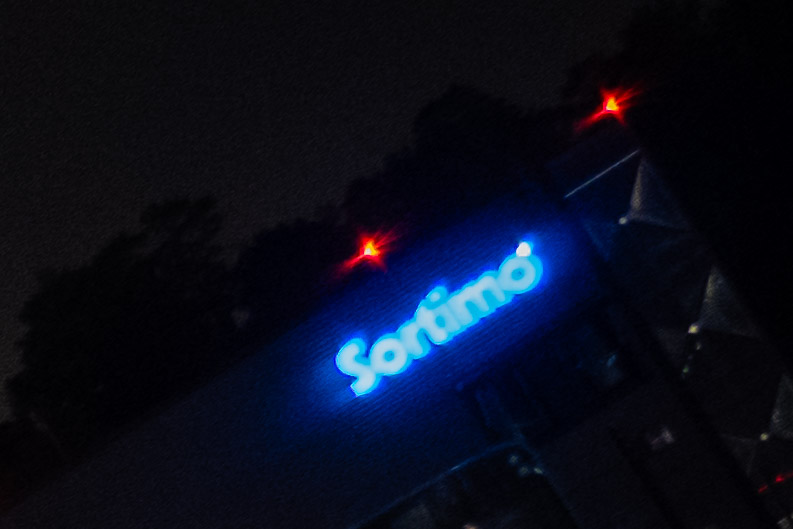
Checking coma on a lens with a maximum aperture of f/4 is somewhat irrelevant, but for comparison: wide open at f/4 there is a small amount of visible coma in a 1:1 crop. It improves significantly by f/6 and is almost gone at f/6.3. Compared to the other zoom lenses, it is similar to the 24–120/4 but not as good as the 24–70/4.
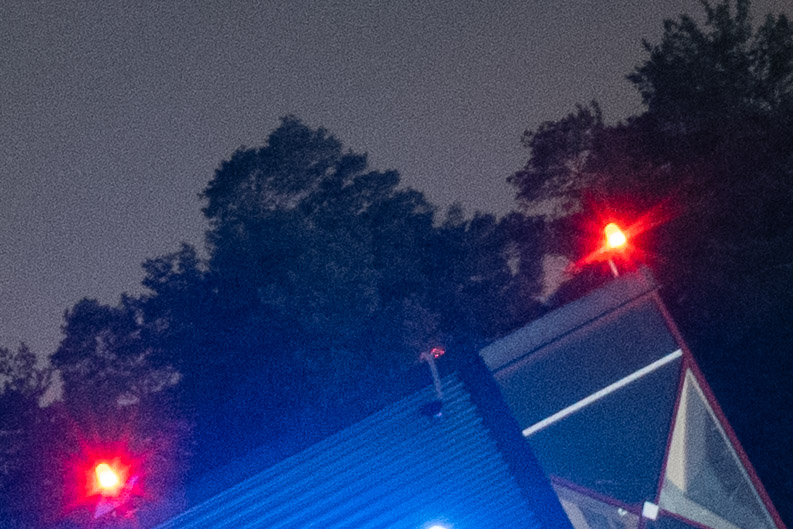
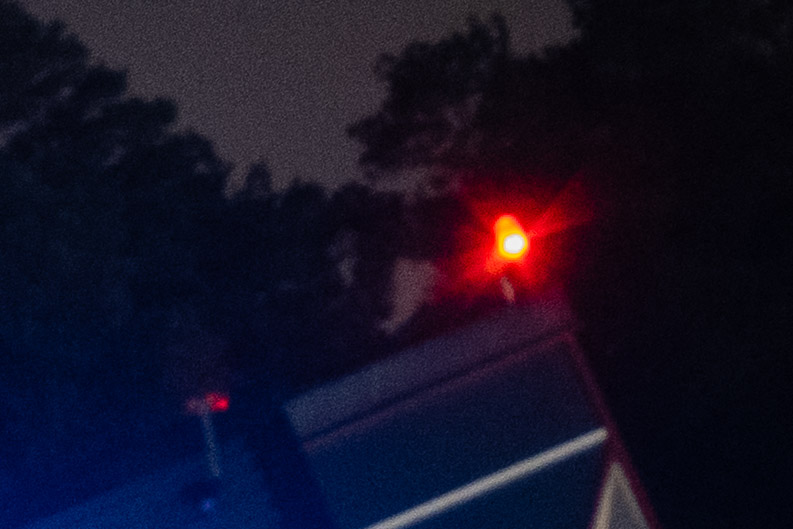
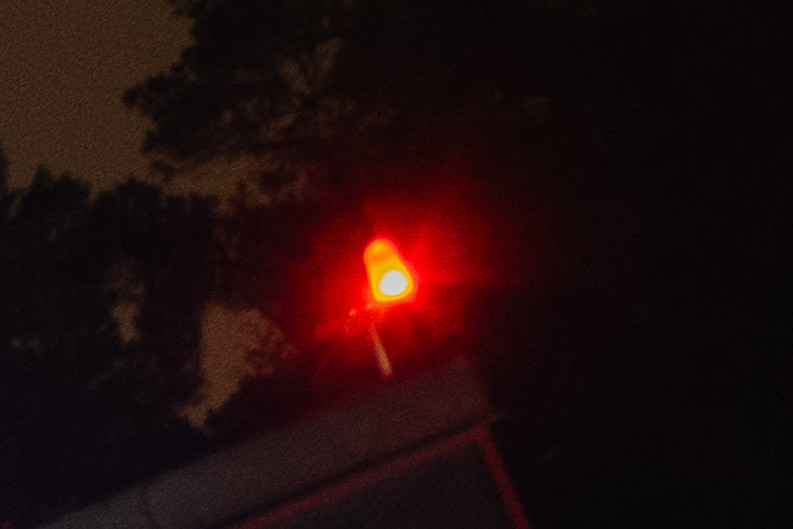
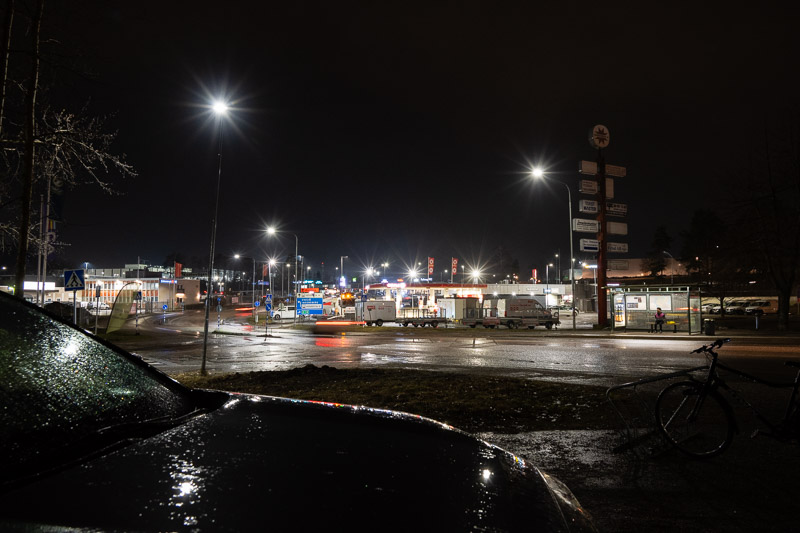
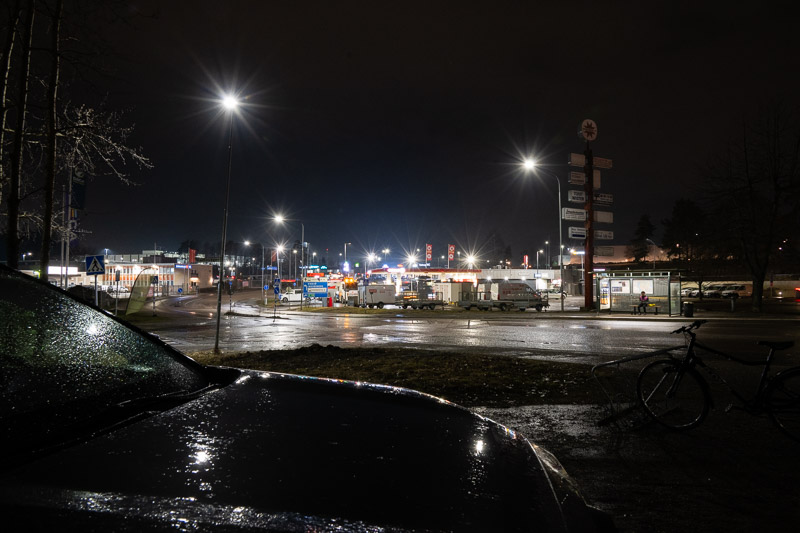
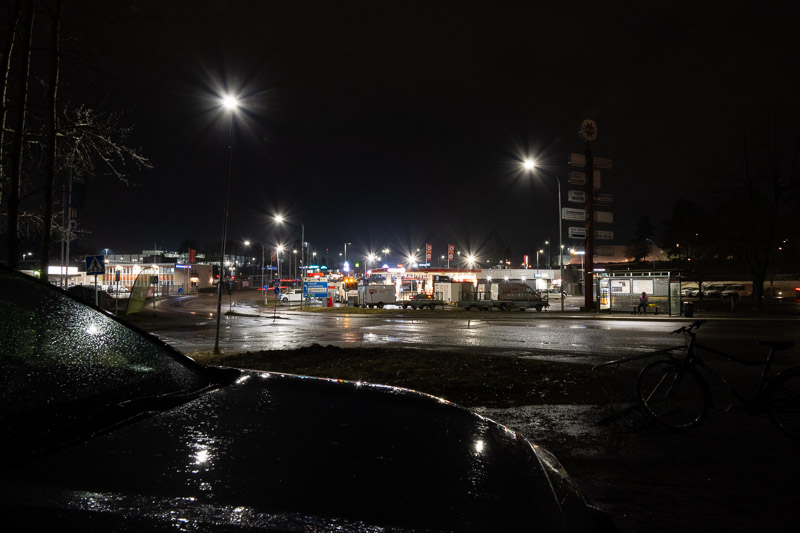
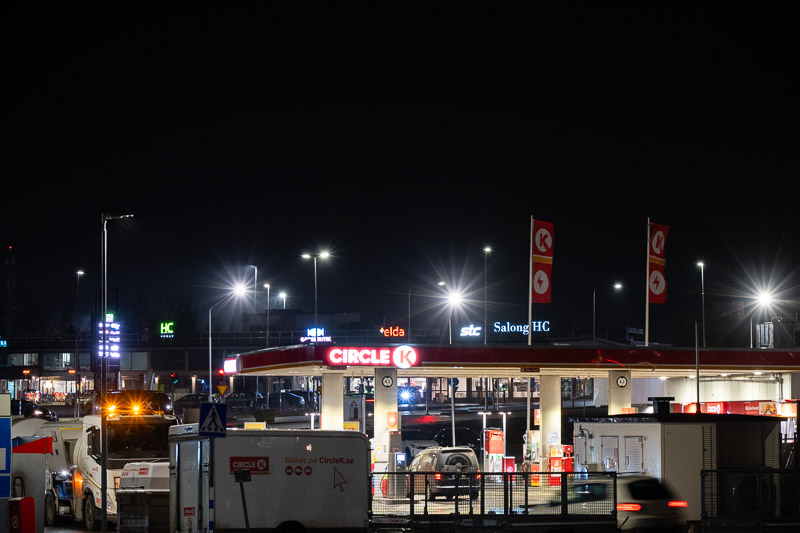
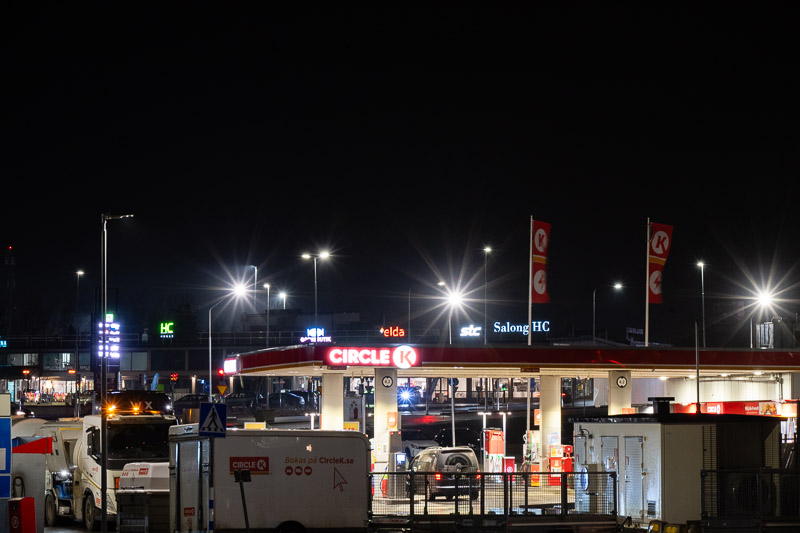
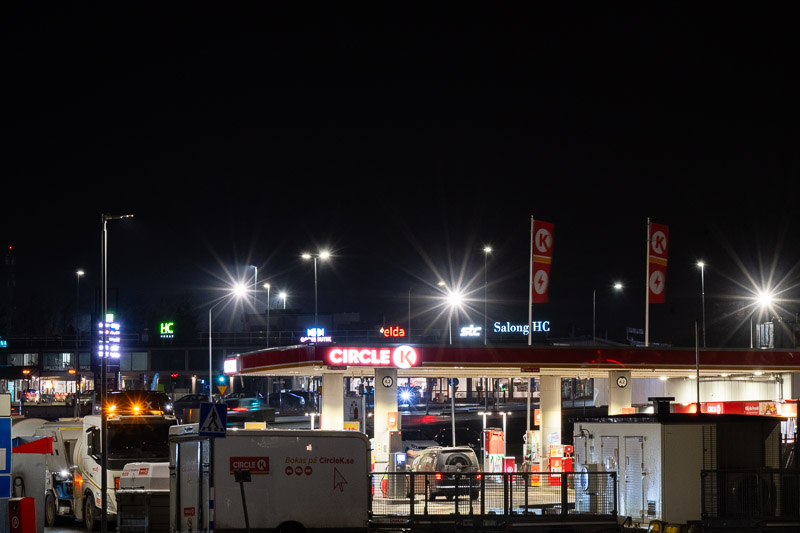
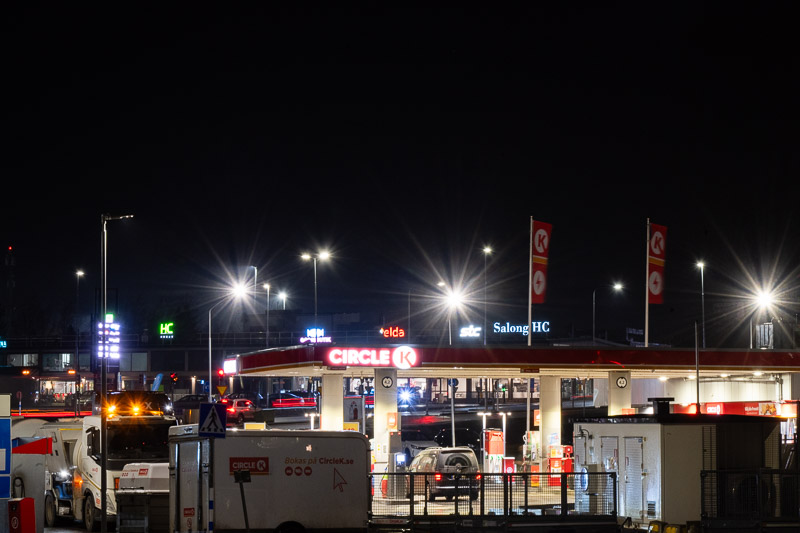
Sunstars
This 24–200mm can produce sunstars, but they are not equally well defined at all focal lengths. They become better defined toward the telephoto end. Its behavior in this regard is also somewhat unusual. Normally, sunstars appear at smaller apertures and become more defined as you stop down, with the most distinct shapes at the smallest apertures. With this lens, however, sunstars start appearing around f/8 and become well defined by about f/11 or f/16, depending on focal length. At smaller apertures they start to lose definition again.
In this category the 24–120/4 S delivered the best result, while the 24–70/4 S produced the least well-defined stars.
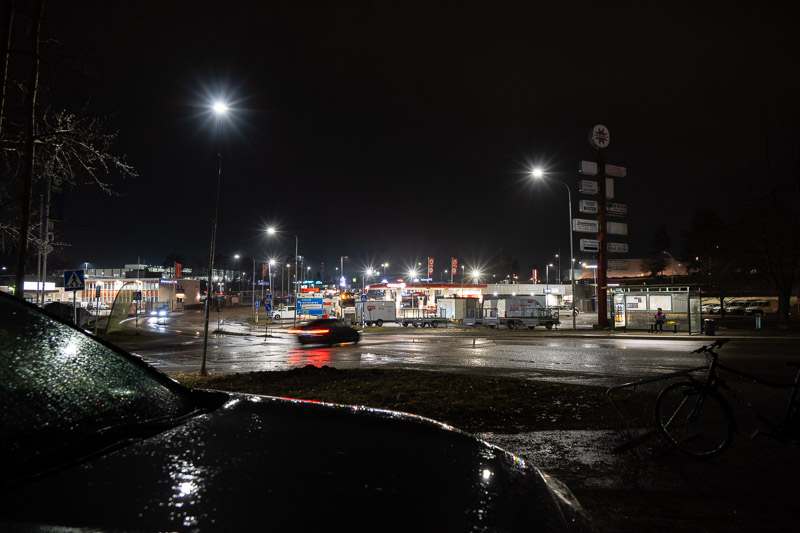









Focus Breathing

The Nikon Z 24–200mm shows a small amount of focus breathing. It’s not very pronounced, but it is there. Both the 24–70/4 S and the 24–120/4 S perform better in this regard, showing almost no focus breathing. If you are not planning to use this lens much for video, it is unlikely to be an issue.

Bokeh


While a 24mm f/4 or an 85mm f/6.3 might not have the specs typically associated with ‘buttery’ bokeh, you can still achieve background blur across the entire zoom range. At wider focal lengths, you’ll need to get physically close to your subject; however, as you zoom in, the lens compression of the telephoto end helps create a pleasing blur even from a distance.
Short Distance






Mid-Distance





Long Distance

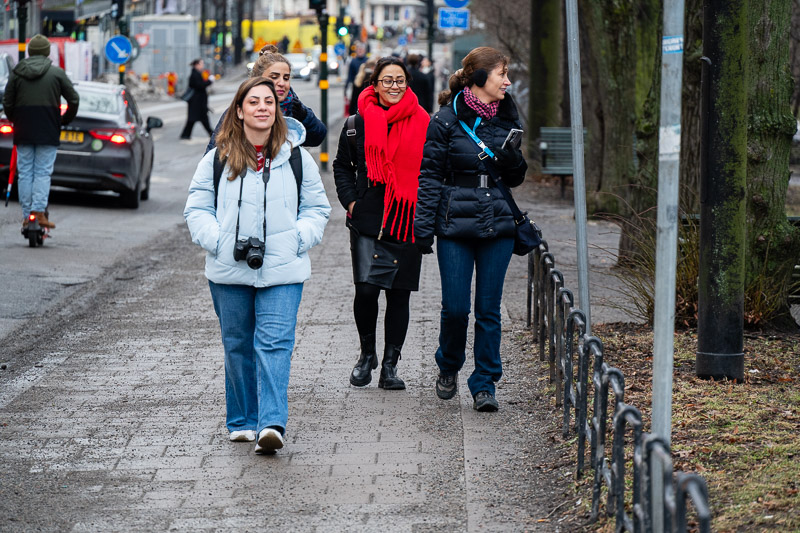

Bokeh is subjective, and its beauty is truly in the eye of the beholder. To me, while there’s nothing wrong with the rendering of this lens, the softness is fairly average. You can certainly get a pleasing blur at longer focal lengths and close subject distances, but in most other scenarios, the bokeh is just ‘okay’.
Conclusion
| I LIKE | AVERAGE | I DON’T LIKE |
|
|
|
While not a Nikon S lens, it has almost all the good traits of the S lenses. This 24–200mm has all of Nikon’s top coatings, plus two ED glass elements, two aspherical elements, and one additional aspherical/ED element. It also has weather sealing and a metal lens mount. This is one of Nikon’s most versatile lenses, and Nikon clearly makes good use of the flexibility of the Z mount.
It is an excellent lens, and instead of going into all its individual features, I can say that it is better than the Nikon F-mount 24–120mm f/4 lens, which I owned and which was my favorite zoom lens before switching to mirrorless.
We had two questions in the introduction. The first was whether this lens could be the only do-it-all lens you travel with. If you ask me, the answer is yes—absolutely, even for landscape photography. I normally use f/8–f/11 there, and at those apertures it’s effectively on par with the S lenses in practice, except when the sun is included in the frame.
The second question was whether it is as good as the S-series standard zoom lenses, the 24–70/4 S and the 24–120/4 S. The answer is no; it still does not match the optical quality of the S lenses. The S lenses also maintain a constant f/4 maximum aperture, which is helpful in darker situations. However, this is also an unreasonable and somewhat unfair comparison, as this is a superzoom sold at a lower price.
On the other hand, this lens beats the S lenses in versatility by extending the focal range to 200mm and by including VR, which is very helpful, especially at longer focal lengths. While it does not quite match the optical quality of the S lenses, it performs very well on its own and delivers more than enough sharpness. It is also more budget-friendly.
I hope this review of the Nikon Z 24–200mm f/4–6.3 VR has been helpful in making your decision! If you’re planning to purchase this lens, you can support us by buying it through one of the affiliate links below.
| Buy new: Amazon (anywhere) for $797 (Affiliate links) Buy used: Kamerastore from $620 (Affiliate links) |
Writing articles like this is time-consuming and costly. If you found this review useful or it helped you save money, but you’re not interested in buying any of the lenses, you can still support us by treating us to a coffee (donate)!
Alternatives
There are no direct alternatives available for the same focal length range, but I mention the ones that are closest
Nikon Z 24-120mm f/4 S
I have done a comparison of this lens with the reviewed lens in almost every section in this review, so no further info is necessary.
Buy new: Amazon (anywhere) for $997 (Affiliate links)
Buy used: Kamerastore, ebay.com from $820 (Affiliate links)
Nikon Z 28-400mm f/4-8 VR
This is the only other superzoom that goes from wide to telephoto. Its obvious advantage is the extended reach up to 400mm, but it only starts at 28mm on the wide end. It also drops to f/8 from 200mm onward. Optically, the reviewed lens still has a slight edge over this 28–400mm.
Buy new: Amazon (anywhere) for $1147 (Affiliate links)
Buy used: Kamerastore, ebay.com from $855 (Affiliate links)
Nikon AF-S 28-300mm f/3.5-5.6G VR
This is an F mount lens from Nikon’s DSLR era, you need an FTZ adapter to use it on Z cameras. The reviewed lens is clearly better than this lens.
Buy new: Amazon (anywhere) for $1040 (Affiliate links)
Buy used: Kamerastore, ebay.com from $380 (Affiliate links)
If I would Rank the lenses mentioned in this articla based on their optical quality, it would be like this:
- Nikon Z 24-120mm f/4 S | Nikon Z 24-70mm f/4 S
- Nikon Z 24-200mm f/4-6.3 VR
- Nikon Z 28-400mm f/4-8 VR
- Nikon AF-S 28-300mm f/3.5-5.6G VR
Note that we are splitting hairs here; none of these lenses are bad, there are good ones and better ones.
More Sample Images














Most of the sample images in this review and many more can be found in higher resolution here.
Further Reading
- What camera gear and accessories do I use most frequently?
- REVIEW/COMPARISON: Nikon Z 24-120mm F/4 S – How It Compares to Z 24-70/4 S
- Review: Nikon Z Nikkor 24-70mm f/4 S
- REVIEW: Nikon Z Nikkor 14-30mm F/4 S
Support Us
Did you learn something new, find this article useful, or simply enjoy reading it? We’ve put a lot of time and resources into creating it, and your support helps us keep going. If you’d like to show your appreciation, please consider clicking the Donate button!



(Donations via Paypal or bank card)
What’s in my camera bag? MY 2026 KIT!!
- Main camera : https://amzn.to/3TsGtKg
- Camera grip : https://amzn.to/4e0G3CR
- Memory Card 1: https://amzn.to/47pA20i
- Memory Card 2 : https://amzn.to/3XHYxlZ
- Camera 2 : https://amzn.to/3Xifou8
- Camera grip: https://amzn.to/4dYYpV9
- Memory card 1: https://amzn.to/4e5h2H0
- Memory card 2: https://amzn.to/3zu7W7n
- Small travel tripod: https://amzn.to/4goIX68
- Mini tripod: https://amzn.to/4e09XXX
- Small shoulder bag: https://amzn.to/47tPMiY
- Medium shoulder bag: https://amzn.to/4ej4bjY
This site contains affiliate links, for which I may receive a small commission if you purchase via the links at no additional cost to you. This helps support the creation of future content.


Martin
Latest posts by Martin (see all)
- Analogue Photography: Part 7 — Gran Canaria with Kodak Portra 400 - September 30, 2026
- REVIEW: Leofoto 25L All-in-One Travel & Camera Backpack - September 16, 2026
- REVIEW: TTArtisan AF 50mm f/1.8 NEO - September 13, 2026
Thank you for the review! I had the opportunity to compare all the listed zooms. As a result, I kept the Z28-400.
Overall, if you need maximum compactness and 24mm is the dominant value you use, then the Z24-70 f/4S is your choice.
If you are engaged in reportage shooting, then the Z24-120 f/4S is suitable for you. If you need a compact and budget-friendly superzoom, then I recommend the Z24-200.
And if you are looking for the best set of parameters among all the superzums on the market for all bayonets, then the choice is obvious — Z28-400. Although it is, of course, inferior to the Z100-400 by 400 mm, but when the question arises: should I take two cameras with two lenses Z24-70 f/4S and Z100-400 or one camera and one lens with me on trips, then at my age the answer becomes clear! If your camera has a different mount, I recommend purchasing the Z5ii for the Z28-400 and getting the most versatile and affordable system that will allow you to cover the range from 28 mm to 400 mm.
Very nice complement and comparisons, thanks
Thank you, that’s very interesting. I’ll add that my 24-200 is exactly the same as the one described in the test. Although, I know that some people have had bad copies of 24-200s. In my case, up to 135-150mm, the sharpness is so good that it’s almost impossible to tell if it’s a superzoom. Yes, it’s not easy to get bokeh with this lens, but it doesn’t seem to be designed for that purpose. I’ve been thinking about replacing it with a 28-400 for a long time, but as I mentioned earlier, my 24-200 is a very good, and I don’t want to lose it. In the end, I decided to buy a Tamron 150-500, and I can say that while the Tamron is sharper than the 24-200, it lacks the stabilization of the 24-200. The difference is significant. Ultimately, the 24-200 is the perfect camera for my travel needs. Paired with a 40mm f/2 lens, it covers almost everything except birds and stars. My copy performs best at 35mm. Additionally, it performs better at 45 megapixels than at 24 megapixels, and in DX mode, it reaches an equivalent of 300mm. While it may be too short for birds, it is still suitable for capturing images.
This is one of my favorite lens of all time, and my favorite Nikon lens. I have exotic lenses like the 200mm f/2, but this 24-200mm produced at least 100x more photos that I really like. I just stop it down to f/8, hand hold it to as slow as 1/8s. For low light I carry a light tripod and a shutter release. The autofocus isn’t as good as the Tamron 28-200 or SIgma 20-200, but it is still snappy enough.
How you think the Sigma 20-200 and the Nikon 24-200 compare?
I think the compromise of the Sigma 20-200 is too great. I use it to shoot events when I get paid very little, and I don’t want to bring two cameras/two lenses. I don’t like holding its zoom ring. I should get life+guard on it.
The Nikon 24-200 is better in almost every aspects, other than autofocus speed, magnification ratio (especially at ~80mm), and no 20mm. And since I am a Nikon+Sony shooter, I feel more comfortable with the zooming orientation .
You can obtain the uncorrected image in RawTherapee software. It is cross-platform and free. Strongly suggest using that for checking distortion in these reviews.
I’m aware of that, and I’ve used it in several of my reviews—but is there a point?
This lens can only be used on Nikon Z cameras, and those cameras never allow you to deactivate the distortion correction.
Even in RawTherapee the distortion correction embedded in the RAW file is applied automatically.
You have to proactively find where you can disable it, and do so to see the distortion.
Should I test and show something that nobody will ever see in real life?
What jumped out to me right away while reading this review was how the information presented in the Lens Distortion section provided absolutely no useful information and seemingly redundant, so the feeling reading the section made me wonder why it was even included at all in this review. I understand there is a standard template for these reviews, to maintain consistency across the blog. But rarely do I see a review on here where both distorted and undistorted are not shown, hence why this jumped out at me.
You do have a good point and I agree somewhat, but lens manufacturers are, in an effort to keep costs and complexity of lens elements down, making compromises in certain areas and I think it may be increasingly important for us to know where those compromises are being made. It seems distortion correction may be overlooked on many lenses these days and manufacturers are relying a lot on digital manipulation to compensate. Essentially making this less and less of an analog experience, i.e. the problem with modern smart phones today.
When I am shopping for a lens, I actually am very interested to know how much optical distortion is being corrected, because if it is extreme, it actually results in loss of sharpness in parts of the frame. For example, if there is extreme barrel distortion, the corners need to be expanded in software which is essentially stretching the pixels further apart. Similarly, if there is extreme pincushion distortion, to correct it requires the center pixels to be stretched apart, resulting in loss of sharpness in the image center. One could say this is already addressed in the sharpness section of the blog post, as it compares center and corner sharpness.
A person may want to adapt lenses across camera systems, where automatic distortion correction might not be possible (although this doesn’t apply to Nikon Z lenses as the flange distance is way too short and thus their lenses cannot be adapted to any other camera system…).
Anyway sorry to be such a bother. I may be somewhat of a lens snob and perfectionist when it comes to this sort of thing 🙂
I agree with you in general, but when it comes to this lens, you’ve already made all the arguments for why it’s unnecessary.