Introduction

I am always looking forward to put this recap together, so without further ado let’s have a look at some of the highlights of 2025 together.
Videos and Social Media
For those of you that are not aware: Martin presents most of his reviews also as videos:
 You can find all his video reviews on our Youtube account, like and subscribe!
And we also have:
 A Discord server since the beginning of 2023.
 And Martin keeps taking good care of our Instagram account.
Reviews
Thanks to Martin’s support we again managed to publish at least two new articles every week in 2025, many of which were reviews. We published reviews of:
- 17 E-mount lenses
- 12 M-mount lenses
- 17 Z-mount lenses
- 20 F-mount lenses
- 6 lenses for other mounts

Told you last year there are many F-mount lens reviews to come, guess soon we have covered most of the interesting ones.
Several of these reviews have only been possible thanks to some of you parting with their beloved lenses for a few weeks, so that we can review them. You know who you are, thanks a lot for that!
I also managed to cross out some exotic lenses on my list of lenses I would like to review. There are still some there, so if you have one of those, you are located in Europe and you would be willing to part with it for a few weeks that would be greatly appreciated. Just drop a note.
I updated most of the guides in March, some again in September, but keeping them up to date is a neverending task and it is already time to update them again.
Highlights
There were actally a whole lot of highlights this year, so I decided to summarize them in a few categories.
Lenses with big Entrance Pupil

After more than 15 years we saw the release of not one but two new 200mm 2.0 lenses, the Laowa 200mm 2.0 C-Dreamer AF and the Sigma 200mm 2.0 DG Art OS. Just shortly after that 200mm lens, Sigma released the even more impressive Sigma 135mm 1.4 DG Art and honestly, they sell it under value – not something I have said about a newly released lens before. The Samyang 85mm 1.2 XP is another lens that fits this category. After having used all of Samyang’s XP lenses I can clearly say this is the best one. A pity it doesn’t come with autofocus, if it did I would have surely kept it for its beautiful rendering.
Super Fast 50mm Lenses

Regular readers know I have a soft spot for the super fast 50mm lenses. The problem is these are often rare and expensive low volume lenses and sometimes it takes years to get the opportunity to review one of them. Now this year I got the opportunity to review several of those, the Nikon 58mm 1.2 Noct-Nikkor (thanks to a long time reader), the original Canon 50mm 0.95 Dream Lens (thanks to Camera Obscua Elburg) and the SLRmagic 50mm 0.95 Hyperprime, one of my white whales due to its extremely low production count. To close the year properly I will also publish a review of the Canon EF 50mm 1.0L USM – still the fastest AF lens 36 years after its release – around New Year’s Eve.
Nikon’s f/4.0 Z-mount Zooms

Martin reviewed no less than three constant aperture Z-mount zooms and they are all great lenses. The Nikon Z 14-30mm 4.0 S is a compact ultra wide zoom that takes standard filters despite starting at 14mm. And while I – after having reviewed the Sony FE 20-70mm 4.0 G – coudn’t go back to an f/4.0 standard zoom starting at 24mm, both the Nikon Z 24-70mm 4.0 S and the Nikon Z 24-120mm 4.0 S, offer a more impressive optical performance.
Sony’s Gen II Lenses

I have said it many times: some of the first generation E-mount lenses weren’t particularly great. The same cannot be said about the second generation lenses. The Sony FE 70-200mm 2.8 GM OSS II is absolutely amazing despite being surprisingly lightweight, the Sony FE 85mm 1.4 GM II is the highest resolving fastest focusing 85mm 1.4 I came across so far and the Sony FE 16mm 1.8 G is arguably better than the Sony FE 14mm 1.8 GM while being only half the price. Sadly with that 16mm lens not only I encountered severe sample variation issues – a too common issue with these fast ultra wide angle lenses. Also a review of the Sony FE 70-200mm 4.0 G Macro OSS II – the first true 1:2 macro tele zoom I have seen in a long time – will be released soon.
Viltrox going Strong

Viltrox might be the manufacturer that released the highest number of new lenses this year and we reviewed a lot of them. While not every lens they released proved to be great, actually many were and across all their series. The Viltrox 35mm 1.2 LAB is a true flagship product I already said a lot of good things about, but also the Viltrox 14mm 4.0 Air and the Viltrox 85mm 2.0 Evo are amazing lenses, despite being compact and affordable. If you are using an APS-C camera the Viltrox 56mm 1.2 Pro and the Viltrox 25mm 1.7 Air are also worth a closer look.
M-mount lenses

The amount of exciting new M-mount lenses was a bit lower in 2025 compared to the previous years. There were still two I want to mention here: the Solinon 18mm 5.6 Asph and the Thypoch 75mm 1.4 Simera. The Solinon was designed by one of our readers and fits a niché rarely covered by other manufacturers: slower but highly capable yet compact lenses. The 75mm 1.4 is the culmination of Thypoch’s Simera line up: their best lens so far and my easy recommendation if you are looking for a 75mm M-mount lens.
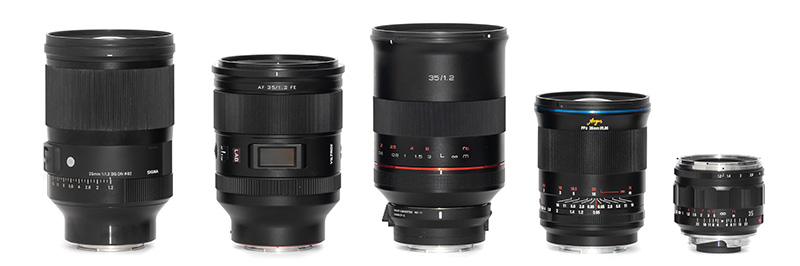
Super Fast 35mm Comparison
After my Super Fast 50mm M-mount Lens Comparison in 2023 and Fast 28mm lenses Comparison in 2024, this year I also had a look at the Super fast 35mm lenses. I wasn’t able to source a Nikon Z 35mm 1.2 S though and in the meantime Sigma updated their Sigma 35mm 1.2 Art DG DN, so that comparison can already be considered somewhat outdated.
What else happened in 2025?
Reviews of APS-C Fixed Lens Cameras
and why I don’t really care about those anymore.
This year I got the chance to have a look at the Fuji X100VI and the Ricoh GR III – probably the two most popular fixed lens cameras with an APS-C sized sensor. Both follow slightly different concepts and therefore appeal to different audiences, but they have one thing in common: when I used them I realized that for me personally one of the latest flagship camera phones makes a lot more sense as a single compact picture taking device.

Having an ultrawide, a wide and a tele lens with macro function in one device clearly outweighs the potential advantage of having that bigger APS-C sensor. Especially as in many situations the phone’s computational photography capabilities shift the boundaries in favour of it – despite it making use of smaller sensors. The smartphones already killed off smaller sensor cameras and they will not stop there.

In my “2023 – Year in Review” I also predicted we will see smartphones with interchangeable lenses and the 2.35x “200mm” extender lens for the Vivo X200 Ultra and the Vivo 300 Pro is probably the first serious entry. I am sure it won’t be the last. And see what the phone manufacturers do: they include an Arca Swiss compatible tripod collar, something Nikon, Canon and Sony (amongst many others) fail to do to this day.
Canon RF 45mm 1.2 STM
Canon released an interesting lens: the Canon RF 45mm 1.2 STM. Unlike the other RF lenses this is not a huge, highly corrected, complex design, but rather a Voigtländer 40mm 1.2 with AF. From initial responses it seems many of Canon’s existing users are not a big fan of it, personally I think this lens is very appealing and I would much rather have that one than the Nikon Z 50mm 1.4 (which is more expensive even) or the high performing (but somewhat boring and also more expensive) Sony FE 40mm 2.5 G.
Leica M-EV1
Leica finally released an M-mount camera without rangefinder but with built-in EVF instead. While this camera was long overdue, Leica put less effort in it than even I expected. It features the same manual focusing aids as a Nex 3 from 2010, so none of the amazing ones we are used to from the latest Z-mount and RF-mount cameras. A small reminder: this is a manual-focus-only camera. Of course there is also no hybrid viewfinder let alone a tilty display to be found here, so taking non-eye-level pictures is even more annoying than with a normal M camera with its tiltable addon finder. Not even a digital split image is included. Some people (must be true believers) actually think more focusing aids will be added via a firmware update in the future. I wish them lots of luck.
Analogue Adventures

The analogue adventures continued and not only that: Martin started his own. What is special about this is that he already shared some decade old pictures with us in this article.
You can find all the analogue adventures articles here.
Rise of the Chinese Manufacturers
The Chinese manufacturers are improving fast and this is especially true for Viltrox (see above) but also for Laowa, Thypoch and Sirui. We reviewed ten Viltrox lenses alone this year and some of them were actually truly great and their aspherical elements have also become really good. These improvements don’t come from nothing, someone must be investing a lot of money into improving their production facilities.

Some of the Japanese manufacturers think they are still far ahead of the competitors from China, I wouldn’t be so sure about that. And while publicly they would never admit it, I think Sigma’s late efforts into building/becoming a premium brand are due to them being aware that soon they will not be able to compete on price anymore. Their second generation 35mm 1.2 Art DG DN still has flare issues while Viltrox managed to fix those with their 35mm 1.2 LAB lens (which is the main reason I am using the Viltrox as my 35mm AF lens of choice now).
Ai based Post Processing
Since the Ai based editing tools have been introduced in Lightroom and Photoshop they had a huge impact on my image editing workflow. Retouching tasks that used to take hours can now be completed in seconds and professional photographers that are not using these tools are at a huge disadvantage.

The Denoise Ai noise reduction allows me to take pictures handheld where I had to use a tripod in the past, to further improve the quality of pictures I took a decade ago and the possibility to remove reflections allowed me to rescue pictures I once deemed useless.
I am sure this is just the beginning and I cannot even image what else we will see in the future (Algorithm to get rid of Coma artefacts around stars please?).
Supporting Us
I also want to use this opportunity to thank everyone who used our donation buttons, which helps us a lot with creating new content. Some of you even added small notes to the donations and you can be assured we read all of them with great joy.
We do not reply each one of you individually (getting the E-mail addresses from Paypal is also very time consuming) but I promise every message is being read thoroughly and greatly appreciated.
Some people even set up monthly or yearly donations this way, which shows how much trust you put in us to keep creating interesting content. We will sure try not to disappoint you.

 via Paypal (BastianK)
via Paypal (Martin)
For those that are new here (Welcome!) some additional information I am sure the regular readers are already aware of:
Martin and I have our own donation buttons as well as affiliate links, so the money donated or generated through the links goes directly to the author of that article where you clicked on the button or link.
These donations allow us to sometimes buy a lens with the sole purpose of reviewing it and selling it afterwards, which cannot always be done without a loss. For reviews I usually have to buy higher priced (used) lenses from a dealer, to be able to return them if they are faulty. These lenses are then being sold afterwards at a lower price on the blog/ebay/online forums. The first place I share when such lenses are available is our Discord Server.
What the Future brings
I wonder if Viltrox can keep the pace at which they release new lenses and I wonder if we will start to see the first AF zoom lenses from the Chinese manufacturers in 2026. Optical performance they have pretty much figured out by now, I hope we will also see improvements in after sales services. With these lenses becoming more complex and expensive I hope we will one day see repair options for them outside of China. For many professionals having to send a lens to Asia for a repair isn’t really an option.
Sony just completed its lineup of f/2.0 zooms and I expect f/1.2 primes to be next. I also wonder if they will release some more affordable fast primes similar to the Canon RF 45mm 1.2 and Nikon’s Z-mount f/1.4 series.
I have honestly no idea what Nikon is up to. I wish for a Z-mount camera similar to the Sony A7C series, but I don’t have high hopes for something like that. When it comes to lenses I think they may actually use 2026 to focus on Cine lenses.

I am still sure we will see some exciting new lenses next year, so I hope many of you will keep following us on that journey.
Further Reading


Latest posts by BastianK (see all)
- Review: Sigma 35mm 1.2 DG Art II - August 29, 2026
- Analogue Adventures – Part 56: Nikon AF3 35mm 2.8 - August 26, 2026
- Review: Zeiss Otus 100mm 1.4 Apo Sonnar - August 23, 2026
Thanks for all the great reviews. Best site on the whole web!
Thanks for all you have done. At this point, this is the only place I trust for lens reviews. Others care about fast posts and social currency. Here, it’s well and truly about the glass, and the potentials thereof.
Thanks for all great reviews! Merry Christmas
Danke für die hervorragende Arbeit! Eine solche Fülle an getesteten, auch unbekannteren bzw. älteren Objektiven an modernen Kameras ist einzigartig im Netz. Dazu jede Menge inspirierende Fotos! Weiter so und viel Erfolg!
Vielen Dank 🙏
Thank you for the summary of a rather eventful year.
I, too, would have expected at least a bit more innovation from the Leica M-EV1, but Leica doesn’t see its mission as keeping pace with Sony, Nikon, or Canon — and simply doesn’t have the skills or resources to do so. Besides, the flange focal distance of the M-system would mean that a tilting screen would make the body thicker, and then we’d have another bulky body like the M240, which was heavily criticized for that very design.
Within its narrow limitations, the M-system manages to rekindle the joy of photography for enough people, something that today’s sophisticated digital cameras like the Sony A1 can no longer convey. That’s the reason, why many use them side by side and therefore, I see no reason to constantly speak so disparagingly of Leica and its fans.
The days when I could get excited about such monstrous lenses as the Viltrox or the Sigma 35mm f/1.2 are long gone.
I wish you a happy New Year and an eventful 2026.
“the Canon EF 50mm 1.0L USM – still the fastest AF lens 36 years after its release”
Fujifilm has an autofocus 50mm f/1.0 for a couple years now.
Aps-c lenses with f/1.0 are simply not the same thing.
Thanks to your reviews I bought 2 Viltrox lenses!
Thanks guys. Your productivity in 2025 never seized to amaze me – most full-time reviewers would have trouble keeping up that pace without sacrificing quality. Speaking of quality and trustability, I don’t see any competition. What else to say, except respect trough the roof.
Happy New Year and all the best in your private lives!
Thank you so much, always nice to read your comments!
Thanks, especially, for the frank comments about the Leica M EV-1. I still feel the M platform is very relevant for people who prefer to work simply, don’t need a wide range of lenses, and don’t care about auto focus – but this lackluster initial effort seems unlikely to win many converts. And there’s still the elephant in the room that no one seems to want to discuss: a lot of companies (especially Chinese companies with extensive contract-manufacturing experience) could produce this type of camera, probably with better focusing aids and certainly at a much more pragmatic price. Has Leica sealed its own doom with this half-hearted opening sally?
Great article as always!
‘Sony just completed its lineup of F/2.0 zooms…’
Obviously you know something we do not 😉
Expect this is the coming UWA 2.0 zoom referred to on the Sony Alpha Rumors site? Hope Sony comes with a new 12-24 – or wider – lens soon, to replace the 12-24/4 (or, eventually, the 12-24/2.8 GM)