Some time ago I had the chance to put several older Leica lenses to the test, here are the results.
I have never actually used any of these lenses, I just had them for a couple of minutes to shoot a test series.
I only had one copy per lens so my results might not be representative for other lenses,
Leitz Super-Angulon-R 1:4/21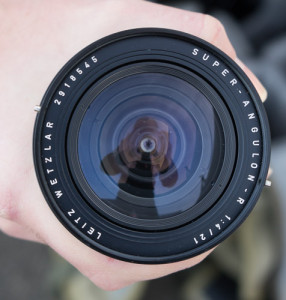
Typical performance for UWA lens of it’s era.
The center is very good from f/4, midframe is okayish and the corners are soft.
Stopped down to f/11 even the corners are sharp but not very much so. CA is controllled quite well.
My Canon nFD 2.8/20 is a better performer for a whole lot less money, but there are many other legacy lenses in the 20/21mm range which have worse corners.
Test
Leitz Wetzlar Elmarit-R 1:2.8/28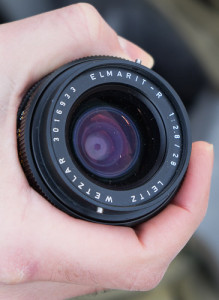
A pretty unremarkable performance, my 20 bucks Minolta MD 2.8/28 is slightly better.
At f/2.8 the center is a lillte soft, the midframe is noticeably worse and the corners are pretty bad.
It takes f/11 for the corners to sharpen up to very good levels.
Test
Leitz Summicron-R 1:2/50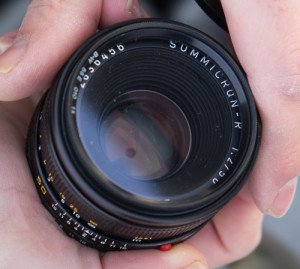
This lens showed an interesting performance pattern.
At f/2 the center is only ok, my other lenses like the Minolta MC 1.4/50 or Canon nFD 1.4/50 are noticeably sharper in the center at f/2. What is remarkable is that the corners are the best I have seen in any legacy 50mm lens at f/2.
At f/2.8 the center sharpens up a lot to excellent levels.
By f/4 the lens shows very good sharpness from corner to corner which is a stop earlier than I would expect from my Canons or Minoltas.
At F/5.6 it is excellent from corner to corner.
I think this is an excellent landscape lens but for general purposes I would prefer other lenses because of the under performing center at f/2. My analysis is based on the analysis of these infinity shot so my conclusion might be a different one if I would use it for actual shooting.
Test
Leitz Tele-Elmarit-M 1:2.8/90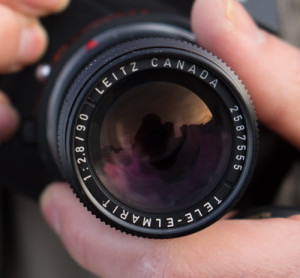
This is a very small lens with very good performance in the center and midframe from f/2.8 with a hint of purple fringing. The corners at f/2.8 are soft.
At f/4 the center improves to excellent levels, the other regions don#t see much improvement.
By f/11 the corners have reached a good level.
I think this lens will work quite well as a very compact portrait lens but for serious landscape work I would leave it at home.
Test
Leitz APO-Telyt-R 1:3.4/180
Writing about a lens is always easier when there are no defects to describe.
The lens shows excellent sharpness from f/3.4 corner to corner with only the smallest hint of CA in the corners.
Test
Conclusion
Based on these results I don’t get all the fuss about Leica lenses.
Sure, all lenses had a very nice finish, nicer than that of other manufacturers .
But if I look at the performance it is pretty similar to that of other lenses of the same era. The only lens which stood out was the 3.4/180 APO but I would suspect that a Nikon 2.8/180 ED AI-S isn’t any worse.
Of course there are other very important aspects about lenses which I couldn’t experience like bokeh, color and contrast or handling etc. but I would be surprised if these lenses performed that much better in these aspects than other lenses.
From what I have read and seen the more modern lenses from the 90’s and later are in fact often better than the designs of other manufacturers, but that’s not the case here.
This site contains affiliate links. If you make a purchase using any of the links marked as affiliate links, I may receive a small commission at no additional cost to you. This helps support the creation of future content.