Analogue Adventures – Part 20: Kodak Color Plus 200 ECN-2 processed

Kodak Color Plus 200

Even with the limited amount of different color negative films available these days Kodak manages to confuse the people by offering two different “low cost” ISO 200 daylight films: the Kodak Gold 200 (which I already had a look at here and here) and this Color Plus 200.
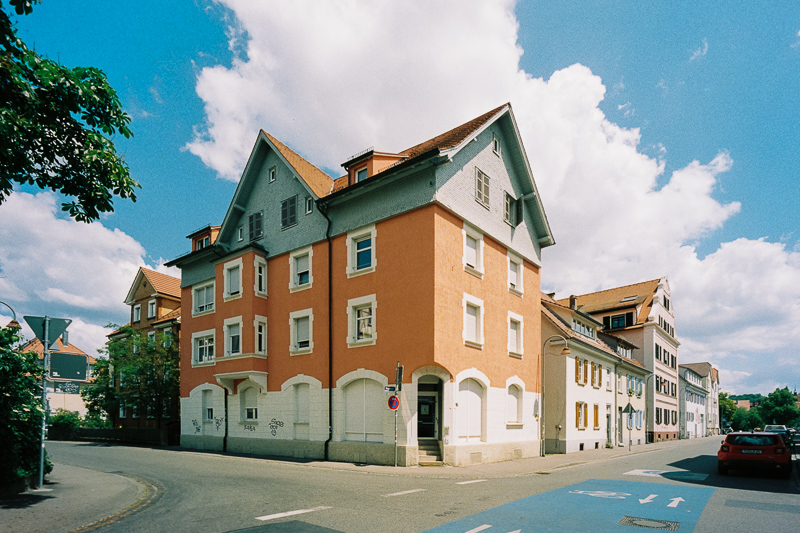
From what I gathered the Color Plus is based on older emulsion technology leading to slightly grainer and contrastier pictures, so let’s have a look at some samples.
Processing (ECN-2) and scanning was done at Silbersalz35 in Germany.

color plus 200 color+ kodak review m6 leica analogue analog
Leica M6 | MS-Optics 35mm 1.4 | f/2.8 | Kodak Color Plus 200 ECN-2
color plus 200 color+ kodak review m6 leica analogue analog
Leica M6 | MS-Optics 35mm 1.4 | f/2.8 | Kodak Color Plus 200 ECN-2
color plus 200 color+ kodak review m6 leica analogue analog
Leica M6 | MS-Optics 35mm 1.4 | f/8.0 | Kodak Color Plus 200 ECN-2
color plus 200 color+ kodak review m6 leica analogue analog
Leica M6 | MS-Optics 35mm 1.4 | f/2.0 | Kodak Color Plus 200 ECN-2
color plus 200 color+ kodak review m6 leica analogue analog
Leica M6 | MS-Optics 35mm 1.4 | f/2.8 | Kodak Color Plus 200 ECN-2

Continue reading Analogue Adventures – Part 20: Kodak Color Plus 200 ECN-2 processed

Review: KMZ Helios-44 58mm 2.0

Introduction

The Helios 44 is basically a copy of the Carl Zeiss Jena Biotar 58mm f/2, optically that is. At the beginning it was even called “БТК” – “БиоТар Красногорский” (BioTar Krasnogorski).  At the end of Wold War II the Russians took the Zeiss’ designs and materials back to Russia and copied them. The Soviet Union manufactured millions of this lens in different variants and it shipped as standard lens on many Soviet (Zenit) cameras.  KMZ (the same factory that made the Zenit cameras) started manufacturing this lens from 1945. The Helios 44 lenses have built a cult around themselves in modern days and have been very popular for portrait photography and videography, it is the number one vintage lens used for making videos on modern cameras. It is very popular for its image character, its clickless aperture, balanced center sharpness and not least its swirly bokeh. Let’s have a look!

Sample Images

Nikon Z6 | Helios 44 58/2 | f/2
Nikon Z6 | Helios 44 58mm f/2 | f/2

Continue reading Review: KMZ Helios-44 58mm 2.0

Review: 7Artisans 15mm 4.0 Asph

Introduction

7Artisans 15mm 4.0 asph uwa review sharpness coma vignetting 42mp 61mp sony a7riv a7r2 a7r3
7artisans 15mm 4.0 Asph on Sony A7rII

7Artisans are definitely busy with releasing new fullframe lenses and the latest addition is this 15mm 4.0 ultra wide angle lens. At first sight you may think this is a rebranded NiSi 15mm 4.0, because it shares focal length, maximum aperture and even its size is similar, but I can assure you this is not the case. So let’s find out which one is the better affordable 15mm lens.

Sample Images

7Artisans 15mm 4.0 asph uwa review sharpness coma vignetting 42mp 61mp sony a7riv a7r2 a7r3
Sony A7III | 7Artisans 15mm 4.0 | f/8.0
7Artisans 15mm 4.0 asph uwa review sharpness coma vignetting 42mp 61mp sony a7riv a7r2 a7r3
Sony A7III | 7Artisans 15mm 4.0 | f/8.0
7Artisans 15mm 4.0 asph uwa review sharpness coma vignetting 42mp 61mp sony a7riv a7r2 a7r3
Sony A7rII | 7Artisans 15mm 4.0 | f/8.0
7Artisans 15mm 4.0 asph uwa review sharpness coma vignetting 42mp 61mp sony a7riv a7r2 a7r3
Sony A7III | 7Artisans 15mm 4.0 | f/11
7Artisans 15mm 4.0 asph uwa review sharpness coma vignetting 42mp 61mp sony a7riv a7r2 a7r3
Sony A7III | 7Artisans 15mm 4.0 | f/5.6
7Artisans 15mm 4.0 asph uwa review sharpness coma vignetting 42mp 61mp sony a7riv a7r2 a7r3
Sony A7rII | 7Artisans 15mm 4.0 | f/5.6
7Artisans 15mm 4.0 asph uwa review sharpness coma vignetting 42mp 61mp sony a7riv a7r2 a7r3
Sony A7rII | 7Artisans 15mm 4.0 | f/8.0

Continue reading Review: 7Artisans 15mm 4.0 Asph

Analogue Adventures – Part 19: Fuji Superia X-Tra 400 ECN-2 processed

Fuji Superia X-Tra 400

Any film is hard to get these days, but the Fuji films are even harder to get than the Kodak ones here in Germay. Therefore I developed the habit of buying any type of color negative film I haven’t used before for this series – even when it means paying 20€ for just this one roll of Fuji Superia X-Tra 400.
Processing (ECN-2) and scanning was done at Silbersalz35 in Germany.

hologon leica m contax-g 16mm 8.0 8/16 center filter review sharpness leica m10 m11 sony e-mount adapter conversion sharpness distortion carl zeiss germany
Leica M6 | Hologon 16mm 8.0 | Fuji Superia X-tra 400 ECN-2
fuji fujifilm x-tra xtra 400 superior review m6 leica analogue analog
Leica M6 | MS-Optics 35mm 1.4 | f/8.0 | Fuji X-Tra 400 ECN-2
fuji fujifilm x-tra xtra 400 superior review m6 leica analogue analog
Leica M6 | MS-Optics 35mm 1.4 | f/2.0 | Fuji X-Tra 400 ECN-2
fuji fujifilm x-tra xtra 400 superior review m6 leica analogue analog
Leica M6 | MS-Optics 35mm 1.4 | f/2.0 | Fuji X-Tra 400 ECN-2
fuji fujifilm x-tra xtra 400 superior review m6 leica analogue analog
Leica M6 | MS-Optics 35mm 1.4 | f/4.0 | Fuji X-Tra 400 ECN-2

Continue reading Analogue Adventures – Part 19: Fuji Superia X-Tra 400 ECN-2 processed

Review: Tamron SP AF 90mm F2.5

Introduction

Tamron SP AF 90mm f/2.5 on Nikon Z6

Tamron made a big impression on the market when they launched their SP 90mm F/2.5 back in 1979. Small, flexible and very sharp. It is originally designed for 35mm cameras (full-frame) but can also be used on APS-C cameras with an equivalent focal length of 135mm. It is a classic dual purpose 90mm macro lens. The lens manages to do a 1:2 magnification, almost macro and many call it for a macro lens although Tamron themselves did not do that and only talked about it as “a medium telephoto portrait lens”.  (They called the previous versions, also with 1:2 magnification, “tele-macro” though.) Anyhow, it has long been the general opinion that it has very good close-up capabilities and it can do 1:1 macro with some help as we will see. It is also very suitable for use as a portrait lens at normal distances. The lens has been updated several times since its first release and changed look and optical formula during over 40 years of its existence. Each new version could have an additional feature, improved optical performance, just a cosmetic update, or a combination of them. We are going to look at the first AF version of this lens from 1990. The lens has been made with native mounts for Nikon F, Pentax K and Minolta/Sony A. I test a Nikon mount lens mostly on a FF mirrorless Nikon Z6 and APS-C DSLR Nikon D7200  (F mount) but I also include images taken with FF DSLR Nikon D600 (also F mount).

Sample Images

Nikon D600 | Tamron AP AF 90mm f/2.5 | 2.5

Nikon D600 | Tamron AP AF 90mm f/2.5 | 7.1 | Focus stacked from 11 images

Nikon D600 | Tamron AP AF 90mm f/2.5 | 3.3

Continue reading Review: Tamron SP AF 90mm F2.5

Sony α | Leica M | Nikon F/Z New article every week