Introduction
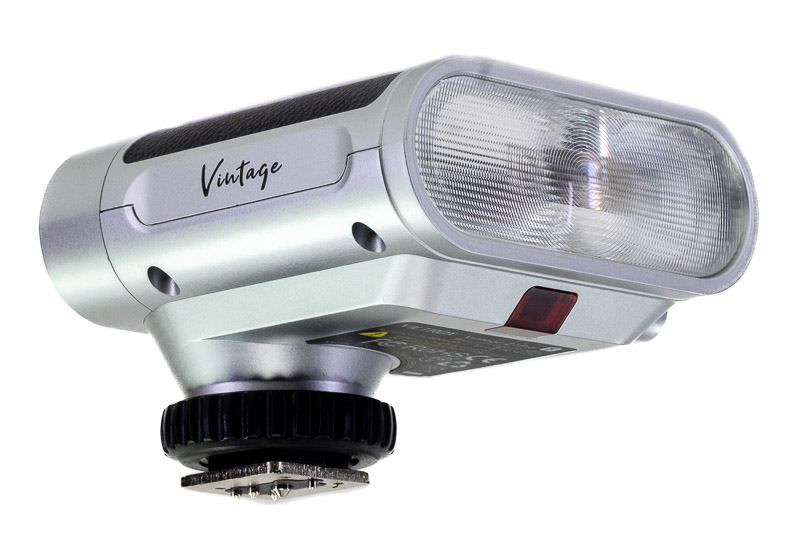
Viltrox previously released the retro-styled, fully manual Vintage Z1 flash. Now the company has followed it up with a significantly improved model that adds features such as High-Speed Sync (HSS) and support for both Manual and Auto TTL modes.
Let’s have a look at this new flash.
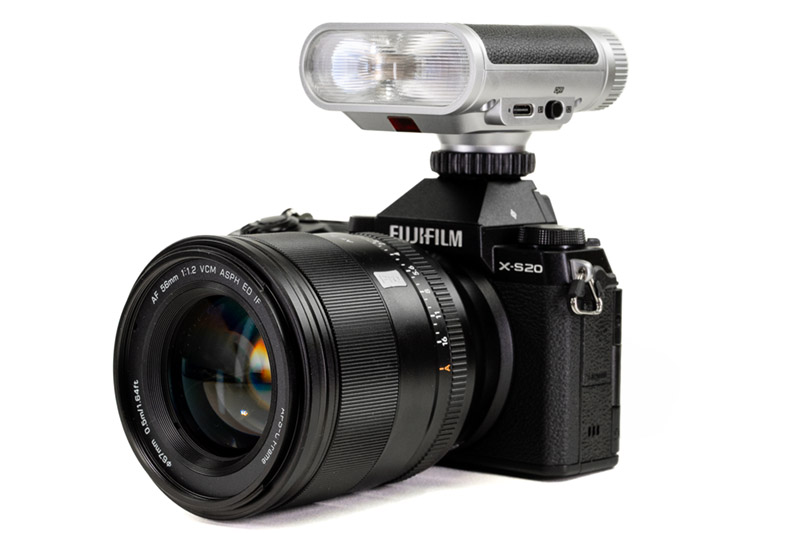
 I tested this flash on a Fujifilm X-S20. Macros with a Raynox DCR-250 attached to a Viltrox 56mm f/1.2
Sample Images






Specifications
| Model Name | Vintage Z1 | Vintage Z1 Pro |
| Flash mode | M (Manual) | M (Manual) / A (TTL Auto mode) |
| Available for | – | Nikon, Sony, Canon, Fujifilm |
| Flash Output levels | 7 levels (1/1 – 1/64) in full-stop increments | 7 levels (1/1 – 1/64) – in 1/3 stop increments |
| HSS (High-Speed Sync) | No | Yes |
| Power (1/1 output) | 23Ws | 24 Ws |
| Flash duration T0.5 | 1/5000 s – 1/50000 s | 1/3000 s – 1/50000 s |
| Colour Temperature | 6500K (±200K) | 6000K (±200K) |
| Trigger | Hot shoe, Wireless trigger (S1 synchronous trig. mode and S2 pre-flash avoidance trig. mode) | Hot shoe, Wireless trigger (S1 synchronous trig. mode and S2 pre-flash avoidance trig. mode) |
| Flash Count | 400 times (1/1 power) | 350 times (1/1 power) |
| Power | Built -in Lithium Battery (3.7 V, 1100 mAh) | Built -in Lithium Battery (3.7 V, 800 mAh) |
| Charging Method | USB-C contact 5V/2A (About 70 min) | USB-C contact 5V/0.8A (About 70 min) |
| Coverage | 28mm focal lenght (≈18mm APS-C) | 28mm focal lenght (≈18mm APS-C) |
| Size & Weight | 68,5 x 50,2 x 74 mm, 116 g | 68,5 x 72.8 x 50,2mm, ≈136 g |
| Buy new: YouTube video here, Amazon $52 (Affiliate links) |
Buy from: Viltrox Store, Amazon $60
Disclosure
Viltrox kindly provided a flash for review purposes.
Handling
The Viltrox Flash Z1 is a compact unit made—like most flashes—of hard plastic.
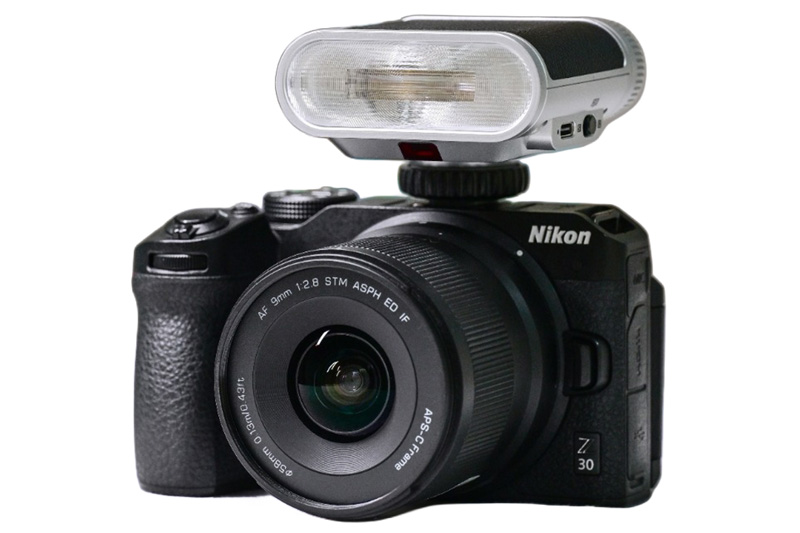
It works in both Manual and Auto TTL modes for Sony, Nikon, Canon, and Fujifilm cameras, though you’ll need the correct version for your camera system.
On the rear are a control wheel, power button, ready light, and LED display.
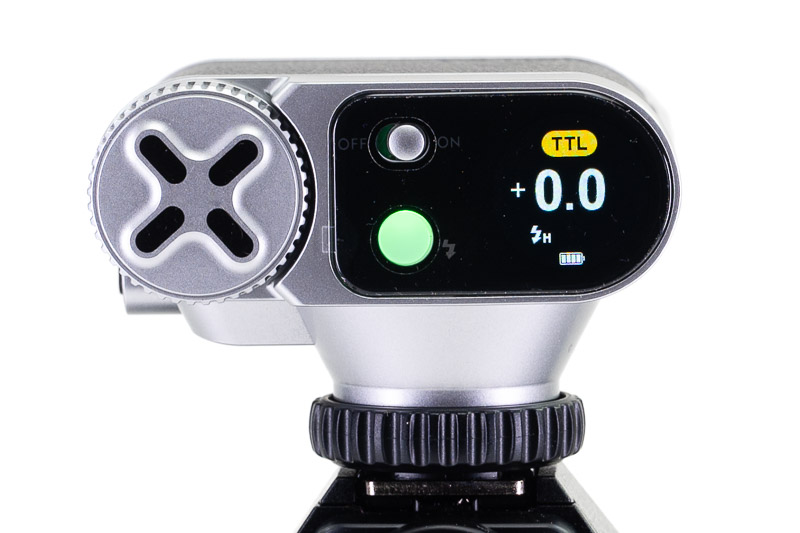
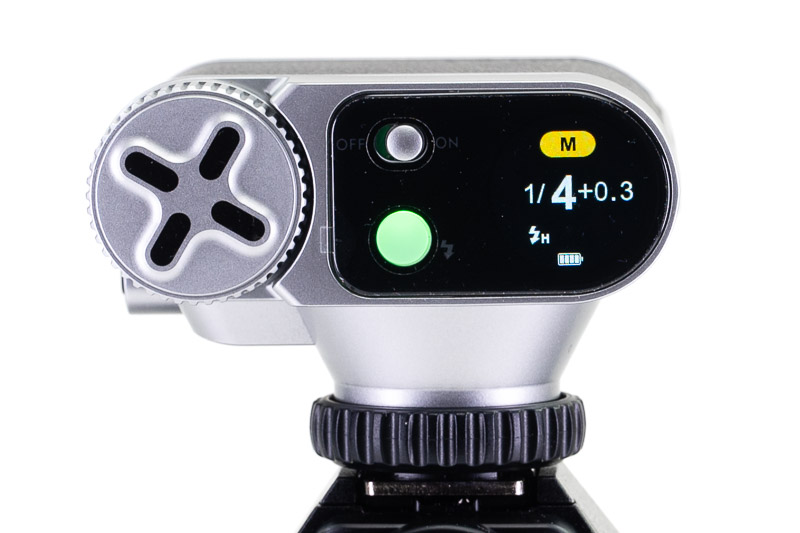
Clicking the control wheel switches between Manual and TTL Auto modes. In Manual mode, turning the wheel adjusts flash power from 1/1 to 1/64 in 1/3-stop increments. In TTL Auto mode, the same wheel controls flash exposure compensation in 1/3-stop increments.
The flash-ready light turns green when the flash is ready to fire and red otherwise. It also functions as a test flash button; pressing it fires the flash.
On the left side of the flash is a switch for selecting S1 or S2 triggering modes, along with a USB-C port for charging the built-in battery. According to Viltrox, the battery is rated for up to 350 full-power flashes or 10,000 bursts at 1/64 power.
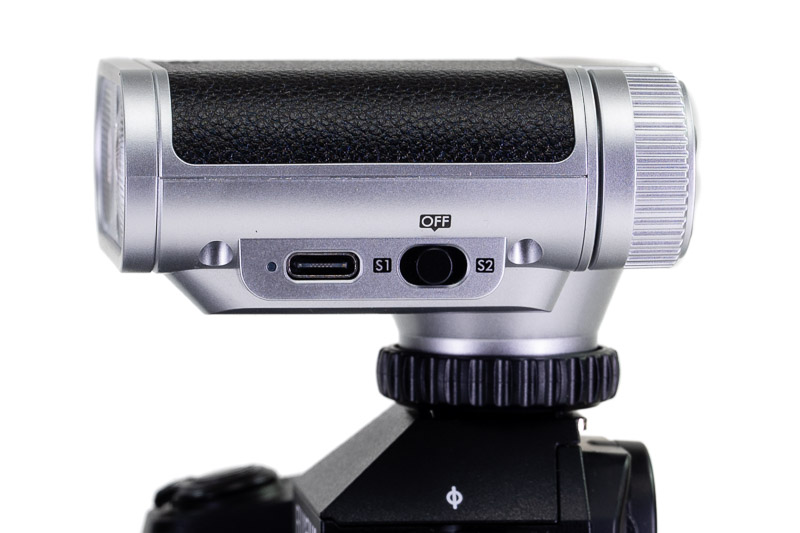
The flash can be triggered either directly via the hot shoe or wirelessly through the built-in optical sensor using another flash. S1 mode synchronizes the flash to fire with the first burst of the master flash, while S2 mode ignores the pre-flash used in TTL setups and synchronizes with the second burst instead. Note that the wireless modes work only in Manual mode.
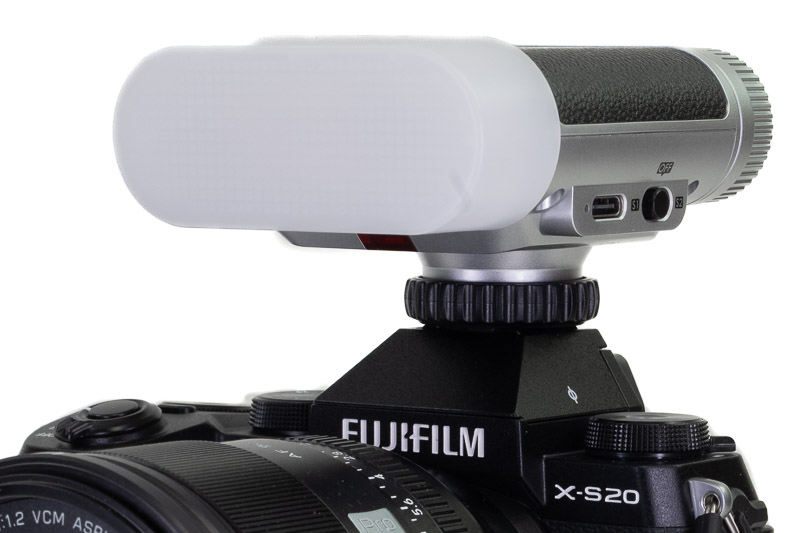
The flash head has no tilt or swivel capability. However, a snap-on white diffuser is included to soften and diffuse the otherwise harsh direct light.
Field Experience
I enjoyed using this flash in many situations. Comparing the specifications with the previous model reveals the many improvements in this new flash. The biggest new feature is the High-speed sync (HSS), which enables you to use the flash at any shutter speed, not only up to 1/60 s, 1/125 s, or 1/250 s, but also at up to 1/4000 s.

Just for comparison, here is an image taken with a flash without HSS support at 1/500 sec:

Let’s start with some of the positives. The flash is as small as the previous flash, which makes it easy to carry around. For example, I use a shoulder bag that fits two cameras with lenses attached, but leaves no space for extra lenses. Even so, I was able to slip this little flash in and carry it comfortably during a full day of walking and shooting.

The flash can be very useful for macro photography.

It’s quite powerful for its size, which is a real plus. The built-in battery is good, rated for about 350 full-power bursts and about 10,000 bursts at its smallest power, so in a real-life normal situation, where you use it at different power, it should last for a couple of thousands busrts—more than anyone would realistically need. Charging takes a little over an hour (around 70 minutes), which is quick. You can also shoot with a power bank attached, effectively multiplying the number of flashes. This setup saves you from having to buy and carry external batteries, swap them when they run flat, or deal with disposing of used ones after long periods of storage.
It has manual mode, which is useful in many situations, and many photographers prefer it for full control. It can also be used off-camera wirelessly, triggered by the burst of another flash. When used off-camera, it can be triggered in S1 and S2 modes, for triggering by the first flash and by skipping the first flash of many speedlights that have a pre-flash.
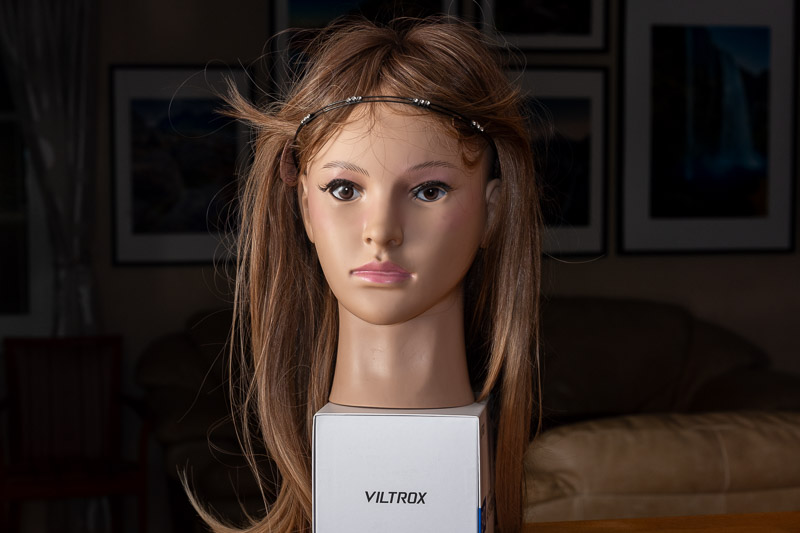
Here is the same scene with the flash on the camera
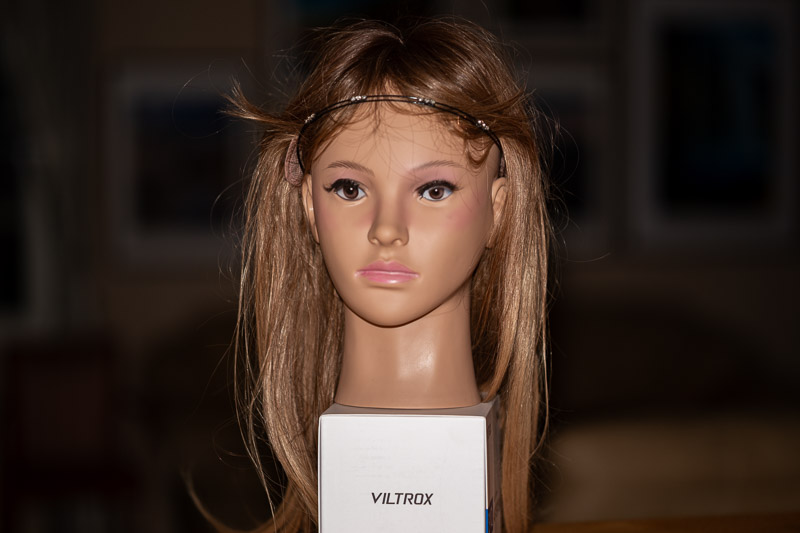
The connection to the camera has a wheel-style lock, which is very sturdy; none of Nikon’s own flashes are locked this tightly on the camera.
It can be used as a small main flash, as a fill flash, and as a macro flash. TTL works quite well in most common situations.

But it’s not all roses—while vastly improved, it still has some limitations.
When it comes to the diffuser, don’t expect it to significantly soften the light. All it really does is reduce the light’s intensity and spread it in all directions in front of the camera. To truly soften flash, the light source itself has to become larger—something this diffuser doesn’t do.
Another common technique is bouncing the flash off a ceiling or wall. In that case, a diffuser can help by spreading the light, allowing the reflected surface to become the larger light source. Unfortunately, since this flash can’t tilt or swivel, that option isn’t available here.
However, in a room with a white ceiling and light-colored walls, the light can become slightly softer because the diffuser spreads light beyond the direct path of the flash. If there’s enough space between the flash and the subject, some light will bounce off the ceiling and walls before reaching the subject, though it’s still far less effective than tilting the flash upward with a diffuser attached.
Here is the same scene in a small room with white ceilings and walls, using TTL (with and without exposure compensation), both with and without the diffuser.
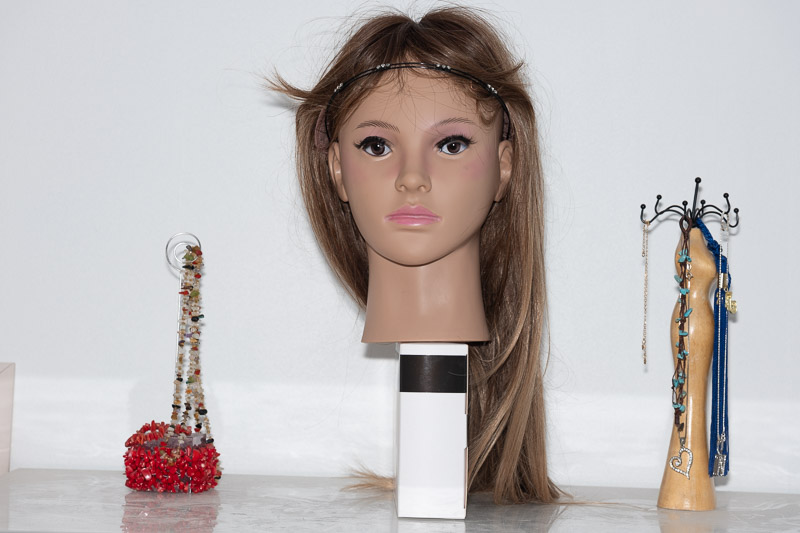


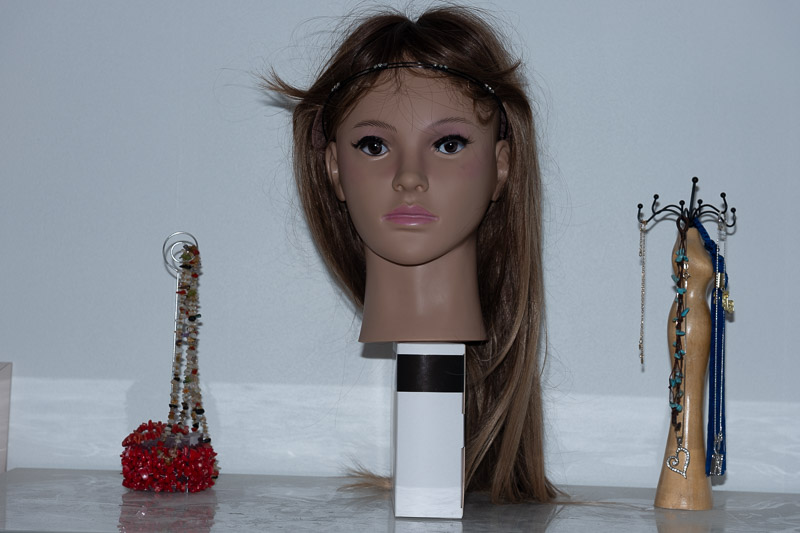
One more thing worth mentioning is the recycling time. I can’t measure it precisely with some fancy setup connected to a chronograph, but I can get fairly close estimates. At full power, the flash takes a little over one second to recycle.
When I used it with the mechanical shutter on the Fujifilm X-S20, which shoots at 8 fps, the flash could not keep up with continuous shooting, as expected. Here is a summary of how often it could fire at different power levels with the battery about half full:
- 1/1 (full power): fired on every 9th frame (frames 1, 10, 19, 28, …), that works out to just over one second between flashes (≈1.125 sec).
- At 1/4: It could fire on every 5th frame (1, 6, 11, 16, 21,..)
- At 1/8: Every third frame (1, 4, 7, 11, …)
- At 1/16: Every third frame (1, 4, 7, 11, …) that works out to just over 333 ms per recycling (≈0.35 to 0.40 sec)
I tested the 1/16 power even at a rate of 3fps and got the same estimates.
While those numbers may look bad at first glance, they are actually about what you would expect from a standard hot-shoe flash. Full-power recycle times are typically between 1.5 and 3 seconds, while this Viltrox managed roughly 1.125 seconds, which is very fast for its class. The best-in-class flashes can recycle in around 0.9 to 1.5 seconds at full power and roughly 0.1 second at 1/16 power.
Of course, there are exceptions — beasts like the Canon Speedlite EL-1, Profoto A10 / Profoto A1X, or Godox V1 Pro / Godox V860III can do much better. But then we are talking about much larger units with price tags that are 4 to 20 times higher than this flash.
Conclusion
This is a compact flash that fits almost anywhere and takes up very little space in your bag. It’s useful in a wide range of situations: as a fill flash during the day, for backlit subjects, to freeze fast action in low light, in macro photography, for nighttime shots of nearby subjects without a tripod, to illuminate faces in dim environments, or to counter harsh shadows from overhead lighting, ceilings, or street lamps.
It’s also quite powerful for its size, offers good battery performance, and can be triggered wirelessly off-camera via the built-in optical trigger. The biggest advantage is High-Speed Sync—a feature normally found only on much more expensive professional flashes.
Of course, it does have limitations, as mentioned earlier—most notably the fixed head, lack of radio-frequency wireless triggering, and absence of a zoom head. A flash without these compromises would cost considerably more, and if you plan on doing serious strobist work, you’ll likely want to look at more advanced options.
That said, considering its size and price, this flash offers excellent value for money, with features typically found only in much more expensive professional flashes—and is arguably the best flash Viltrox has made to date.
| Buy from: Viltrox Store, Amazon $60 (Affiliate links). |
Alternatives
Viltrox Vintage Z1
You can see the specs and compare it with the reviewed flash, but it is the predecessor with neither HSS nor TTL. Although it can also be set at different power levels, but only be set in full stop increments.
Buy new: Viltrox Store, Amazon $45 (Affiliate links)
Viltrox Spark Z3
Another flash from Viltrox, with TTL, but no HSS. Power levels and TTL flash compensation in full stop increments, a very good flash.
Buy new: Viltrox Store, Amazon $55 (Affiliate links)
Nikon SB-400 (for Nikon Owners)
This is an older flash for Nikon cameras, about the same size and weight. The given guide number is 20, but in practice, I have estimated it to be about 14 or 15, so it is more powerful. Its other advantages are that it has a tilt head, but it can be tilted upwards only for softer light. It has rear-curtain sync, slow-sync, and red-eye reduction mode. It uses two AA batteries to power the flash. On the other hand, the Viltrox has an internal battery, is less powerful, can be triggered remotely, supports HSS, and has manual control levels.
Get it at: eBay.com, eBay.de from $70 (Affiliate link)
Godox iT30 Pro
A tiny flash, smaller than the Viltrox, which also supports HSS and can be triggered via built-in 2.4 GHz radio (both as master and slave). It is a little more powerful as well (GN15 vs Z1 Pro’s GN 12), but at a higher price.
Buy: Amazon $80 (Affiliate link)
Godox TT350
While compact, this is a larger and heavier flash than the reviewed Viltrox. It is powered by two AA batteries, which last for about 200 flashes. It is a much more advanced flash than the Viltrox and Nikon, though. Its head is both rotatable and swivel-capable. It, like the Viltrox, has an optical sensor for wireless operation, but it can operate in TTL in that mode. In addition to that, it also has a Radio frequency trigger and can be operated both as a slave and a master flash. It also has manual mode, and in that mode, you can control the power between 1 to 1/128 in 1/3 EV steps. It also has first/second curtain sync and high-speed sync. It also has a zoom head that automatically adjusts for 24 to 105mm; the given guide number is 36 at ISO 100 (head at 105mm position). It is more expensive, though, at about $76.
So, much more advanced, but larger, heavier, and more expensive.
Get it at: Amazon, B&H for $76 (Affiliate link)
Sample Images


Most of the sample images in this review and many more can be found in higher resolution here.
| Buy new: Viltrox Store, Amazon $52 (Affiliate links) |
Further Reading
- What camera gear and accessories do I use most frequently?
- REVIEW: Viltrox Spark Z3 Flash
- REVIEW: FotoPro Origin Plus Travel Tripod
- Review: Walkingway Effect Filters: Black Mist, Streak, Star, Prism, and Soft Filters
- Review: TTArtisan Dot Sight
Support Us
Did you find this article useful or did you just like reading it? It took us a lot of time and money to prepare it for you. Use the Donate button to show your appreciation!



(Donations via Paypal or bank card)
What’s in my camera bag? MY 2024 KIT!!
- Main camera : https://amzn.to/3TsGtKg
- Camera grip : https://amzn.to/4e0G3CR
- Memory Card 1: https://amzn.to/47pA20i
- Memory Card 2 : https://amzn.to/3XHYxlZ
- Camera 2 : https://amzn.to/3Xifou8
- Camera grip: https://amzn.to/4dYYpV9
- Memory card 1: https://amzn.to/4e5h2H0
- Memory card 2: https://amzn.to/3zu7W7n
- Small travel tripod: https://amzn.to/4goIX68
- Mini tripod: https://amzn.to/4e09XXX
- Small shoulder bag: https://amzn.to/47tPMiY
- Medium shoulder bag: https://amzn.to/4ej4bjY
This site contains affiliate links, for which I may receive a small commission if you purchase via the links at no additional cost to you. This helps support the creation of future content.


Martin
Latest posts by Martin (see all)
- REVIEW: SIRUI AURORA 35mm F1.4 - October 14, 2026
- REVIEW: Zhiyun FIVERAY M60 Ultra & Molus X100 RGB - October 11, 2026
- Analogue Photography: Part 7 — Gran Canaria with Kodak Portra 400 - September 30, 2026
Nice little review a skillful usage of the flash. I would not have guessed there was flash used in those sample pictures!
Thanks a lot, Jan.
The interesting thing is that most of the images were taken as JPGs only (no RAW files). I specifically wanted to limit the ability to recover shadows in post. That’s where flash really comes into its own — much like when we used color slide film, where you had to get it right in-camera.
Bonjour
Thank you for the not all roses flash!
In stead of the Godox TT 350, perhaps you can take a look at the Godox iT30 Pro.
A very small flash, that works great with the radio trigger X3 from Godox. It’s a very small trigger that als works with the bigger TT flashes or the Godox AD series.
A flash is very useful if you want to avoid working with RAW files afterward. You can shoot JPG only and have photos that are ready to share straight out of camera on Instagram, Facebook, or with friends and family.
Bonjour,
Good tip, thanks. I’ll add it to the alternatives.
Hi Martin! Excellent review – can you say anything about the refresh speed at full power (how soon it can fire again)?
Thank you!
Thanks Jester.
That is a good point that I missed to include, I’ll add it to the review,
the recycling time at full power is just over 1 sec (about 1.125 sec).
For full detail and the description see the review, just before the Conclusion section.
Hi,
thanks for this review. I choose a compact flash for my travel set fujifilm xt50 + sigma 18-50. Mainly I shoot for my travel blog. I choose between Viltrox z1 pro and Godox it32. I like how compact viltrox flash is but I also understand its limitations. On other hand Godox is bigger and 2x more expensive. My doubts are will I take Godox with me so ofter as smaller and lighter viltrox? Do I really need rotating flash head for my shooting scenarios?
It comes down to two questions in the order I put it
1. Do you use the rotating head feature for your travel photos?
2. How highly do you appreciate the compactness over feature?
The first question can depend on what kind of subjects do you photograph? And in which environment? Having that rotating head any advantage where you use it? How often do you use it?
Answering these questions helps you de decide, I hope.