Category Archives: Uncategorized

What I learned from shooting nothing but a $25 lens on my a7II for a month

When I decided to use only my 45-years-old Minolta MC 1.7/55 in February I had only one basic idea: I wanted to get out of my comfort zone because I know that I improve my skills much faster in anything if I can’t rely on my routines. And I guess I was also curious how I would fare without all the fancy gear I normally use.

My lens cabinet with most but not all my lenses. I think I can safely say that I am a gear head.

During the project I tried to take pictures everyday and I also created additional challenges for myself: One day I only allowed myself to take 5 pictures and on another I had to photograph in conditions I had little experience in.

1. It was much easier than I anticipated

Continue reading What I learned from shooting nothing but a $25 lens on my a7II for a month →

Review: Nikon 75-150mm 3.5 Series E

Introduction

nikon series e z00m 75-150mm 3.5 metabones adapter a7 lowcost lens
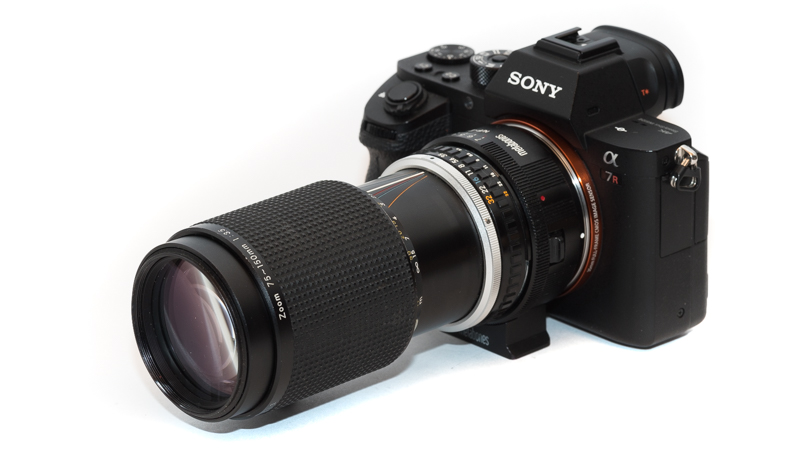
Sony A7rII with Metabones adapter and Nikon Series E 75-150mm 3.5

The Series E lenses were meant as a low cost alternative to the more expensive yet reknown Nikkor lenses. This didn’t work out so well for Nikon, at that time many people were simply not interested in “cheap” lenses made mostly from plastic. Nevertheless, some of these lenses are quite good optically, therefore I take a look at the Nikon Series E 75-150mm 3.5 zoom lens.

Sample Images

nikon series e zoom 75-150mm 3.5 metabones adapter a7 lowcost lens lens flare ghost ghosts veiling glare
Sony A7rII | Nikon Series E 75-150mm 3.5 | 150mm | f/3.5 | full resolution
nikon series e zoom 75-150mm 3.5 metabones adapter a7 lowcost lens lens flare ghost ghosts veiling glare
Sony A7rII | Nikon Series E 75-150mm 3.5 | 75mm | f/5.6 | full resolution
nikon series e zoom 75-150mm 3.5 metabones adapter a7 portrait lowcost lens lens flare ghost ghosts veiling glare
Sony A7s | Nikon Series E 75-150mm 3.5 | 150mm | f/3.5 | full resolution

Continue reading Review: Nikon 75-150mm 3.5 Series E →

The manual photographers series part 2: Martijn Kort

In this series we interview amateur photographers just like us, who inspire us and who share our passion for photographing with manual lenses.

martijn kort photography aerial amsterdam netherlands holland
Samyang 12mm 2.8 Fisheye

Hi Martijn,
can you tell us a little bit about yourself and why you use manual Lenses?

I’m Martijn Kort (33), photographer and airline captain from the Netherlands. About 6 years ago I got my first DSLR and this started my journey to search for the perfect picture. I studied the technical side of photography for a long time. Learning the different techniques, understanding why something happens and how to achieve a certain look. I was looking closely at other photographers work, trying to understand how and why they got the photo they displayed. This gave me a strong base to professionalize my photography and to find my style and Since 2016 I’m an ambassador for ZEISS, which I’m very proud off.

martijn kort photography aerial amsterdam netherlands holland
Zeiss Milvus 21mm 2.8

Continue reading The manual photographers series part 2: Martijn Kort →

Limitations of the electronic shutter function

Introduction

All full frame E-mount cameras (except for the A7r) feature an electronic shutter in addition to the mechanical shutter. While most of them only offer an “electronic first curtain shutter” the A7s(II) and and A7rII even offer a completely silent, purely electronic shutter. But there are unfortunately some limitations you should be aware of.

electronic shutter efcs efc problems comparison sony a7 cameras
Nikon D40 | AF-S 55-200mm 4.0-5.6 | f/5.6

Continue reading Limitations of the electronic shutter function →

Leica R mount lenses

Some time ago I had the chance to put several older Leica lenses to the test, here are the results.

I have never actually used any of these lenses, I just had them for a couple of minutes to shoot a test series.

I only had one copy per lens so my results might not be representative for other lenses,

Leitz Super-Angulon-R 1:4/21SuperAngulon21
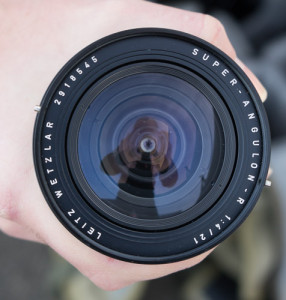
Typical performance for UWA lens of it’s era.

The center is very good from f/4, midframe is okayish and the corners are soft.

Stopped down to f/11 even the corners are sharp but not very much so. CA is controllled quite well.

My Canon nFD 2.8/20 is a better performer for a whole  lot less money, but there are many other legacy lenses in the 20/21mm range which have worse corners.

Test

Leitz Wetzlar Elmarit-R  1:2.8/28Elmarit28
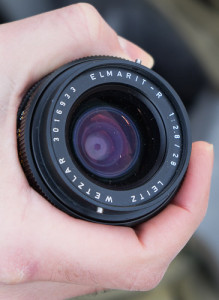
A pretty unremarkable performance, my 20 bucks Minolta MD 2.8/28 is slightly better.
At f/2.8 the center is a lillte soft, the midframe is noticeably worse and the corners are pretty bad.
It takes f/11 for the corners to sharpen up to very good levels.

Test


Leitz Summicron-R 1:2/50Summicron50
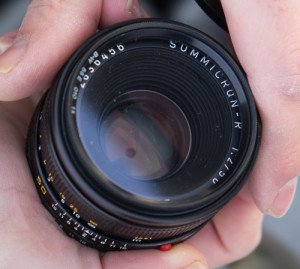
This lens showed an interesting performance pattern.

At f/2 the center is only ok,  my other lenses like the Minolta MC 1.4/50 or Canon nFD 1.4/50 are noticeably sharper in the center at f/2. What is remarkable is that the corners are the best I have seen in any legacy 50mm lens at f/2.

At f/2.8 the center sharpens up a lot to excellent levels.

By f/4 the lens shows very good sharpness from corner to corner which is a stop earlier than I would expect from my Canons or Minoltas.

At F/5.6 it is excellent from corner to corner.

I think this is an excellent landscape lens  but for general purposes I would prefer other lenses because of the under performing center at f/2. My analysis is based on the analysis of these infinity shot so my conclusion might be a different one if I would use it for actual shooting.

Test

Leitz Tele-Elmarit-M 1:2.8/90Elmarit90

This is a very small lens with very good performance in the center and midframe from f/2.8 with a hint of purple fringing. The corners at f/2.8 are soft.

At f/4 the center improves to excellent levels, the other regions don#t see much improvement.

By f/11 the corners have reached a good level.

I think this lens will work quite well as a very compact portrait lens but for serious landscape work I would leave it at home.

Test

Leitz APO-Telyt-R 1:3.4/180telyt180apo

Writing about a lens is always easier when there are no defects to describe.

The lens shows excellent sharpness from f/3.4 corner to corner with only the smallest hint of CA in the corners.

Test


Conclusion

Based on these results I don’t get all the fuss about Leica lenses.

Sure, all lenses had a very nice finish, nicer than that of other manufacturers .

But if I look at the performance it is pretty similar to that of other lenses of the same era. The only lens which stood out was the 3.4/180 APO but I would suspect that a Nikon 2.8/180 ED AI-S isn’t any worse.

Of course there are other very important aspects about lenses which I couldn’t experience like bokeh, color and contrast or handling etc. but I would be surprised if these lenses performed that much better in these aspects than other lenses.

From what I have read and seen the more modern lenses from the 90’s and later are in fact often better than the designs of other manufacturers, but that’s not the case here.


This site contains affiliate links. If you make a purchase using any of the links marked as affiliate links, I may receive a small commission at no additional cost to you. This helps support the creation of future content.