Introduction
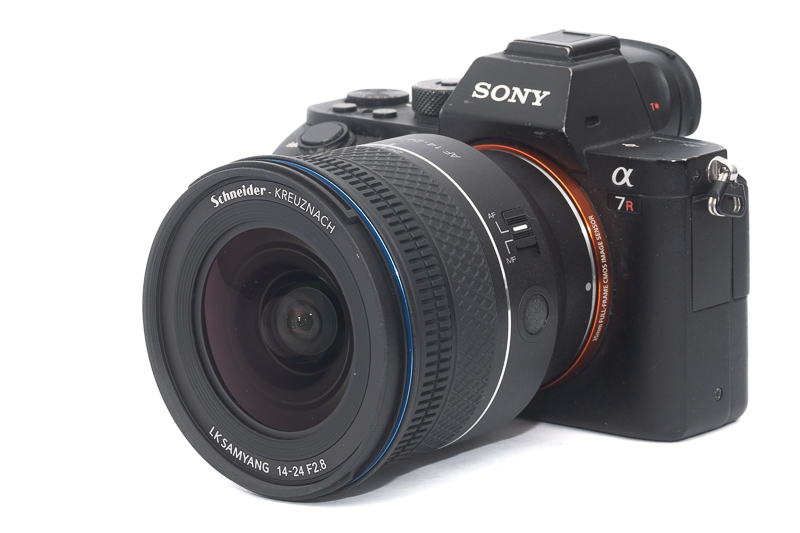
Released in 2007, the Nikon AF-S 14-24mm 2.8G was the first ultra wide angle zoom combining a 14-24mm viewing angle with a maximum aperture of f/2.8. Coming in at almost 1 kg, many people considered it to be too heavy to carry around all day and that bulbous front element didn’t help either. Almost two decades later Samyang decided to show us what the advantages can be, designing a lens with the same specifications, but for today’s mirrorless cameras. Let’s have a look together at the smallest and lightest 14-24mm 2.8 lens – that even comes with a standard 77mm filter thread – the Samyang x Schneider Kreuznach AF 14-24mm 2.8 FE.
Sample Images
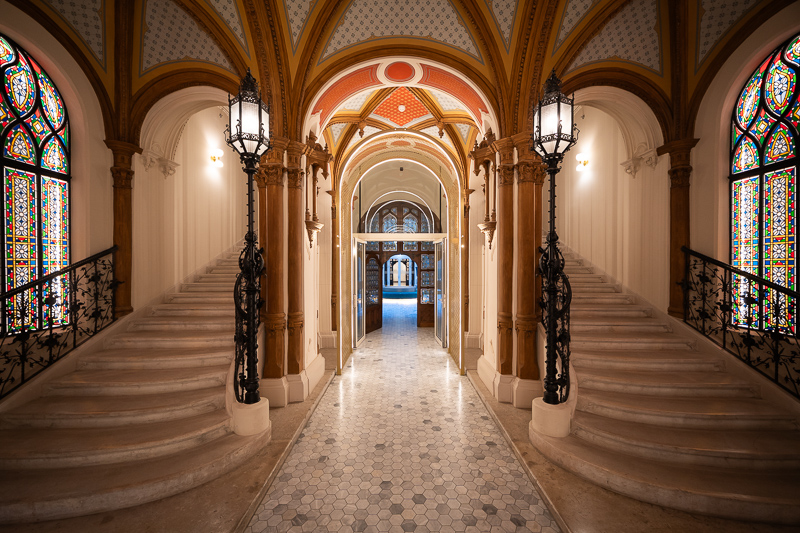



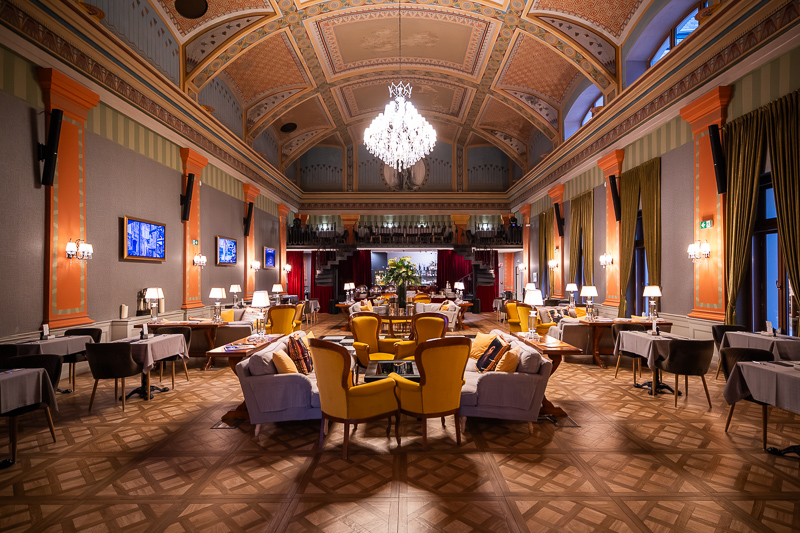


Many of the sample images in this review can be found in full resolution here.
Specifications
The Schneider Kreuznach x LK Samyang AF 14-24mm 2.8 FE has the following specifications:
-
- Diameter: 89 mm
- Field of view: 84.1° to 114.2° (diagonally)
- Length: 90 mm
- Weight: 443g (without hood[16g], without caps)
- Filter Diameter: 77 mm
- Number of Aperture Blades: 9 (rounded)
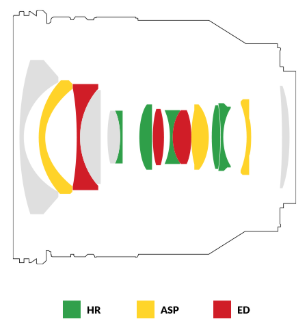
- Elements/Groups: 15/11
- Close Focusing Distance: 0.18 m
- Maximum Magnification: 1:3.4 (at 24mm) 1:6.5 (at 14mm)
- Mount: Sony-E
- Released: 2025
buy from amazon.com | amazon.de | ebay.com | ebay.de | B&H (advertisement/affiliate links) for $959
Disclosure
This Samyang AF 14-24mm 2.8 FE was kindly provided free of charge by our reader Lars (check out some of his pictures on Instagram) for review purposes, thanks a lot!
Schneider Kreuznach x LK Samyang
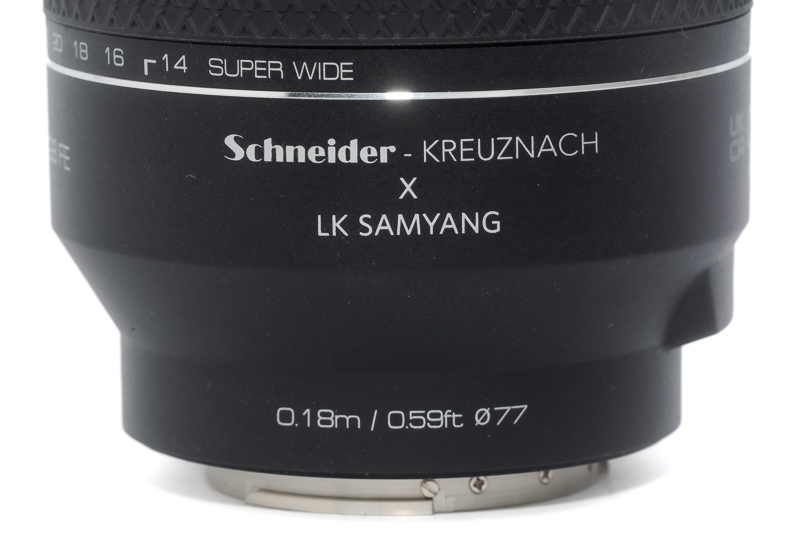
Most of you have probably already heard of the Korean lens manufacturer Samyang. In 2024 that name was changed to LK Samyang where LK apparently stands for “Leading Korea”.
In 2025 a collaboration/partnership with Schneider-Kreuznach was announced. According to the Schneider-Kreuznach hompage, the work is split like this:
- LK Samyang is responsible for product development, manufacturing, quality assurance, marketing, sales, and customer service.
- Schneider-Kreuznach contributes its expertise in the form of optical design reviews, metrological analyses, and product fine-tuning. The company also evaluates and tests products to ensure they meet the highest standards.
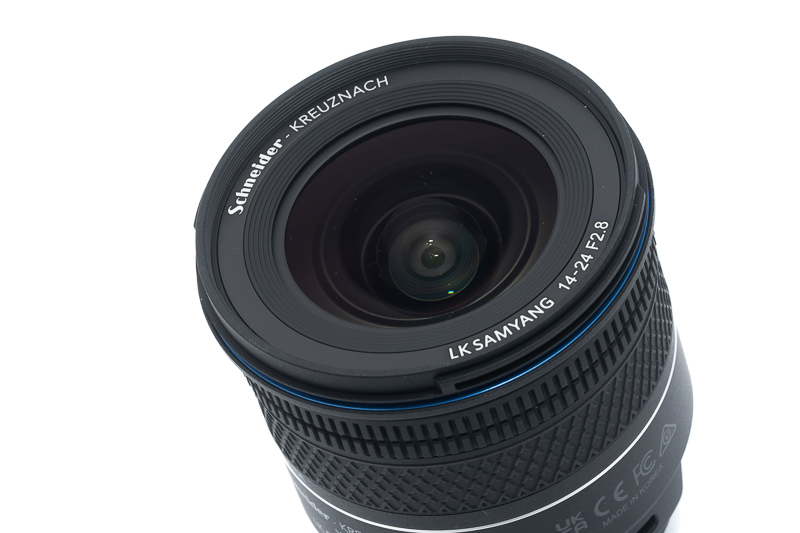
As far as I can remember, this Samyang AF 14-24mm 2.8 FE was the first lens with that branding and its casing also looks different compared to previous Samyang lenses. It features a blue ring at the front instead of a red ring, which we saw on some Samyang lenses in the meantime.
Handling / Build Quality
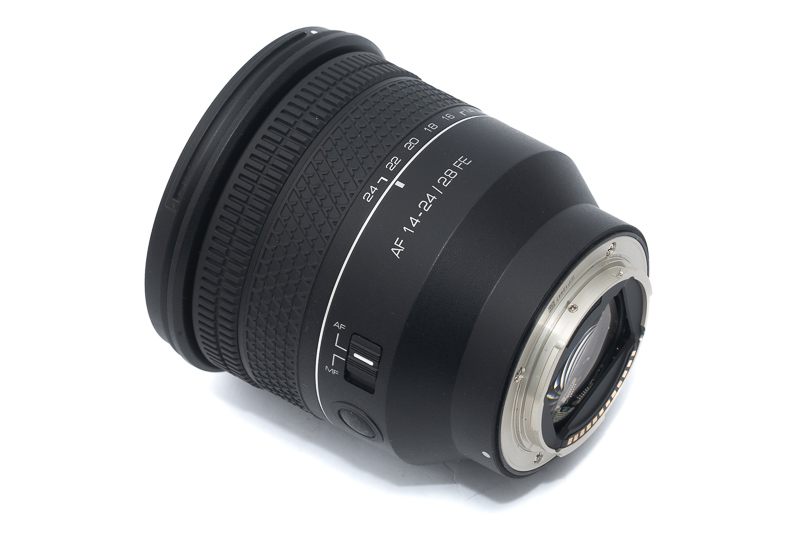
This Samyang AF 14-24mm 2.8 FE has a slightly different casing design compared to previous Samyang lenses. Most notable are the patterns on the rubberized zoom and aperture rings which are certainly unique. The casing seems to be mostly made from polycarbonate which feels same as on other recent Samyang lenses like the Samyang AF 135mm 1.8 FE.
The focus ring is situated at the front of the lens. It is focus by wire and it takes around 90° from the minimum focus distance of 0.18 m to infinity. The ring has a linear coupling but also a low resistance and therefore isn’t overly pleasant to use.
The zoom ring is situated closer to the camera and has markings for 14, 16, 18, 20, 22 and 24 mm. This sample does not show any zoom creep, but this sample seems to be very new, so it may develop over time. This is also not a parfocal zoom, if you change the focal length, focus needs to be adjusted.
On the side we also have a lens button and an AF/MF switch. Contrary to previous Samyang lenses this does function as an AF/MF switch by default.
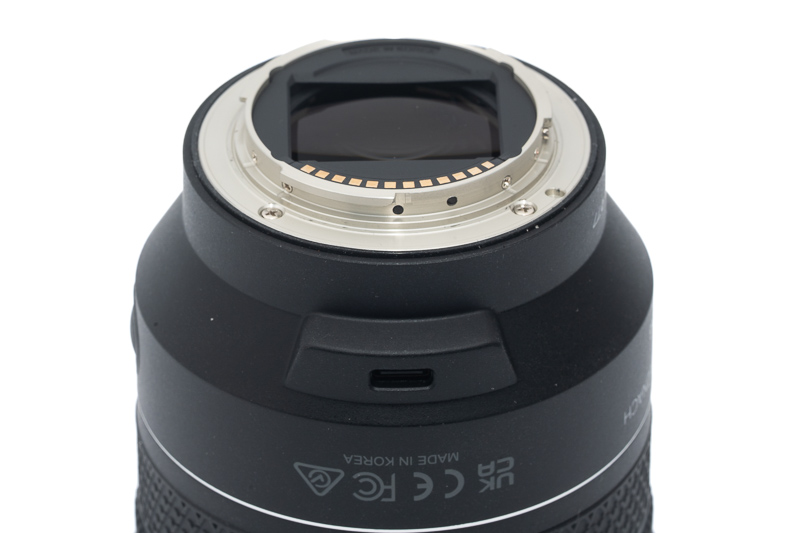
Also unlike previous Samyang lenses this one features a USB-C socket. If that would eliminate the need for the “Lens Station” accessory to update its firmware and change the settings that would of course be welcome, I did not manage to do that though, neither on my Windows computer nor on my Macbook the lens was being recognized that way.
Via lens station this lens was recognized immediately. You can change the throw of the focus ring in somewhat odd steps (fast = 60°, normal = 90°, slow = 120°) and you can turn the AF/MF switch into a switch that will allow you to change the aperture setting using the focus ring.
As you can see in the picture above there is also a rubber gasket to be found at the bayonet.
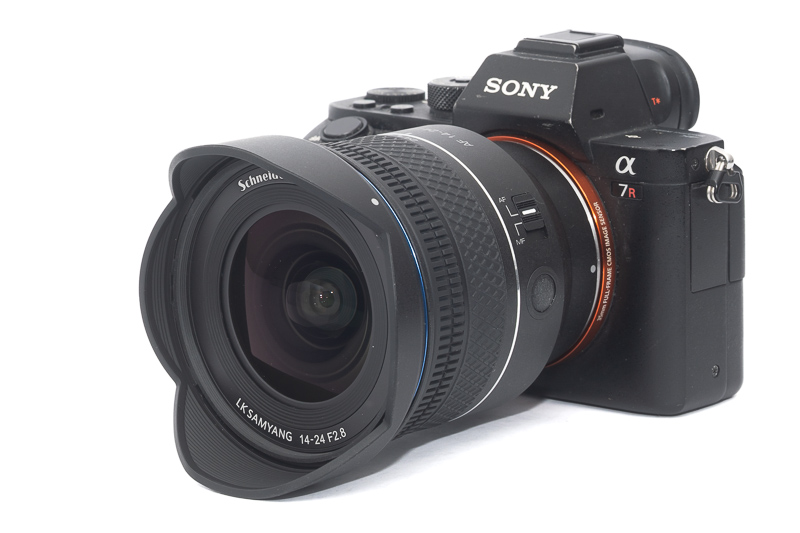
The lens comes with a simple bayonet-style plasic hood. That it also has a normal 77mm filter thread is of course one of its stand-out features.

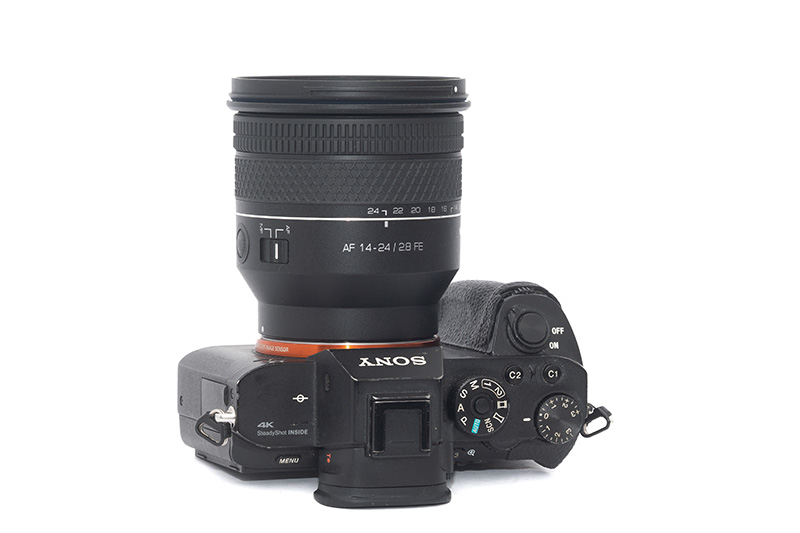
The lens is shortest at the 24mm setting and extends on zooming out to 14mm.

This Samyang AF 14-24mm 2.8 FE is a small lens considering its specifications. It is about the same length as the Sony FE 24mm 1.4 GM and only weighs 443g.
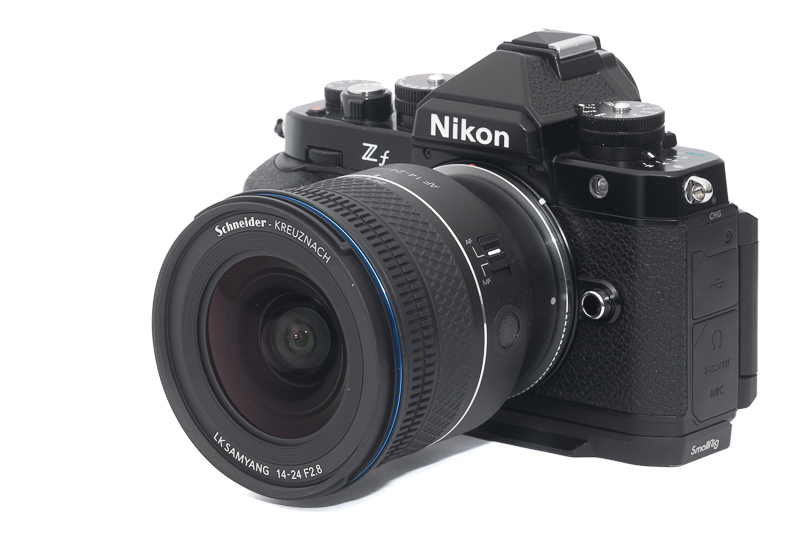
With the Megadap ETZ21pro+ and the Viltrox E-Z adapter the lens seemed to work very well on the Nikon Zf. I did not test these combinations deeply in the field though.
AF performance
I am not shooting sports or fast moving animals/humans so if you want to know if the lens is fast enough for this, or how it compares to other lenses in this segment, you may have to look for a different review with a more detailed assessment of this aspect.
The AF worked very well but then a lens this wide isn’t very demanding to begin with. The AF is also not completely silent.
Vignetting


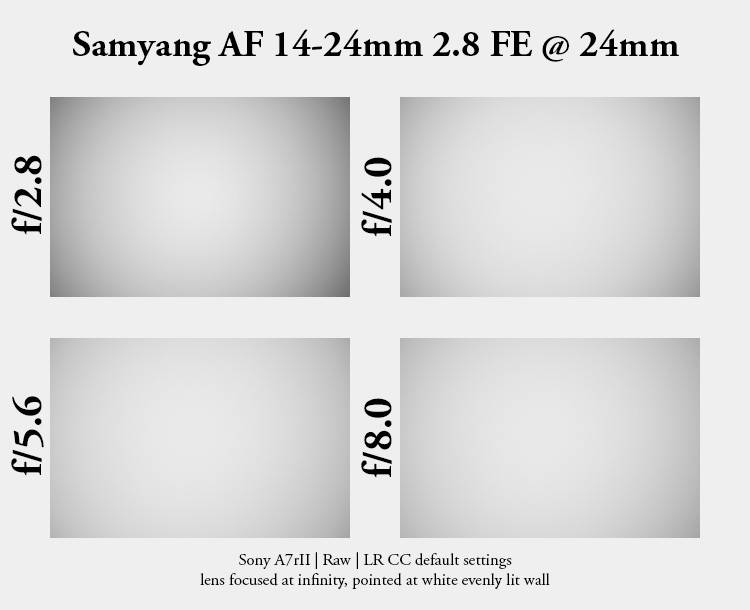
| 14mm | 20mm | 24mm | |
|---|---|---|---|
| f/2.8 | 3.2 EV | 2.5 EV | 2.4 EV |
| f/4.0 | 2.4 EV | 1.9 EV | 1.8 EV |
| f/5.6 | 2.0 EV | 1.7 EV | 1.6 EV |
| f/8.0 | 1.8 EV | 1.6 EV | 1.5 EV |
| f/11 | 1.8 EV | 1.6 EV | 1.5 EV |
As this is the smallest 14-24mm 2.8 lens I also expected it to show the highest vignetting figures and that is indeed the case. At pretty much every combination of focal length and aperture it shows 0.7 EV stronger vignetting than either the Sony FE 12-24mm 2.8 GM or the Nikon AF-S 14-24mm 2.8G.
Especially at the 14mm end this Samyang lens shows strong barrel distortion which you are obviously supposed to correct. This is why I am showing you the vignetting values after distortion correction here. Below I also added the graphs without distortion correction for the 14mm setting for comparison’s sake.

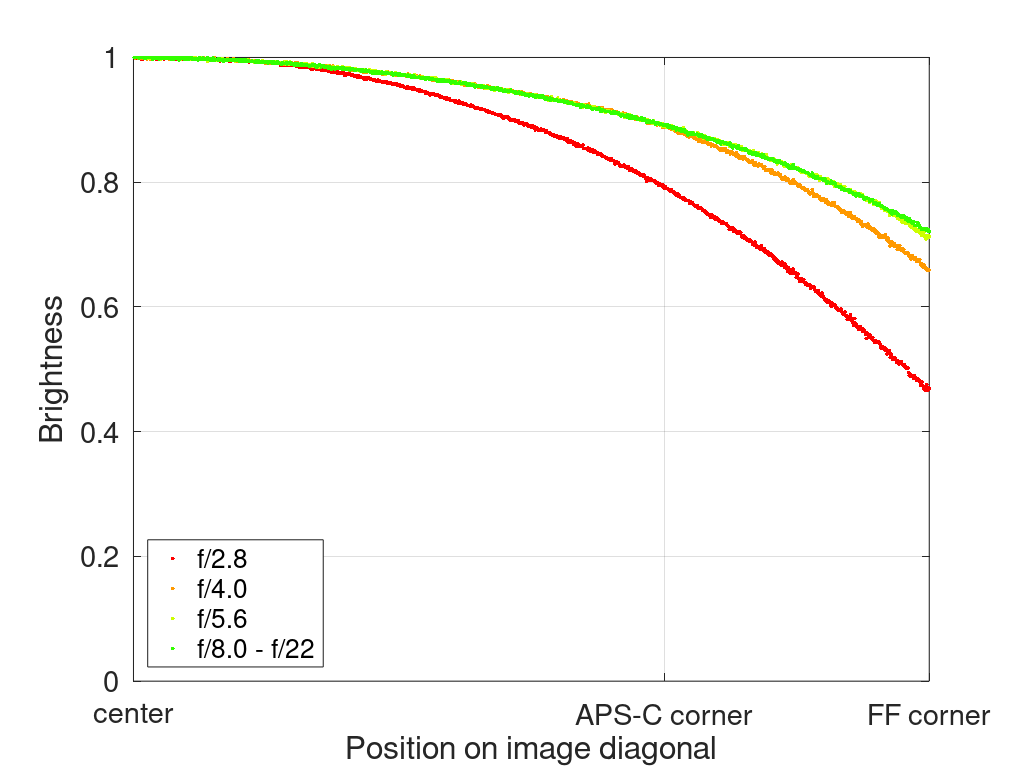
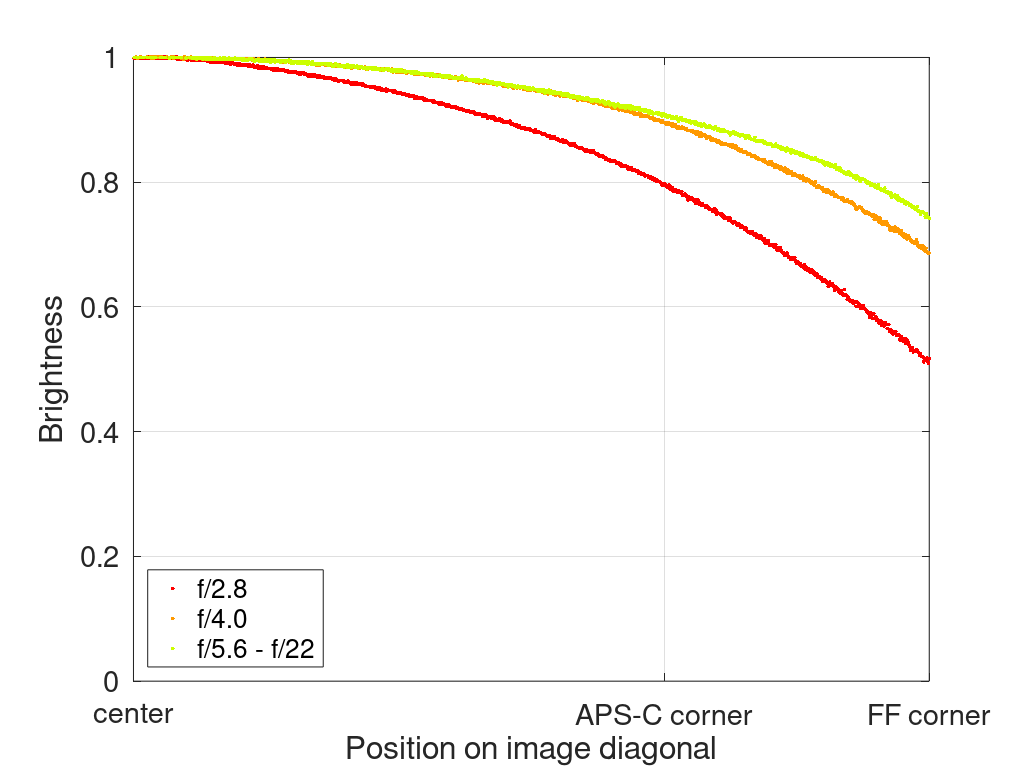
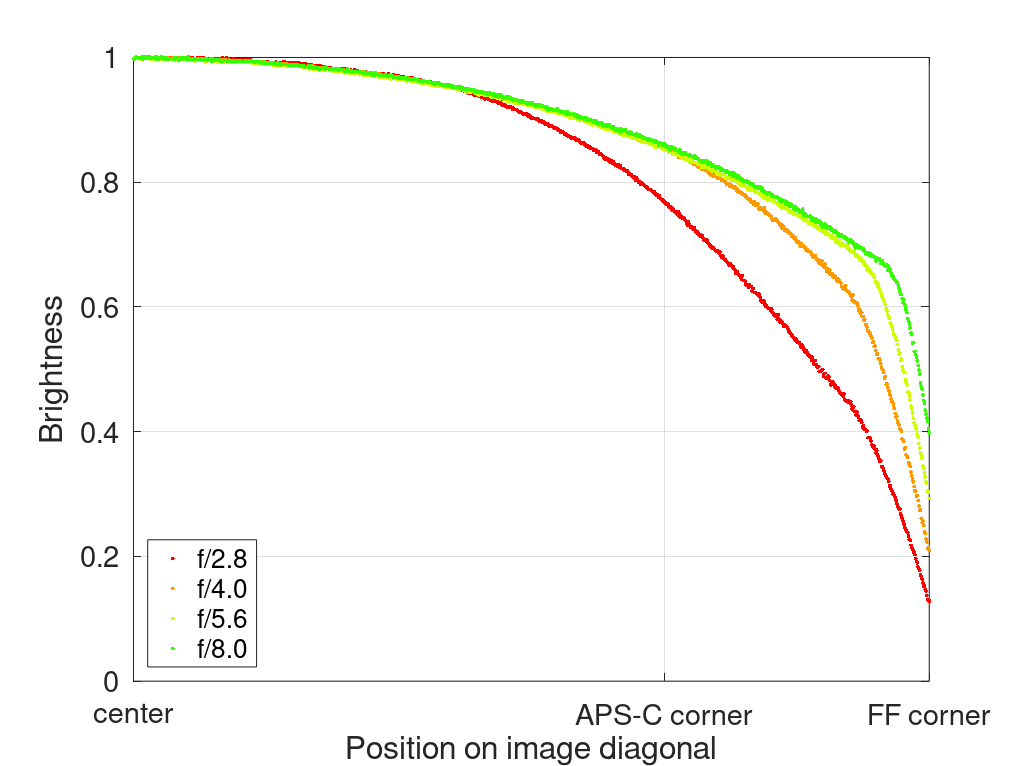
It is recommended to have a look at this article first to get an idea how this brightness graph works.
Sharpness
infinity (42mp Sony A7rII)
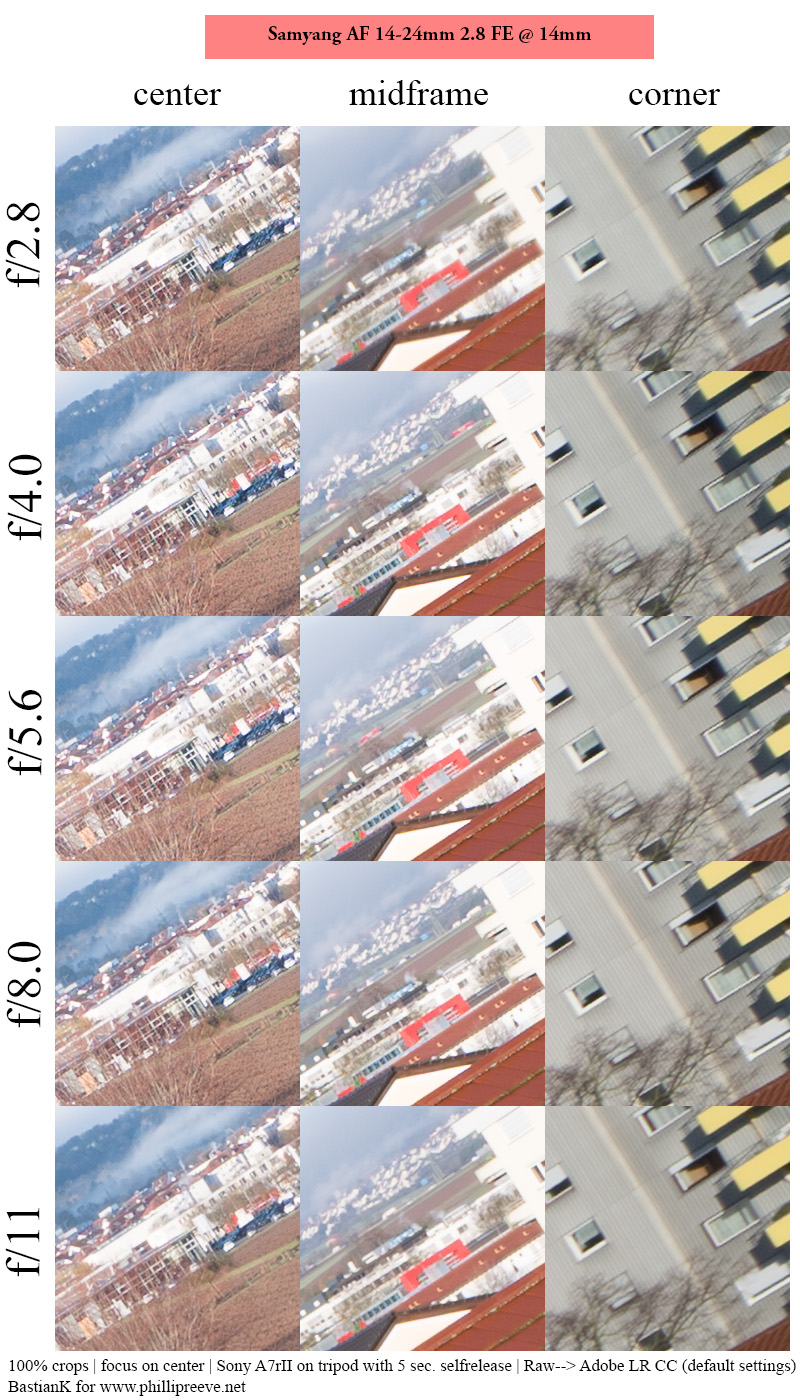
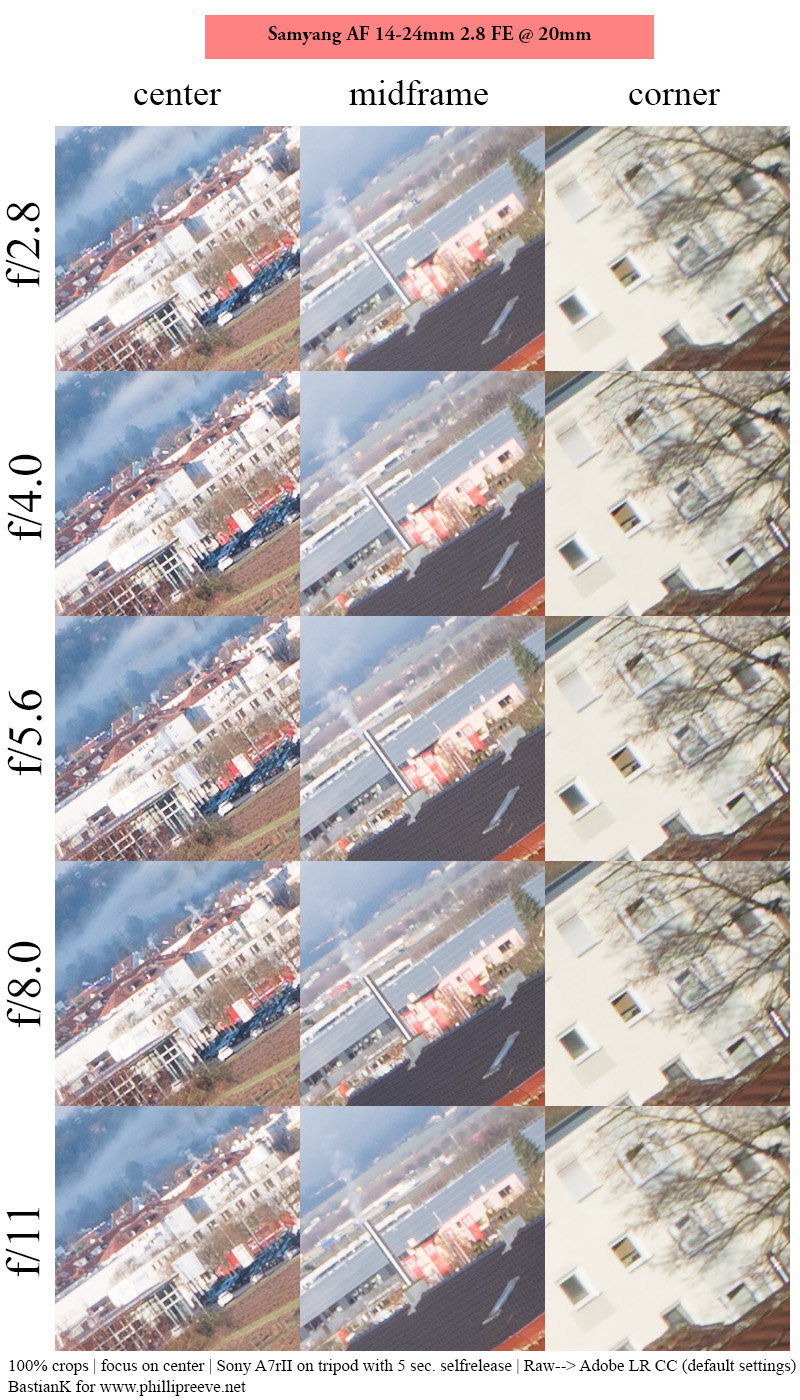
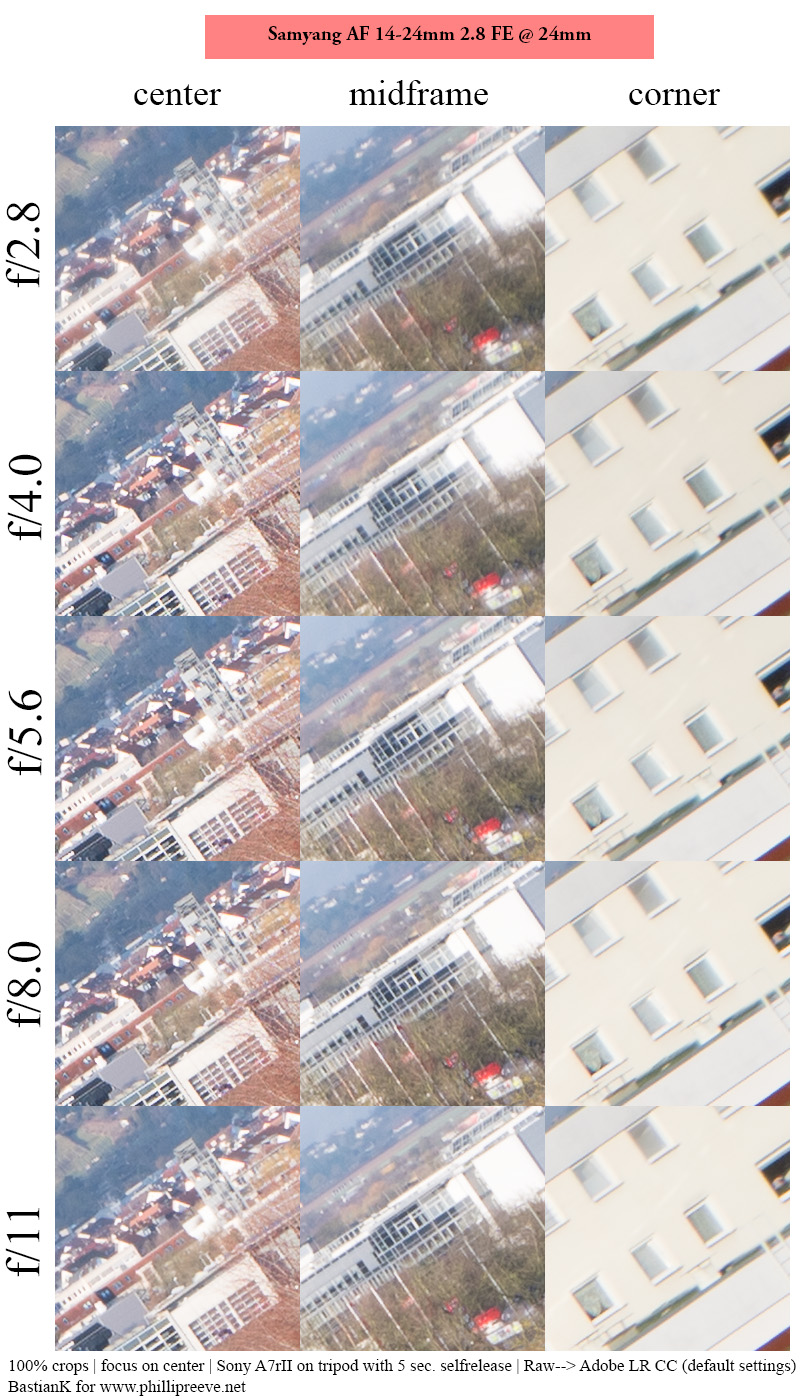
We are looking at the extreme corners after applying distortion correction here.
At 14mm we see a good albeit not amazing performance at f/2.8 as midframe and corners clearly benefit from stopping down one to two stops.
At the 20mm setting we have a slightly more even performance at f/2.8, but also here stopping down to f/4.0 increases the performance in the midframe and corners. Corners look good at the 20mm but never amazing and there is hardly a difference between f/4.0 and f/11.
As is often the case for ultra wide angle lenses, the long end is a bit of the weak spot. Here I found the whole image to be a bit softer at f/2.8 and I definitely recommend to use f/4.0 if the light levels allow for it.
The performance of this Samyang AF 14-24mm 2.8 FE is surprisingly similar to the Nikon AF-S 14-24mm 2.8G from 2007 – at all focal lengths, but especially at the 24mm setting, where both lenses suffer from spherical aberration. Keeping in mind this Samyang lens is half the weight, significantly smaller, takes normal 77mm filters and its MSRP actually lower, I still consider this a success.
If money is no object, the Sony FE 12-24mm 2.8 GM is not only wider, but also performs better across the whole focal length range without any softness at the 24mm setting or the need to stop down for midframe and corners to look very good.
This zoom lens is also not parfocal, if you change the focal length you should also adjust the focus setting.
close (0.18 m)
14mm



100% crops from center, A7rII
24mm



100% crops from center, A7rII
The minimum focus distance is achieved throughout the whole focal length range, which leads to the highest magnification (1:3.4) being available at the 24mm end.
Also at these distances the image is a bit softer at f/2.8 at the 24mm end and at the 14mm end we see a bit of field curvature – as is often the case for ultra wide angle lenses in close focus scenarios.
At first sight again a very similar performance to the Nikon AF-S 14-24mm 2.8G, but we need to take into consideration that this Samyang offers much better magnifications.
Flare resistance
As always evaluating flare is a complex matter since you can get any lens to look bad if you push it hard enough and a slight change of scenario can affect results a lot. With a zoom lens there are even more variables, as the performance can change a lot with the focal length as well.
Many of the 14mm lenses come with a bulbous front element (e.g. the Nikon AF-S 14-24mm 2.8G or the Sony FE 12-24mm 2.8 GM) and these sometimes face severe issues in this category. Now this Samyang lens does not have a front element as bulbous, but then Samyang lenses did often not fare particularly well in this category. Let’s find out what to expect here.

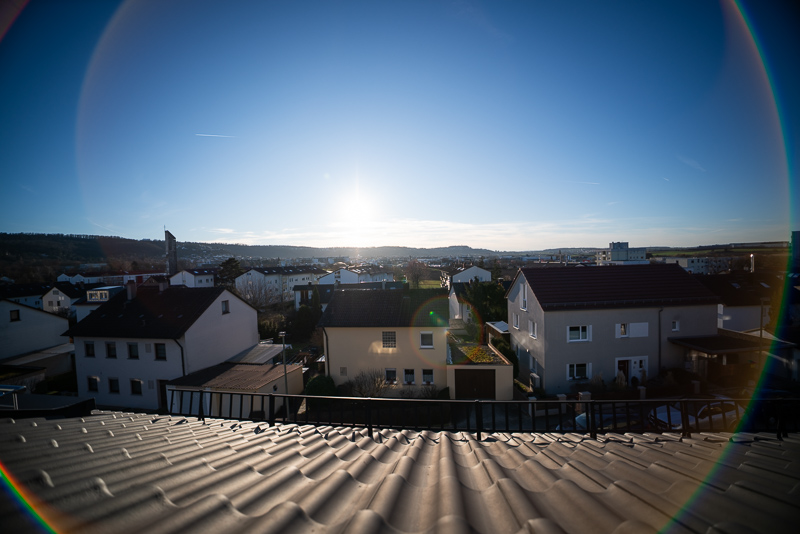


Ah well. At the 14mm setting, with a strong light source close to the center of the frame, you can create a massive ring flare. This is actually something that can easily completely ruin your pictures. The good news: veiling flare is hardly an issue and contrast stays on a high level.
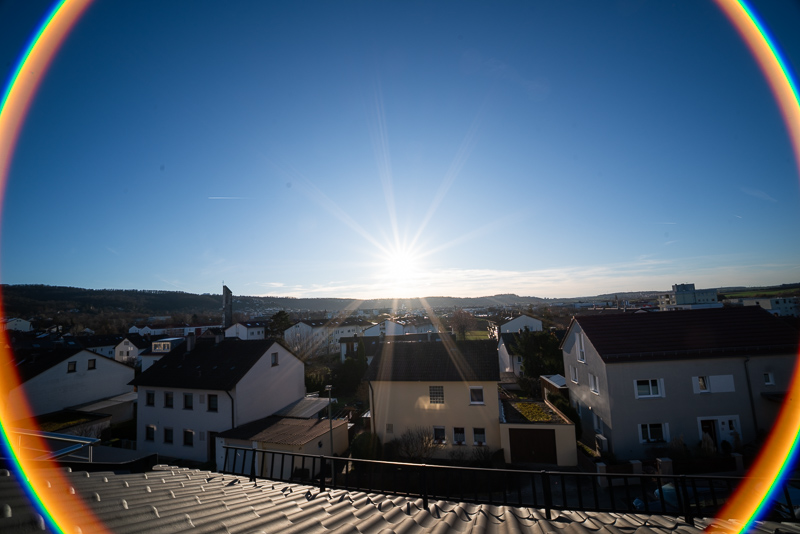
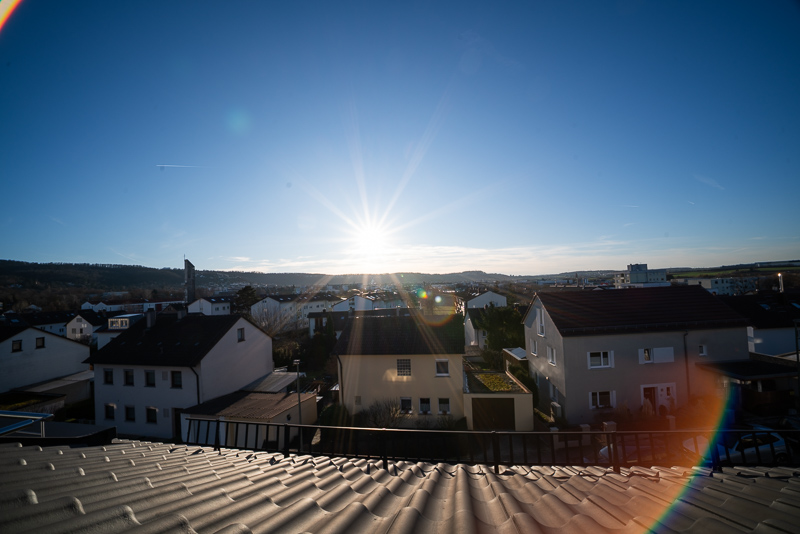
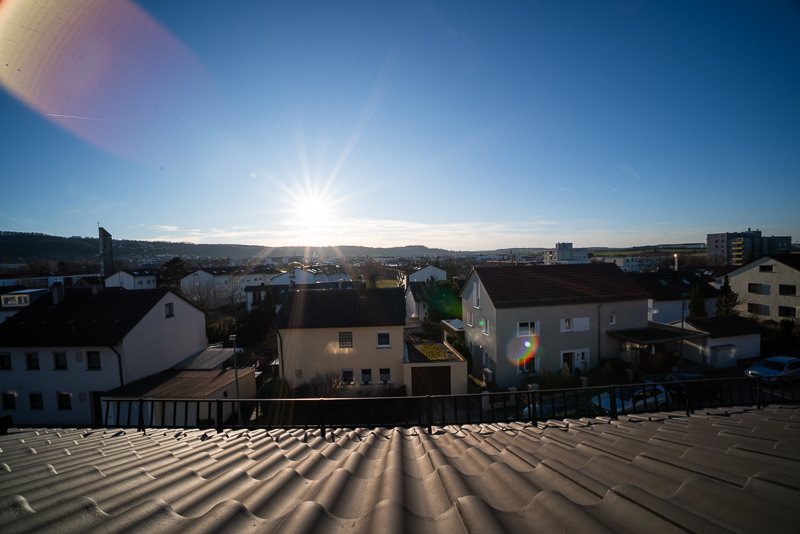
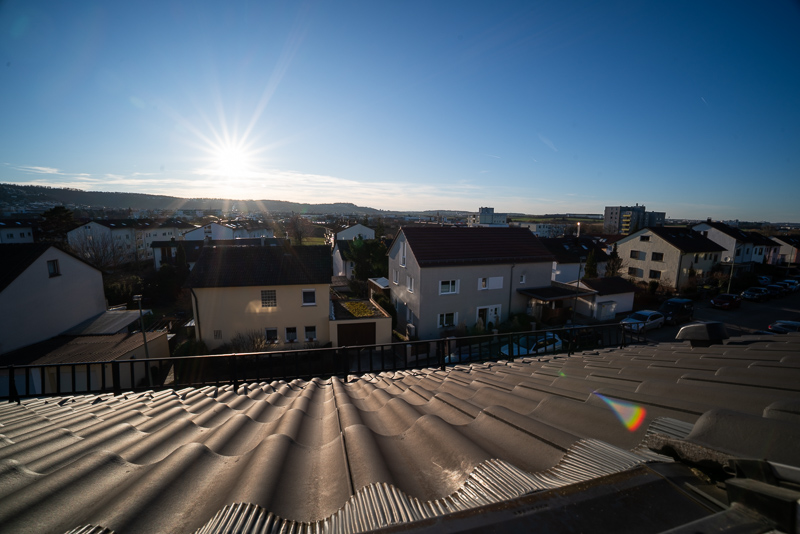
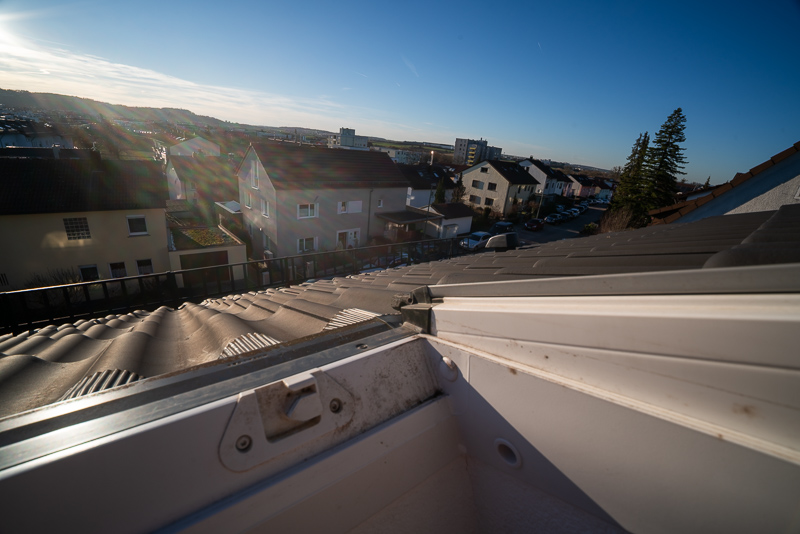
If you were hoping that stopping down will help getting rid of that huge ring flare: no, not the case. Stopped down there are actually even more artefacts that can appear.
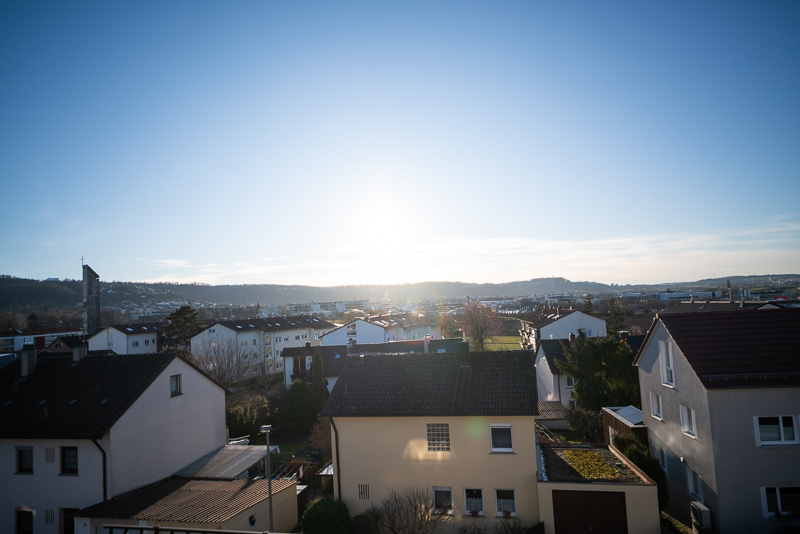
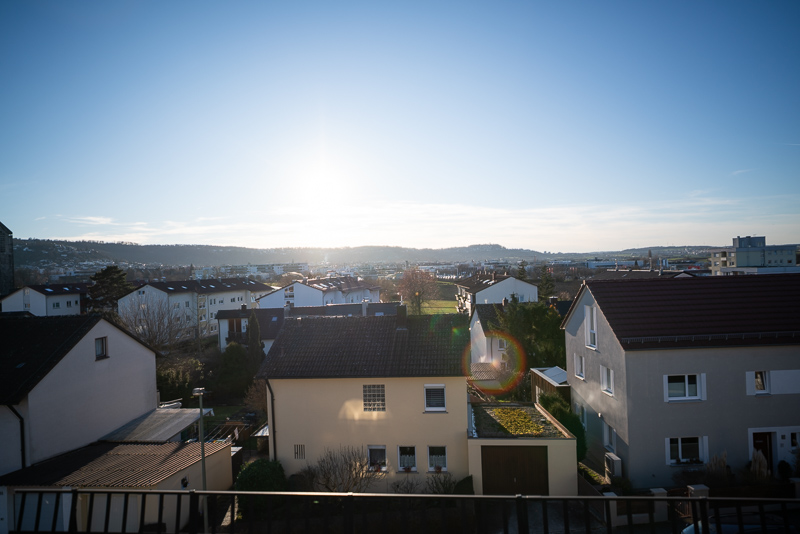
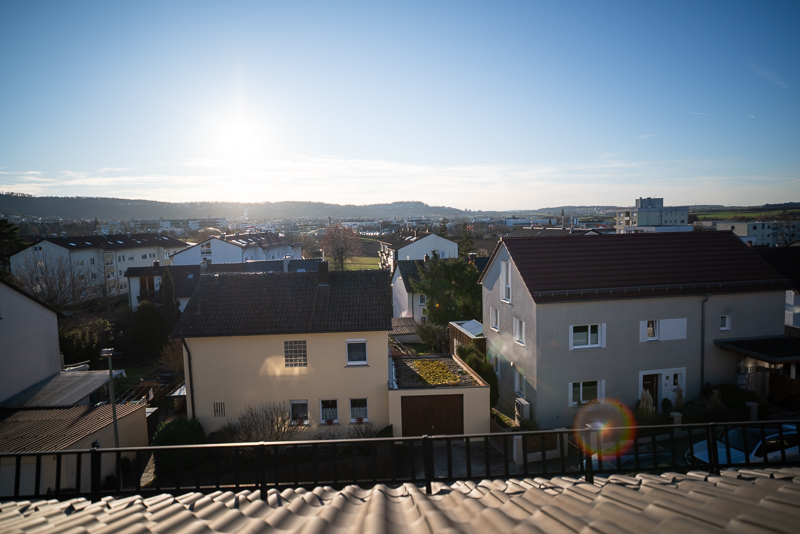
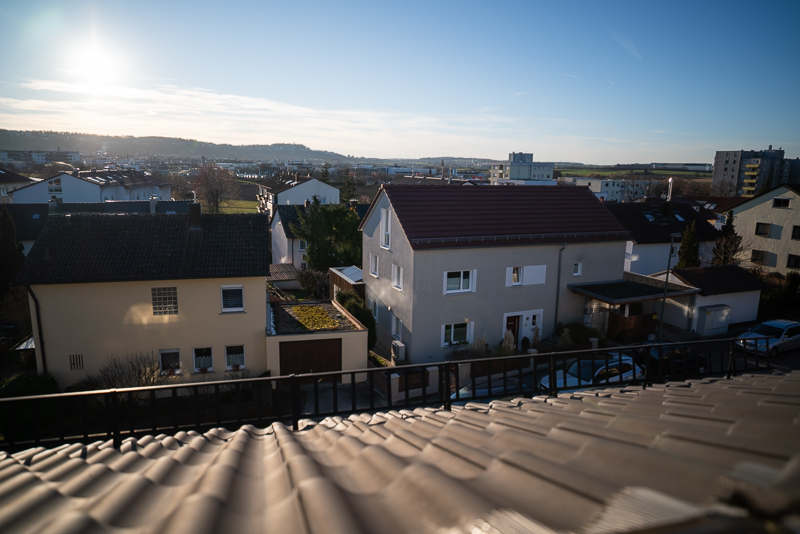
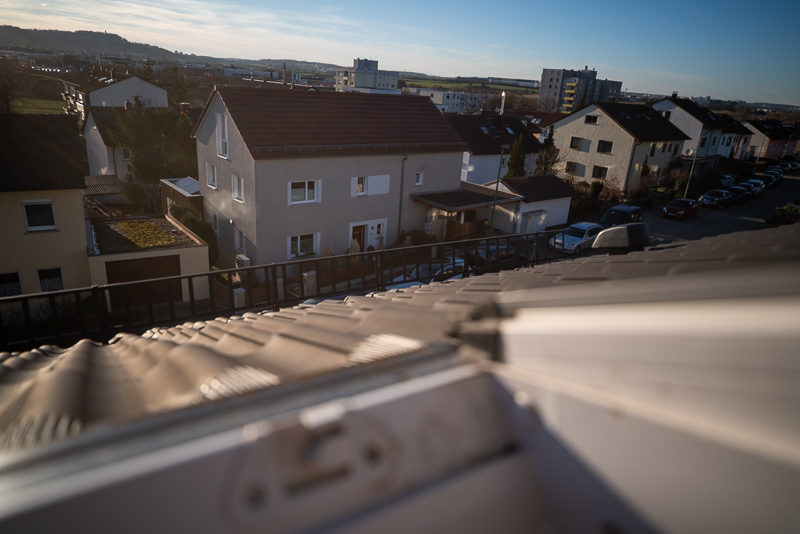
At the 24mm end I found the performance to be a bit better. The ring flare is not in the frame anymore, but we can see ghosts in more situations here.
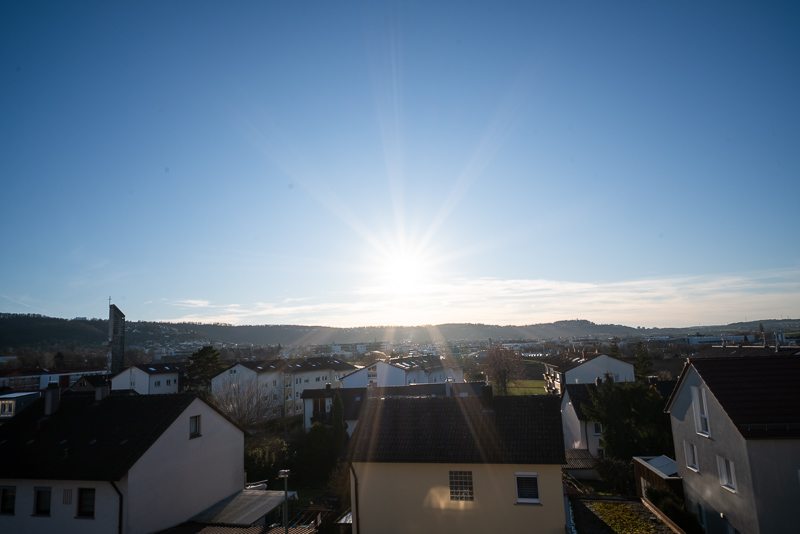
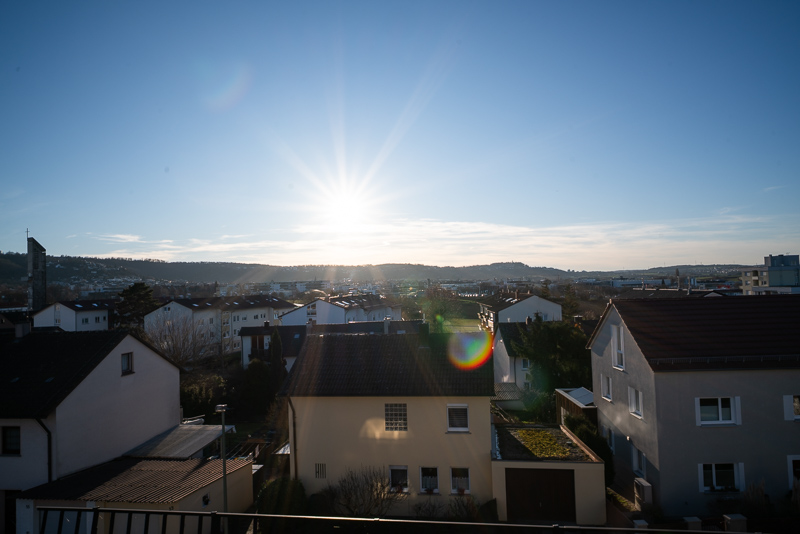
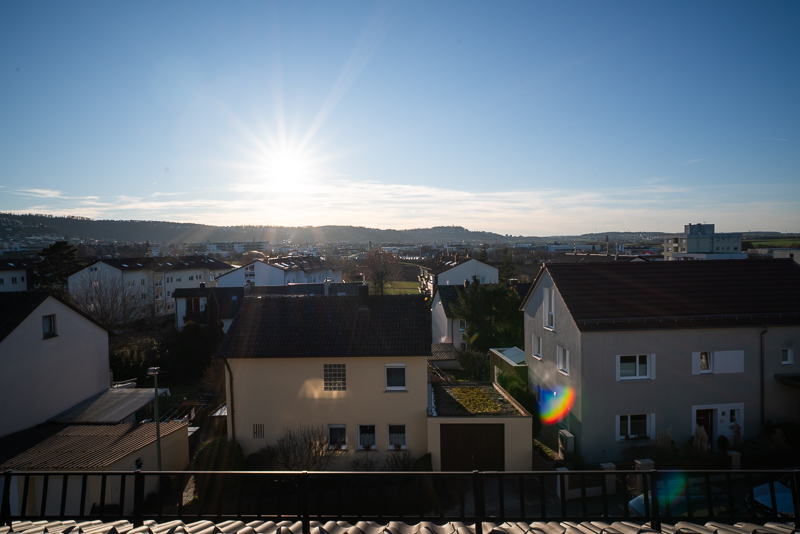
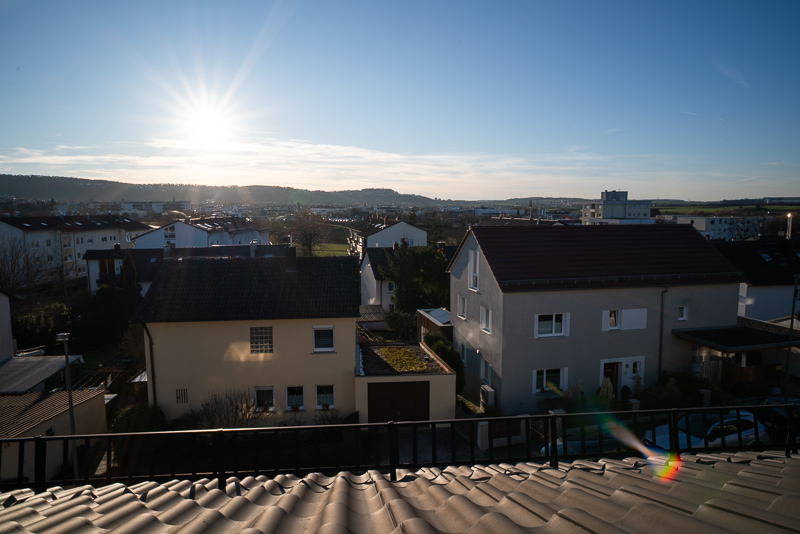
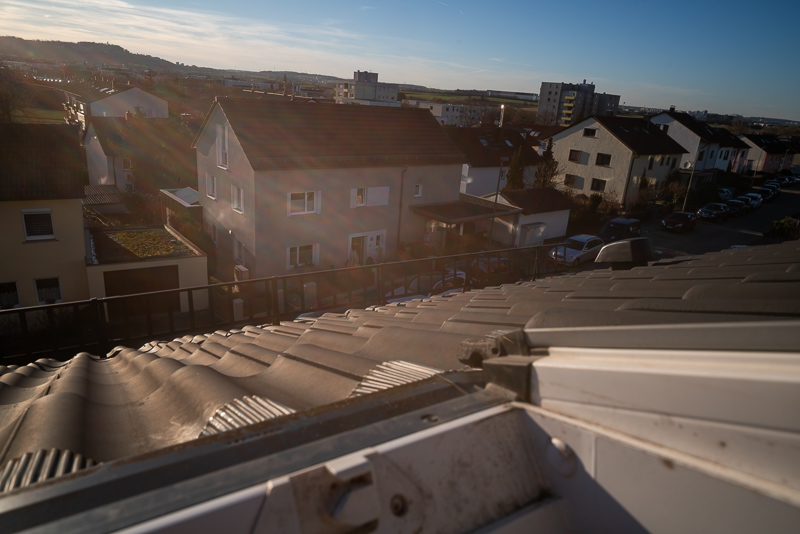
As was already the cast at the 14mm setting, also at the 24mm setting veiling flare can be a problem stopped down (see Pos5). This only occurs at a specific angle relative to the light source though so can often be avoided.
For a lens released in 2025 this is not a great performance. It actually shows more issues than the almost two decades older Nikon AF-S 14-24mm 2.8G and also the Sony FE 12-24mm 2.8 GM with its huge bulbous front element performs way better – without any issues with massive ring flares.
Coma
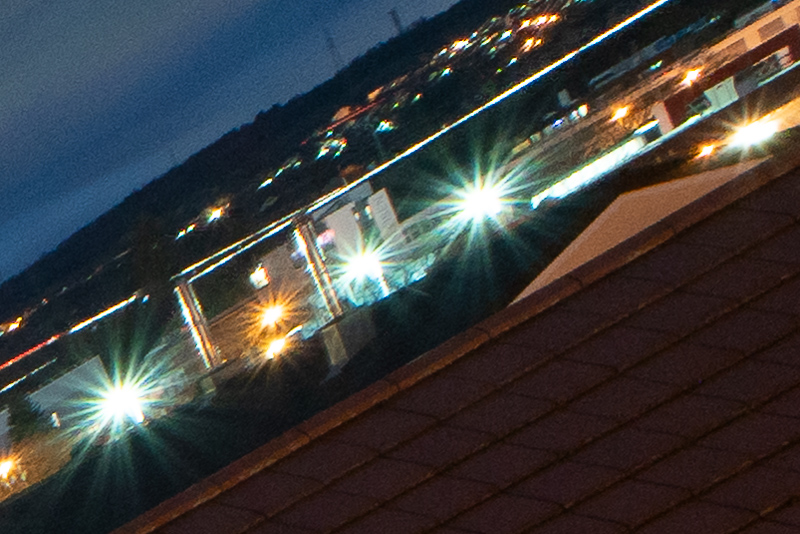
14mm
24mm
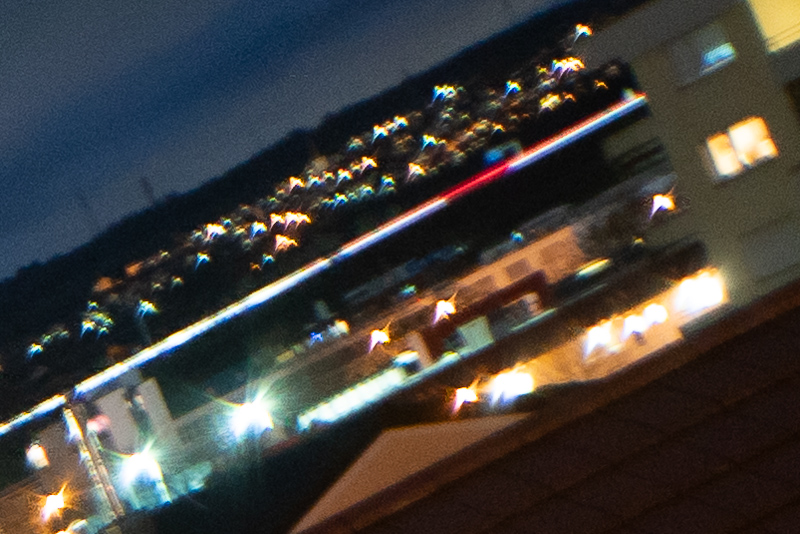

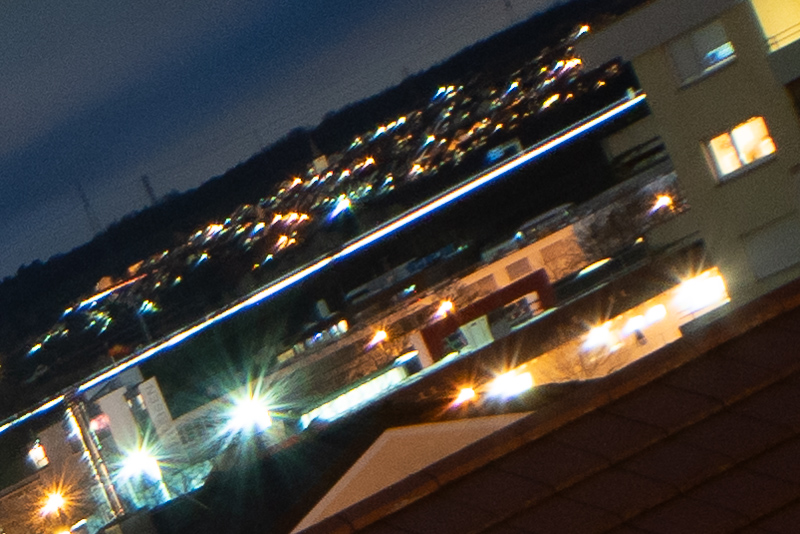
We are looking at the extreme corners after applying distortion correction here.
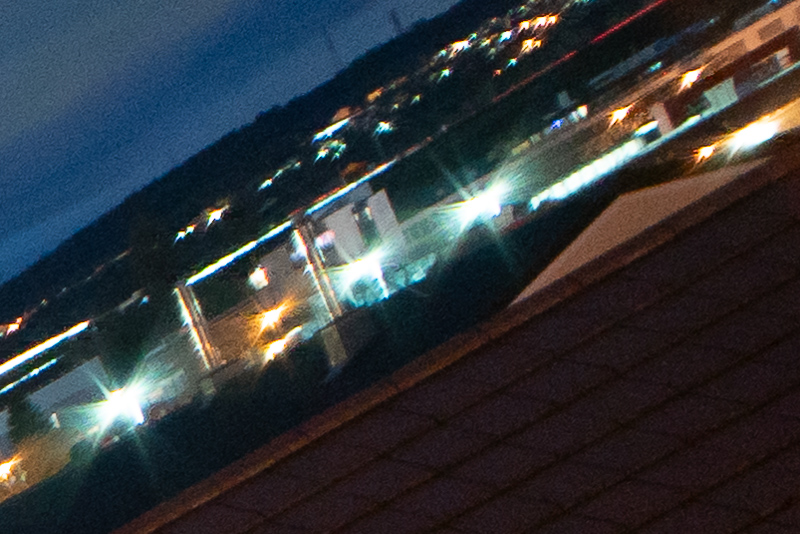
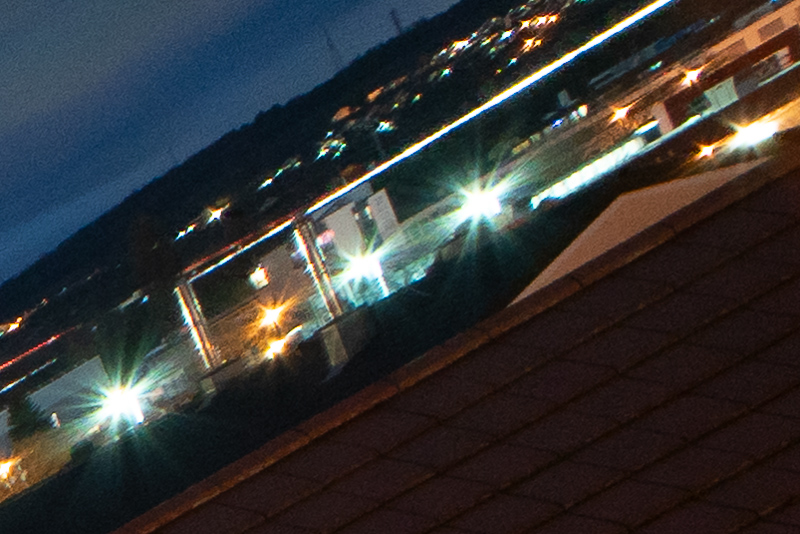
Contrary to flare resistance, Samyang has a good track record when it comes to correcting Coma. With the maximum aperture of f/2.8 in combination with the 14mm viewing angle I also expect some people to use this lens for astrophotography where this is important.
At the important 14mm end we can only see minor artefacts in this very demanding city scene. With actual stars there won’t be any issues. At the 24mm end these artefacts are slightly bigger and here I would rather stop down a bit if possible.
Also here the Nikon AF-S 14-24mm 2.8G performed very similar (impressive for a lens from 2007) whereas the Sony FE 12-24mm 2.8 GM hardly shows any artefacts.
Distortion
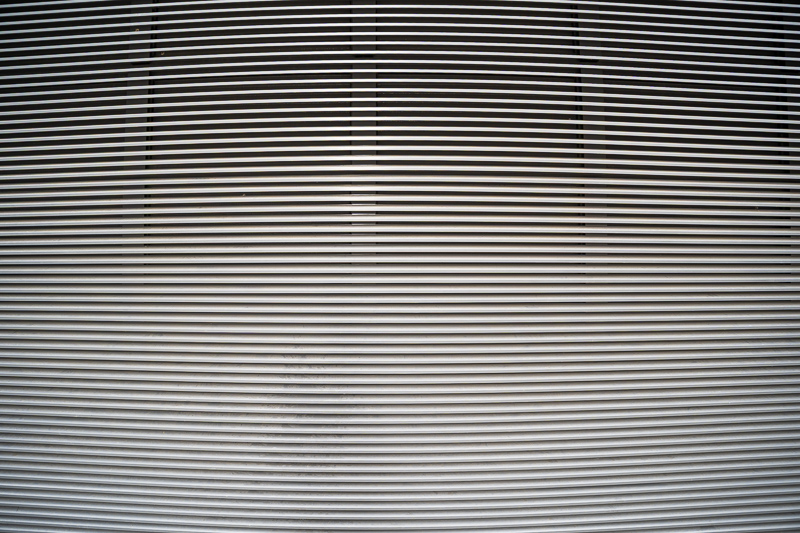

At 14mm we see strong slightly wavy barrel distortion which will be rather obvious when taking architecture pictures with many straight lines running through the frame.
Distortion decreases on zooming in and is almost zero around 22mm before it turns into a slight pincushion distortion at 24mm.
Like most of the modern ultra wide angle zoom lenses also this one is obviously meant to be used with digital distortion corrections – which do a pretty good job as can be seen above.
The Lightroom/Camera Raw profile needs to be downloaded from Samyang’s homepage.
Bokeh

This isn’t really a main application for a lens like this in my opinion, at close focus distances it is still possible to get a bit of background blur in your pictures though, even at the 14mm setting.

For an ultra wide zoom lens the quality of the bokeh is also surprisingly good. You can have a look at my review of the Zeiss 18mm 3.5 to see how bad bokeh can look in an ultra wide lens.

Sunstars
14mm
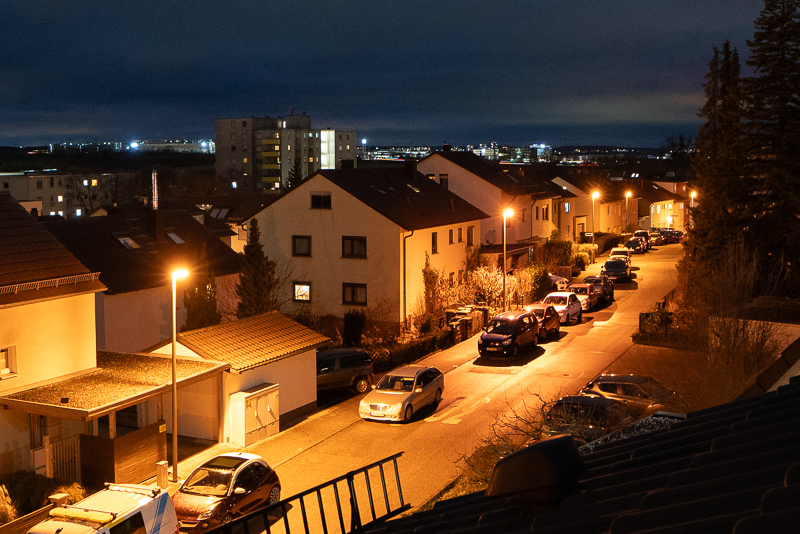
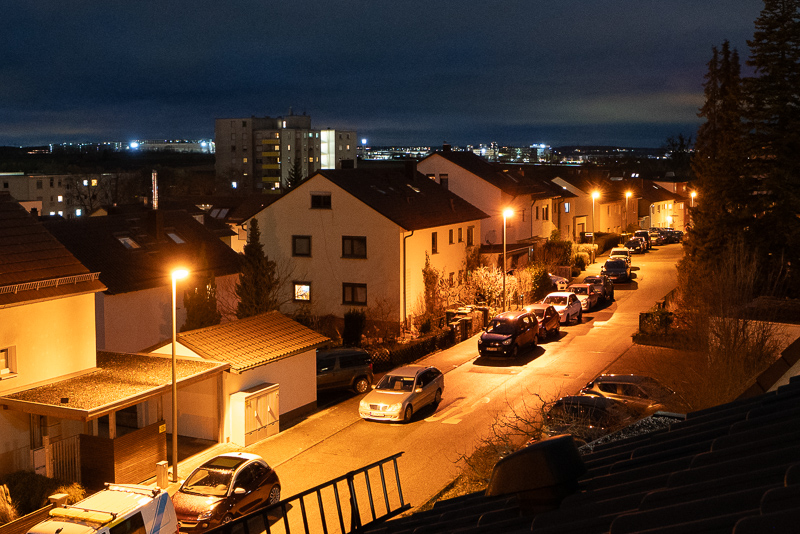
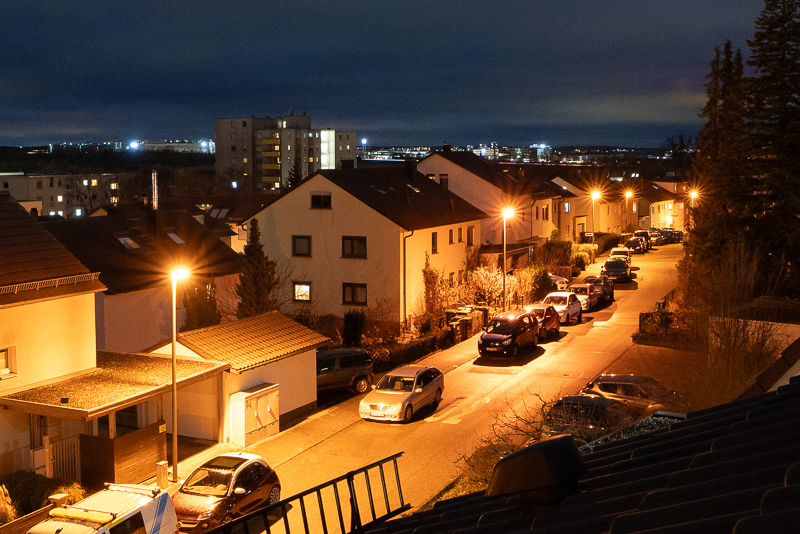
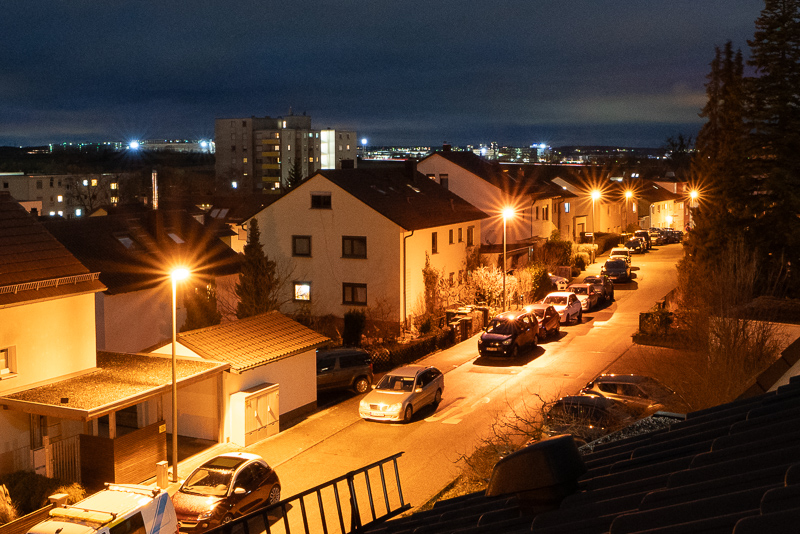
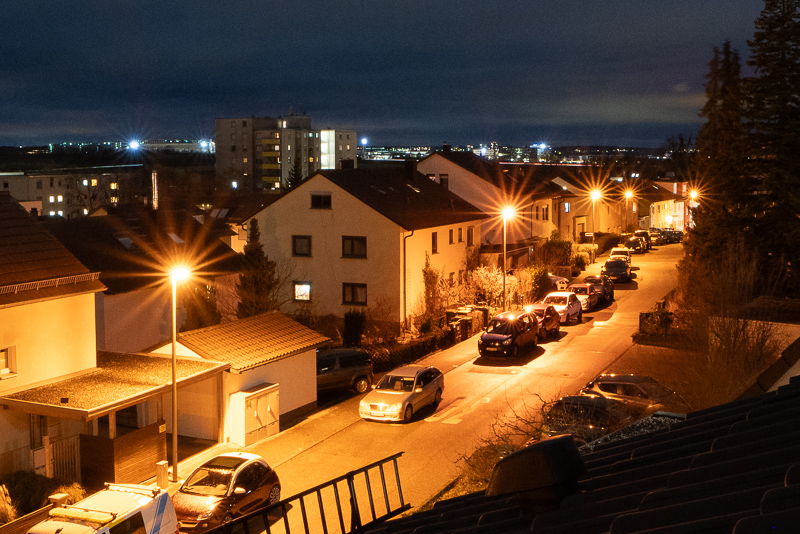
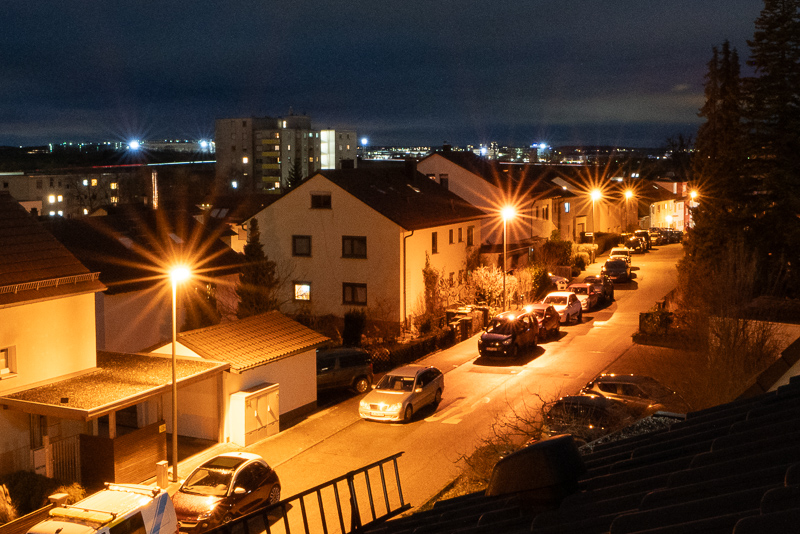
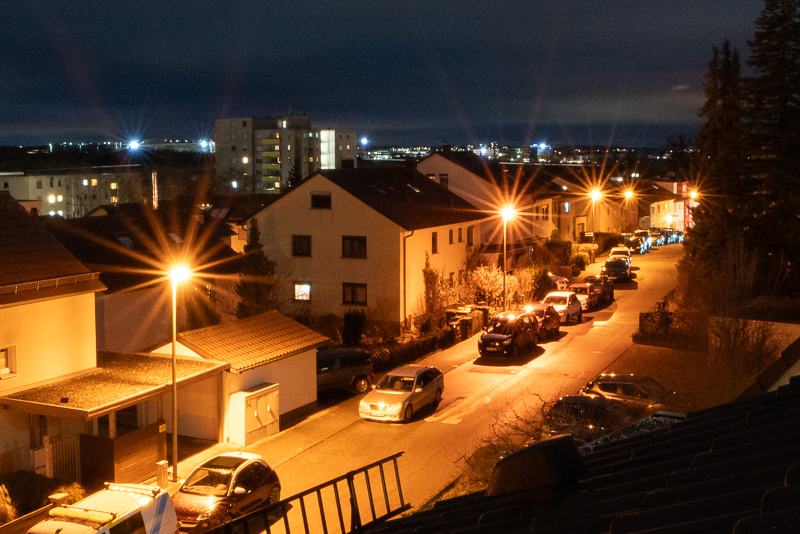
24mm
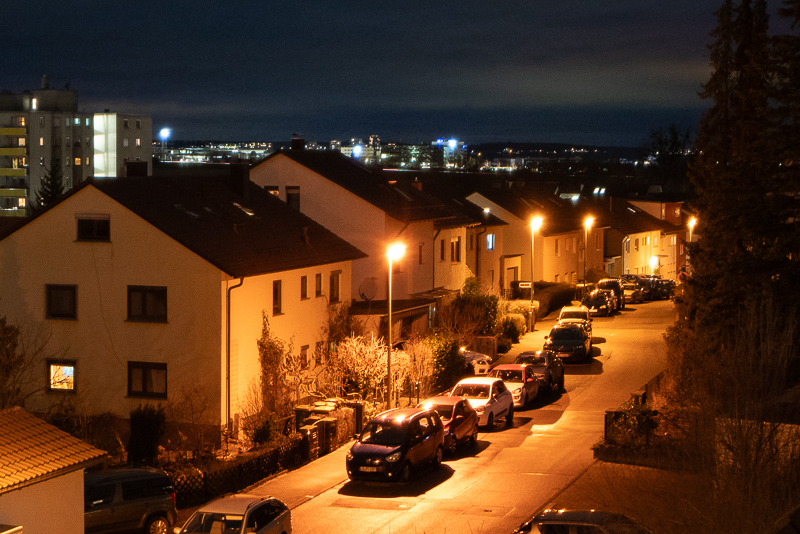
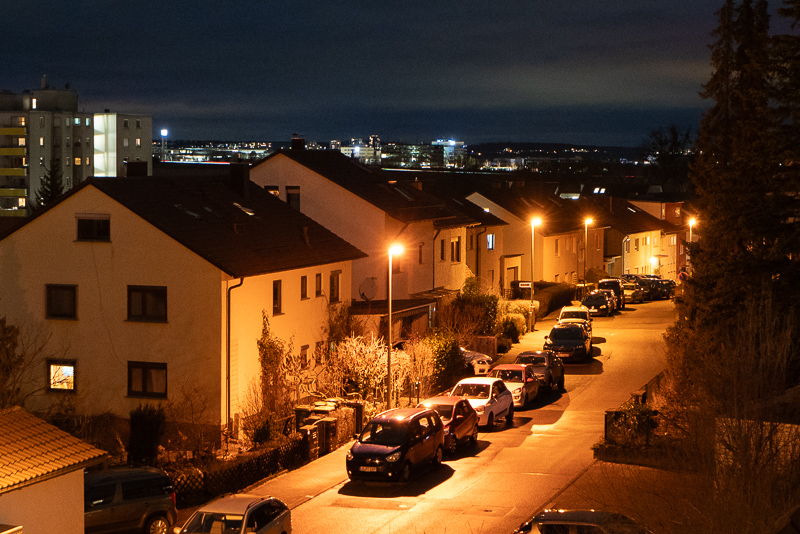
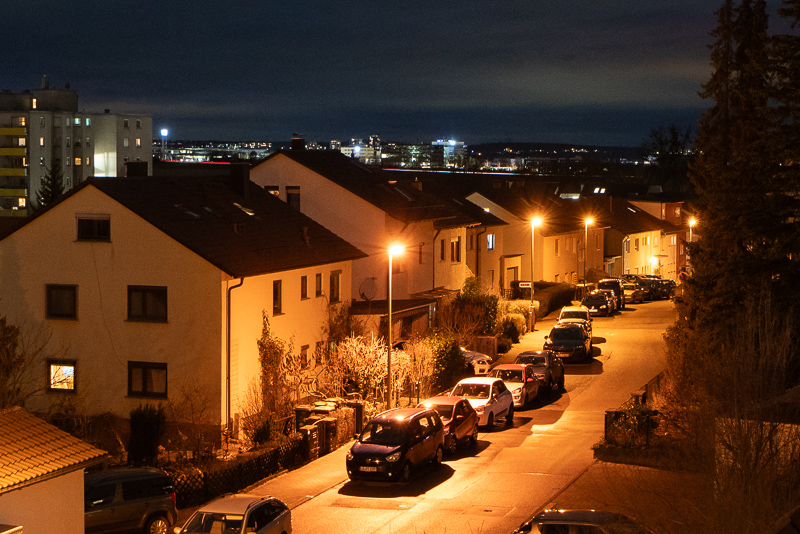
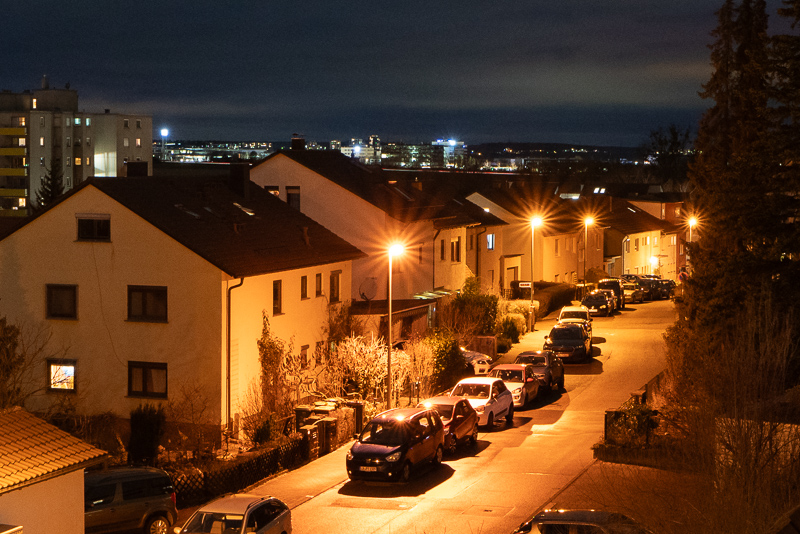

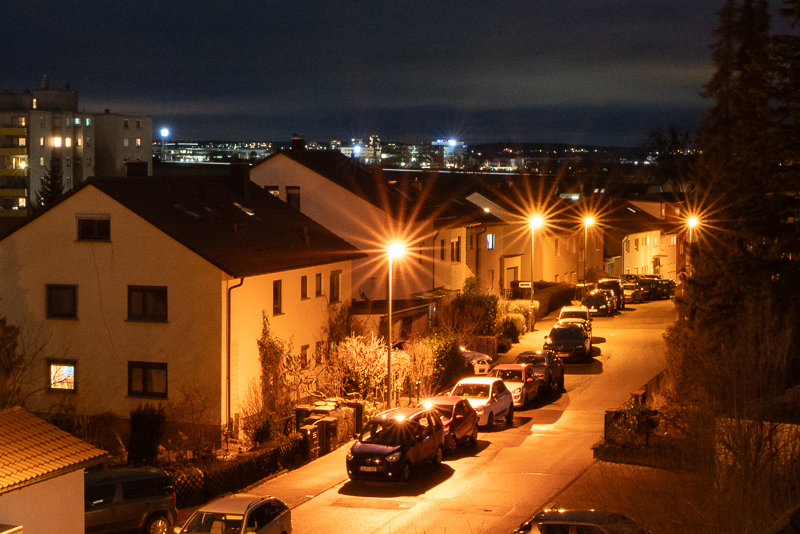
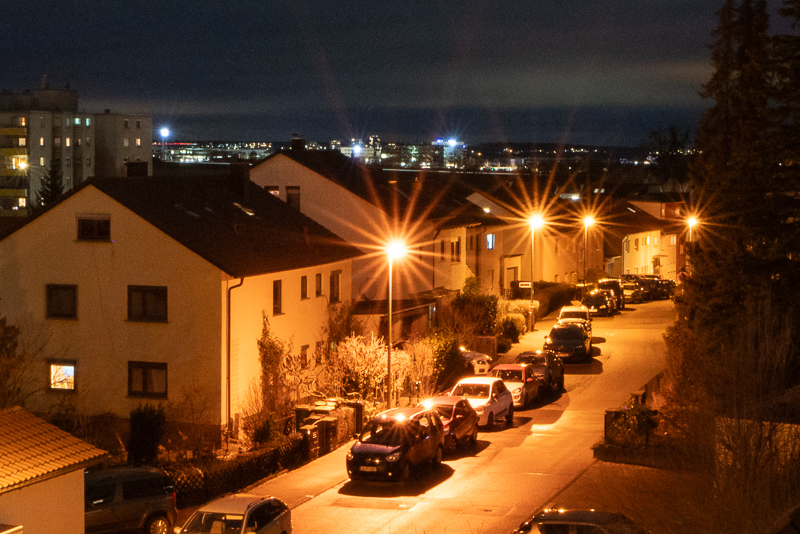
In the past Samyang lenses weren’t exactly known for nice sunstar rendering. When it comes to small point light sources – like you can see here – I definitely see some improvements. Having a look at the flare resistance section we can see that with bigger light sources (like the sun) the sunstars still don’t look particularly nice though.
As this is a highly subjective topic, may have a look at this article to see which kind of sunstars you prefer.
Chromatic Aberrations
lateral
Just like first party lenses (e.g. the Sony FE 12-24mm 2.8 GM), also this Samyang AF 14-24mm 2.8 FE features a built-in lens correction profile for lateral CA that will also be recognized in most raw converters, so in the end: you won’t see any.
longitudinal
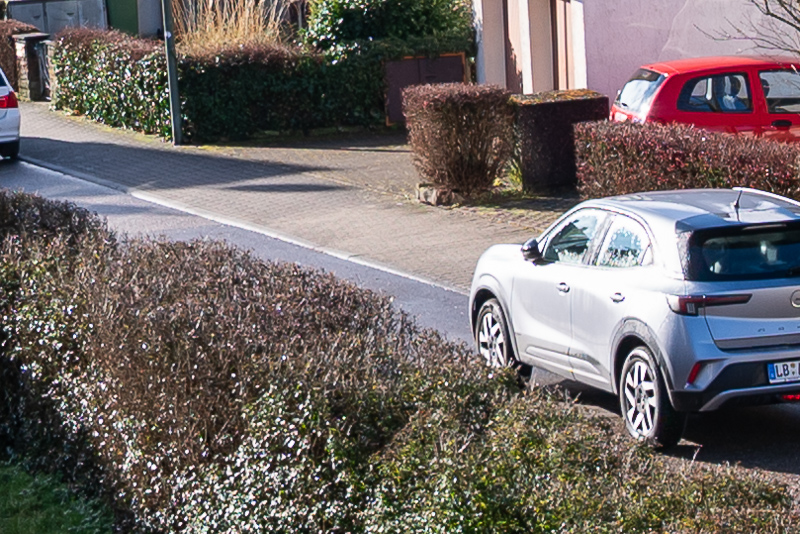
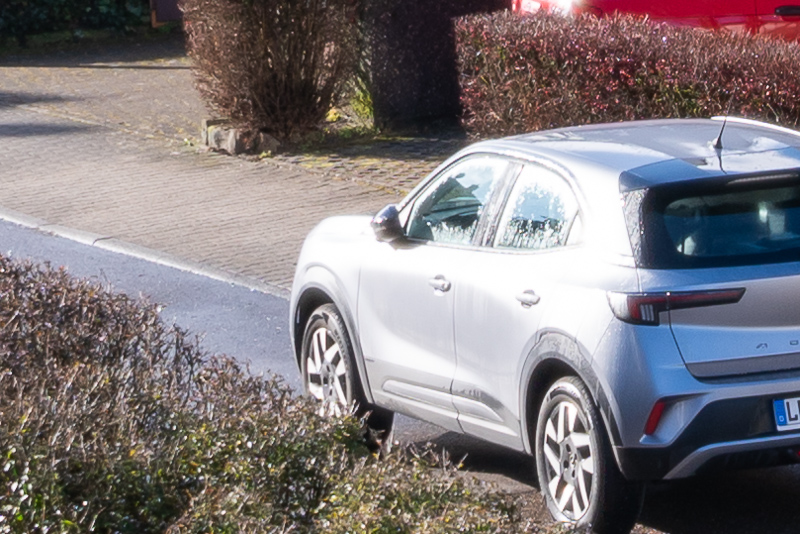
Because of the parameters bokeh fringing isn’t really something to worry about and also purple fringing hardly exists.
Conclusion
good
|
average
|
not good
|
Samyang has something these days, that many other lens manufacturers lack: a clear and coherent concept. Already the Samyang AF 24mm 1.8 FE, Samyang AF 50mm 1.4 FE II and the Samyang AF 135mm 1.8 FE were the lightest and smallest lenses in class while offering good optical performance and at the same time being more affordable than the competitors.
This Samyang AF 14-24mm 2.8 FE takes that concept even a step further, as it is the only 14-24mm 2.8 zoom that comes with a standard 77mm filter thread and its dimensions are closer to many wide angle primes than other ultra wide zooms starting at 14mm.
The optical performance is generally best at the wide end (which is usally the case for ultra wide angle zooms). At 24mm I found it to be a bit soft due to spherical aberration, this might also be due to sample variation though as the MTF graphs paint a different picture. The downsides were expected: strong vignetting and strong uncorrected distortion. Like many manufacturers also Samyang should invest some time and money in improving the flare resistance of their lenses, getting rid of that obnoxious ring flare.
In the field – and this is probably obvious from the sample images in this review – I found this lens to be a versatile, easy to carry and high performing (at 14-21mm already at f/2.8, at 24mm from f/4.0), ultra wide angle zoom. If I was looking for a 14-24mm 2.8 lens today, this is the one I would be getting.
buy from amazon.com | amazon.de | ebay.com | ebay.de | B&H (advertisement/affiliate links) for $959
Alternatives
As usual, I will only talk about the most obvious alternatives here. You can find many more ultra wide angle options in our 9-18mm Ultra Wide Angle Guide.
E-mount
Sony FE 12-24mm 2.8 GM:
Sony released their flagship ultra wide angle zoom Sony FE 12-24mm 2.8 GM in July 2020. This lens pushed the boundaries of what was deemed possible by offering an even more impressive 12mm focal length at the wide end. That is not all: Sony also has figured out how to make ultra wide angle lenses with bulbous front elements yet very good flare resistance. If money and size/weight are no object to you, this is the best performing, most impressive ultra wide angle zoom at the moment (2026).
buy from Amazon.com | Amazon.de | B&H | ebay.com (advertisement/affiliate links) for $2998 (new)
Sigma 14-24mm 2.8 Art DG DN:
I haven’t personally tried the Sigma 14-24mm 2.8 Art DG DN designed for mirrorless cameras. I would expect it to perform a bit better at the 24mm end, but it is much heavier and bigger and due to its bulbous front element is incompatible to normal filters. For many people I think this Samyang lens is actually the smarter option these days.
buy from amazon.com | amazon.de | B&H | ebay.com (advertisement/affiliate links) for $1299
Z-mount
Nikon Z 14-24mm 2.8 S:
For their Z-mount mirrorless cameras Nikon released the Nikon Z 14-24mm 2.8 S in 2020. It generally performs better than this Samyang lens, but it is also much bigger, about 50% heavier and comes without that convenient 77mm filter thread.
buy from amazon.com | amazon.de | B&H | ebay.com | ebay.de (advertisement/affiliate links) for $2097 (new)
DSLR lenses
Nikon AF-S 14-24mm 2.8G:
Released in 2007, for about a decade the Nikon AF-S 14-24mm 2.8G was the king of f/2.8 ultra wide angle zooms. Now in 2026 this Samyang lens matches its performance in most categories (not flare resistance and vignetting) and it really shows the advantage of designing ultra wide lenses for mirrorless cameras, being significantly smaller, lighter and simply more convenient to use.
buy from ebay.com | ebay.de | amazon.com | amazon.de | B&H (advertisement/affiliate links) for $1750 (new) or starting at $600 (used)
Sigma 14-24mm 2.8 Art DG HSM:
It took until 2018 for someone to match the performance of the aforementioned Nikon lens and it was Sigma with their 14-24mm Art DG HSM. The performance is very similar at the 14mm end, but the Sigma shows a better performance at the 24mm end and it also seems to have better flare resistance. On today’s mirrorless cameras I think this is a hard sell.
buy from amazon.com | amazon.de | B&H | ebay.com | ebay.de (advertisement/affiliate links) for $1249 (new) or starting at $700 (used)
Further Sample Images


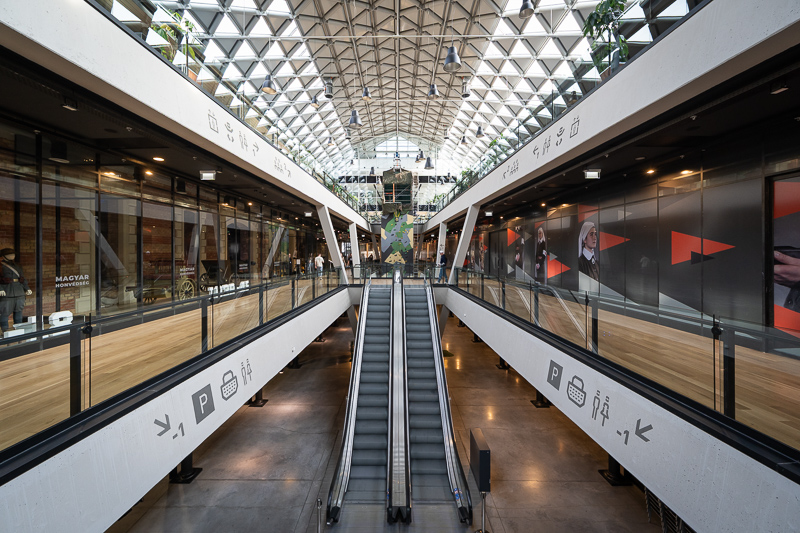

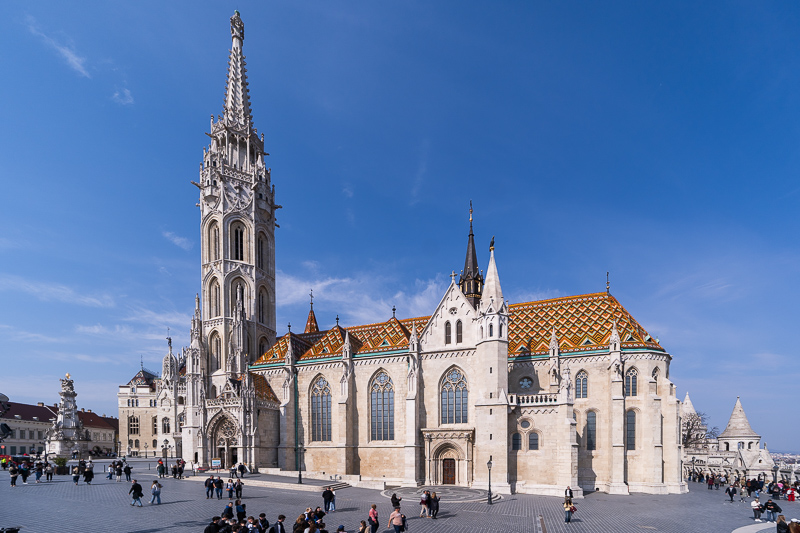


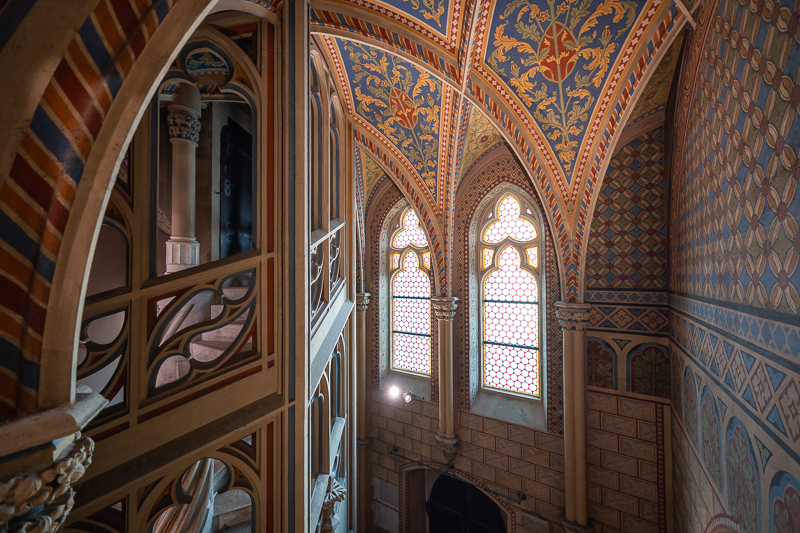
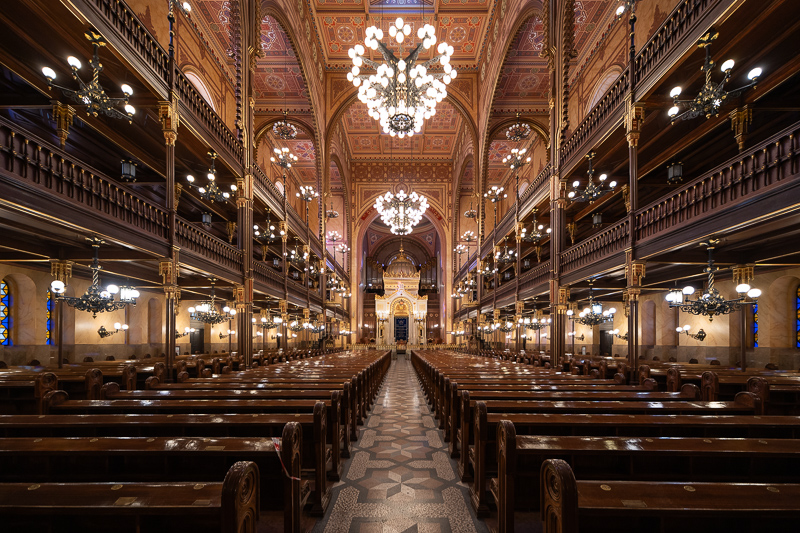





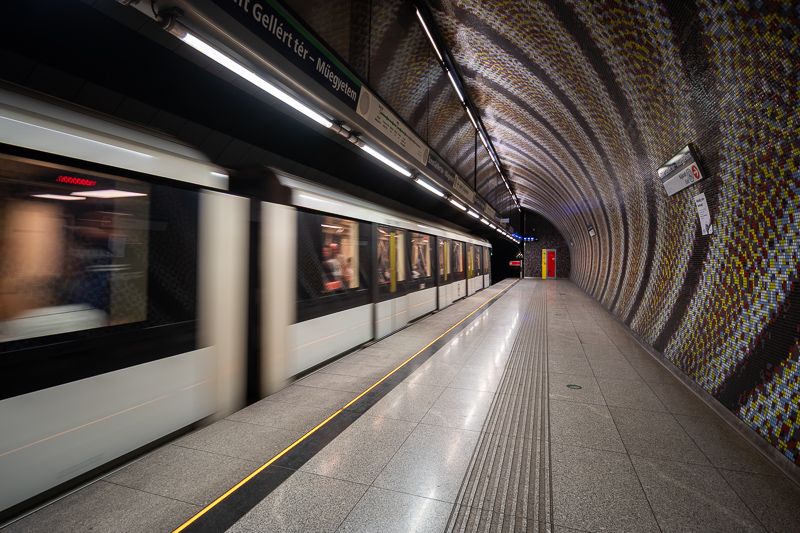
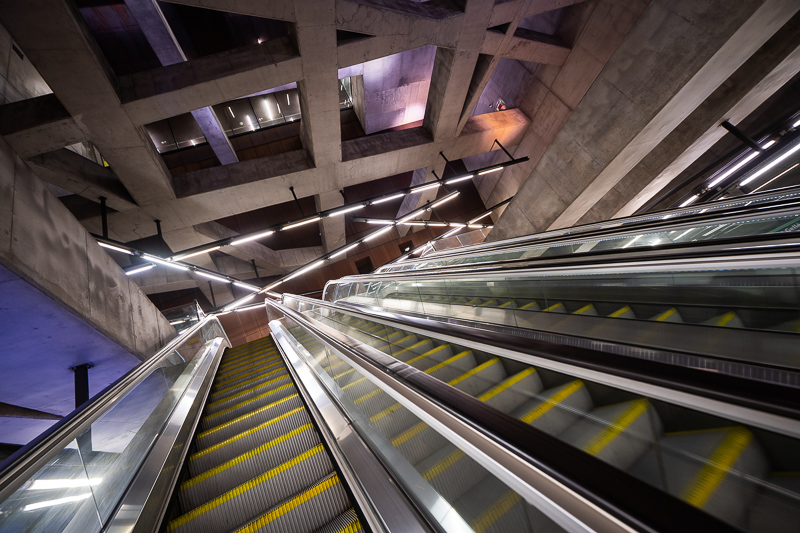

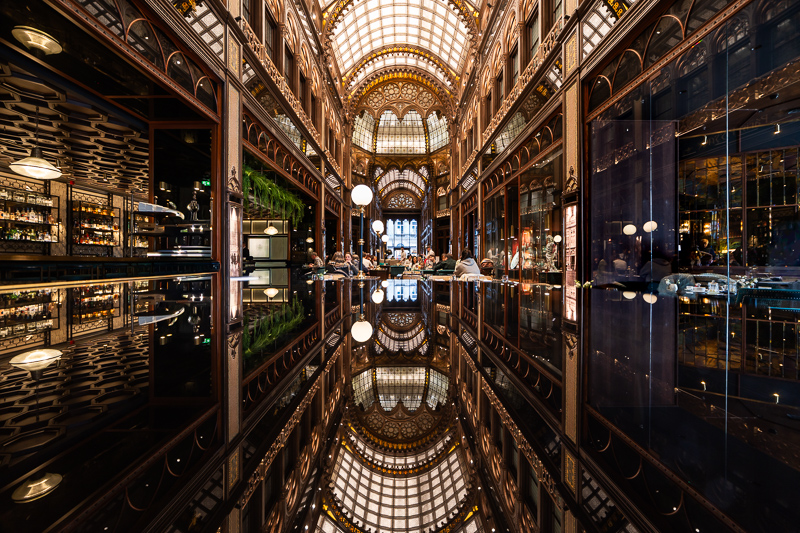
Many of the sample images in this review can be found in full resolution here.
Further Reading
- All Lens Reviews
- Review: Laowa 10mm 2.8 AF
- Review: Viltrox AF 35mm 1.2 FE LAB
- Review: Sony FE 85mm 1.4 GM II
- Review: Sigma 135mm 1.4 DG Art
Support Us
Did you find this article useful or just liked reading it? Treat us to a coffee!

 via Paypal
This site contains advertisement/affiliate links. If you make a purchase using any of the links marked as advertisement/affiliate links, I may receive a small commission at no additional cost to you. This helps support the creation of future content.


Latest posts by BastianK (see all)
- Review: Nikon Z 35mm 1.2 S Nikkor - October 17, 2026
- Prime Day Photoshop+Lightroom offer for Amazon Prime Members (EU/UK) | Update: also at B&H - October 7, 2026
- Review: Nikon AF-S 18-35mm 3.5-4.5G - October 7, 2026
Would be interesting to see whether the old manual 14/2.8 Samyang is better than this new 14-24 @ 14mm. Those original 14/2.8 are pretty cheap on the used market.
Trust me it is not better, and while it’s famous for having many bad copies (or decent copies that turn bad over time thanks to plastic parts inside), that may also be the case with this zoom to some degree, so I’ll not take it into account.
It’s worth a try if you want to try a wide angle for about 100 eur (which is possible on eBay), but for most applications that cheap Viltrox 14mm makes better sense I recon. Viltrox lenses really drop in price when used (or practically unused and sold).
It has even worse distortion, far worse built quality, no options to mount filter, its soft at 2.8f, this one looks considerably better.
14/2.8f is good for playing around, was descent option for night sky photography some ~10 years ago, when there were very few 2.8f FF wide angle lenses available. Nowadays its not great. Plenty of lenses available, especially now with Viltrox 16mm 1.8f – amazing lens, basically flawless for that price. If you can get an optics at this level and price these days, something like a Samyang 14/2.8f is just not worth the money.
Interesting, but how will it age…
I stil have a Schneider Kreuznach Xenon 50mm f2.0 that I adapted to M42. Took it out of my old Balda that did not survive the Sahara. The Xenon is still ok after all these years. So I wander why Schneider-Kreuznach does want to give their name to Samyang without any guarantee for quality… So we should not on forehand say that there might be lots of bad copies.
These third party lensmakers from China or Korea learn fast.
Wavy distortion results in an additional horizontal field of view after correction.
Outstanding photos you truly have a gift for wide angle.
Good review Bastian (as always). Christopher Frost and Dustin Abbott had the same findings at 24mm with descreased contrast–I don’t think it’s your copy.
I have been eying this lens for a bit–I think it looks great given all things considered. For my tastes, the UWA zoom I’d be getting given the price, size and performance.
Thanks again.
I think for many people this lens is a very good choice.
The software sucks and so does their documentation. You have to download a USB driver (on windows) for their software to connect. Their download page, instructions, etc don’t tell you any of this.
I had to search around and find a news post they published for a different lens to find the USB driver: https://www.lksamyang.com/en/about/notice-view.php?seq=1708
That incredibly obvious rainbow ring flare is rough… I would’ve given this a try given how light/small it is, basically calling my name, but as it is I’d rather carry the Viltrox 14/4 Air alongside whatever 16/17-xx zoom or whatever set of primes I’m using. I’m hoping we see another 14/15-xx on E mount that isn’t $1,700+ (like Sony’s) or 800g (like Sigma’s).
I know E mount is already spoiled for options when it comes to UWA zooms, but other than this Samyang x Schneider a compact and not overly expensive 14-xx remains a bit of a hole in the lineup… I don’t even care if it’s F4 or variable, I’d like to see another option. Please Tamron/Sigma? (Viltrox/Typoch?!)
100% agree with all these points. That ghosting flare is rough any time the sun is in the frame (not good for something partly targeted at landscape shooters), I’d rather just carry the Viltrox 14/4, this is a hole in the lineup, and I also wouldn’t care if it’s f4 or variable (actually I’d probably prefer it so it’s as light as possible). It’s killing me that I can’t buy this lens due to the flare issues, as I’ve been waiting forever for a 14mm zoom so I can just carry two lenses when travelling.
I rented the lens because it is much more compact than my Sigma 14-24 DG DN. I do concert photography. The flare resistance is really bad and the lens is almost useless for this kind of photography. I was surprised the AF-C worked well given typical Samyang AF issues (I had to sell 135/F1.8 because of it). The Sigma is perfect when it comes to handle flares, but 800g weight is too much if you carry more lenses.
At the end Sony 12-24/F4 G is the best compromise of weight, size and performance. It is slower, but no such flare issues.
Did you already use the Sony 12-24mm 4.0 for that concert photography task?
I have never used that lens myself but I have also seen pretty awful ring flares from it.
Yes, several times. Nothing such awful like from the Samyang lens.
This lens just has an unbeatable specs combo of size / weight / front filter option for the focal length covered. It’s a gamechanger in my kit bag, and there are easy workarounds for the issues Bastian described.
Yes, the Sony 12-24 GM is a superior lens, but it’s also a wrist-breaker when you have to heave it around for a few hours, much less the whole day.
And I’ve got to say, the quality of the pictures Bastian took in Budapest with this lens are some of the most impressive I’ve seen from any wide angle lens.
🙂 I had Sony 12-24 4.0 and replaced it with Sony 12-24 2.8 in search of ultimate technical quality. And I am still rather happy to had it used during my two Iceland trips.
Now I am about to replace the Sony with Schneider-Samyang, this time in search of a lens I do not hesitate to put in my travel bag ;).
I currently do own both Sony 2.8 and Samyand 2.8 just to tests whether this reduction strategy works for me. For the two very first trips it did work.
Except for having lost the lens hood in the woods only to find out that it cannot be purchased separately 🙁
Any hood related help would be highly appreciated.
Would love to see a review of the sigma 16-28mm if you get a chance!
I had this lens and saw very bad corner performance (every corner, not just decentered). This seems to verify what you hear often about Samyang lenses : a lot of sample variation and maybe lackluster quality control.
Ouch, that flare, hilfe…
Does this lens gets extra vignetting with thick filters?
Didn’t have a thick filter to test with, probably it will.
Probably yes. I tried to stack one thin UV and one normal polarizing, that was already too much.
Great!
Thank you for the great review, Bastian!
I have obtained this 12-24 today and after short tests I can confirm everything good and bad from your copy of the lans is valid for my copy as well, only the softness at 24 mm does not look as bad soft as yours.
Distortion:
I downloaded the profile for Lightroom classic and it works well. Sure, it reduces the horizontal angle of the picture, yet the result looks like 14 mm, so it´s OK. I have done no scientifically measurements, only visual comparison with other lenses.
BUT developing the raw original in DXO Pure Raw while using parameter “maximal rectangle” produces wider (DNG) result, much like the one from uncorrected RAW.
Go give it a try if you use this lens, it´s worth it.
I can be more exact know: lightroom distortion correction delivers same angle of wie like DXO with setting “image cropped to original format”. This is visible less than “maximal rectangle”.